Only International Solidarity Can Free Palestine
Given the structural constraints they face, the path to liberation for Palestinians does not run through armed struggle. Liberation will require the kind of sustained international solidarity that isolated apartheid South Africa.
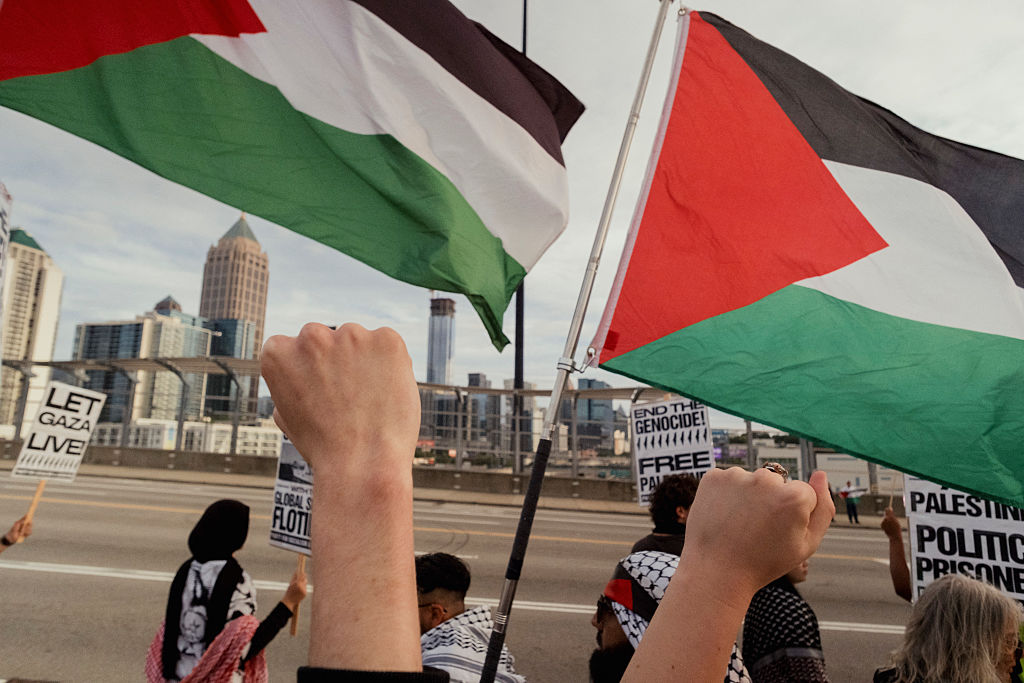
The decisive battles for Palestine solidarity will ultimately be waged inside the United States. (Mehmet Eser / Middle East Images / AFP via Getty Images)
For Palestinians, a lack of leverage has always accompanied their century-long struggle for self-determination. Without a capacity to disrupt the Israeli status quo — and operating against a highly resilient Israel that is immune to exogenous shocks while deeply integrated into American imperial hegemony — Palestinians have limited resources to draw on. Because of this, generations of international supporters have rallied for the cause. Palestine attracted international solidarity in the twentieth century at a level surpassed only by the International Brigades in the Spanish Civil War. Palestinians mobilized international volunteers in their ongoing struggle at levels exceeding what the Algerians, Vietnamese, and South Africans received in their own victorious campaigns.
Now operating on a different terrain, twenty-first-century Palestine solidarity is tasked with an even more audacious mission: mobilizing the masses in a neoliberal world rather than relying on the deterrence and vanguardism of a now-bygone bipolar world. The same global shifts that have set the stage for a Palestinian genocide are also what make the United States the prime site of international solidarity with Palestine at the moment its people need it most.
The Record Points to a Non-Militaristic Path for Palestine
Unlike the Israeli public, both the French and American publics opposed the imperial ventures of their respective governments in Algeria and Vietnam. The drafting of young men into the war machine played a vital role in building this domestic opposition. While a similar dynamic should theoretically hold true for the Israeli public, the lack of a progressive political force in Israel frustrates that potential. The fact that 90 percent of Israelis supported the military campaign in Gaza precisely when the world was gripped by international courts adjudicating it as a case of genocide is not only the responsibility of the Israeli government but also of its political opposition, which it too is open to biblical fantasies. The entire Israeli establishment shares the blame; they took turns betraying — with public consent — every painful concession that the most pragmatic of Palestinians made in the three decades preceding the October 7 attack. Several leading figures from that establishment are only now lining up to offer remorseful melodies.
For Palestinians, that reality alone should have disqualified any purely militaristic strategy, since the main objective of such strategies ought to be problematizing the status quo for Israeli society — especially its elites — by mobilizing the Israeli public for peace. The specific ways in which the October 7 attack was conducted, and the various violations of international law that marred it, speak to a lack of such strategic planning on Hamas’s side as it produced a rally around the flag, which the Israelis are more primed for than others.
Hamas, in fact, planned and hoped for a wider confrontation that would deploy the entire Iranian-backed network from day one to overwhelm Israel militarily, but they jumped the gun by launching the attack before finalizing those coordination plans. However, investigating whether a certain degree of militaristic capability is the deciding factor in anti-colonial struggles invites a meaningful comparison with the Vietnamese example.
Similar to the logic of the October 7 attack, the Central Office for South Vietnam planned the Tet Offensive in January of 1968 as a surprise assault. Yet despite the far superior resources the Vietnamese possessed compared to the Palestinians, the superpowers arming them, and their ability to undertake successive waves of attacks, the military strategy itself failed to bring an already raging war to a swift end. As an imperial power, the United States possessed vast resources to draw on and escalated the war to new heights for an additional six years. What ultimately worked for the Vietnamese was the impact the offensive had on American domestic politics and the antiwar opposition it helped catalyze. Relatedly, while the October 7 attack did not occur at a moment of polarization in Israeli society over the colonial regime itself, it effectively ended an existing internal Israeli polarization over domestic judicial policies.
Relatedly, in Algeria, contemplation of the limits of violence and militaristic capabilities did not evade its anti-colonial leaders. The crushing defeats of the Algerian militias and urban guerrillas in the first half of the Algerian War of Independence ultimately shifted the struggle toward political and diplomatic terrains. Again, the French public was deeply divided over Algeria as the entire French colonial regime neared its end. The conflict was both bankrupting a war-devastated post-1945 France and repeatedly infuriating France’s primary creditor, the United States, which aimed to align Western interests against international communism.
Unlike the military, economic, and diplomatic ascendancy enjoyed by Israel since at least the end of the second intifada in 2005, France at the time was on its back foot. Furthermore, unlike current Israeli policies of Palestinian erasure, the French were actively debating questions of assimilation versus independence for the Algerians. What actually delivered victory for the Algerians was a diplomatic campaign that leveraged international circumstances to its favor, built on top of massive civil society organizing that countered the various political “carrots” France dangled in front of the Algerian public. These combined efforts effectively cleared Algeria of about a million European settlers before Algeria’s liberation army even appeared in the coastal cities where those settlers resided. It was not just the scale of militarism that proved ineffective in achieving Algerian independence; it was a realization of the limits of militarism altogether. European settlers, having snubbed Algerian society, ultimately ejected themselves from the country when they failed to envision equality as Algerians forged it on the ground.
In other words, militaristic anti-colonialism usually facilitates a political process rather than escaping one. The question becomes how any campaign facilitates a political process that a colonial order eliminated.
Here, South Africa Underscores Leverage — Not Just Boycotts
It is widely understood that South Africa’s anti-apartheid struggle triumphed through civilian methods — more precisely, through an international campaign that blockaded the colonial regime into surrender. To imagine a similarly successful solidarity movement for Palestinians, analyzing South Africa’s traction sheds light on what has remained elusive in the Israeli context.
On the eve of South Africa’s triumph, Palestinians were actually engaged in a similar civilian-based struggle against the Israeli occupation: the first intifada of 1987. It possessed a genuine mass base powered by grassroots organizing. However, unlike black South Africans, who occupied a critical position within the leading productive sectors of the apartheid economy, Palestinians were unable to disrupt broad capital accumulation processes by withholding their labor power from critical choke points. Palestinians have consistently existed at the margins of Israel’s economy, which has not only limited their domestic impact on the Israeli status quo but has also capped their capacity to attract powerful, structurally positioned international allies.
A scrutinizing look at what crowned the international anti-apartheid campaign with success — such as the passage of the United States’ Comprehensive Anti-Apartheid Act (CAAA) of 1986 — reveals that international partners held a material stake in South African liberation, rather than just a disciplined adherence to human rights — as vital as that moral clarity was. American labor unions recognized an opportunity in South Africa’s struggle to stem the tide of early neoliberalism by targeting the overseas investment strategies of the American automotive industry, many of which were already vulnerable due to the domestic struggle within South Africa itself.
Those same labor unions, industries, and geographic regions of the United States formed the bedrock of African American political ascendance within the Democratic Party, which held a decisive grip on policymaking. In short, the South African anti-apartheid struggle’s internal leverage aligned with American labor’s structural leverage to help dismantle apartheid. In contrast, Palestinians remain marginalized within the Israeli economy, while their international supporters have themselves been politically marginalized by the relentless advance of neoliberalism.
The Crushing Weight of a Neoliberal Order
An immediate example of this lack of multisource leverage is apparent in the Palestinian Boycott, Divestment, and Sanctions (BDS) campaign. While this campaign has shown steady expansion over its two decades of existence, the genocide beginning in 2023 has significantly elevated its reach. However, a tracker on the BDS website reveals that trade union support lags behind the general trend of broader civil society involvement, and most of that labor involvement remains European rather than American.
Neither the longevity nor the depth of international labor’s existing BDS undertakings have altered Israel’s strategic incentives to date. For instance, the Canadian Union of Postal Workers’ (CUPW) 2008 BDS endorsement did not impact mail volumes with Israel. Later, British and European unions adopted BDS resolutions committing their members to boycotts and trimming their pension funds’ investments in Israel. Yet these unions’ pro-Palestine demands on their respective governments remain unanswered despite their routine nature — to say nothing of the British government’s ongoing attempts to criminalize the patient organizational work poured into the cause in the UK.
Even the Italian trade unions’ general strike against Israeli transgressions — no small feat for BDS campaigners — failed to compel the Italian government to act legally. In response, the movement built a tracking system to coordinate logistically on how to block armaments shipments to Israel. Echoing a successful 2021 South African action to block Israeli military cargo, this Italian-led coalition of trade unions rendered numerous Mediterranean seaports off-limits to military cargo bound for Israel. This certainly complicated logistics for the war machine, forcing some Israeli-centered shipping companies to absorb losses and merge. However, the flow of military cargo itself did not decline significantly, as much of it sailed under sovereign privilege — precisely that of the United States deploying massive naval vessels to deliver armaments directly to Israel, thereby marginalizing European labor actions. In other words, the pre-neoliberal vestiges of power in existence are marginal in their impact.
The effects of labor’s disempowerment on Palestine solidarity have also allowed sections of capital deeply enmeshed in Israel’s colonial regime to go largely unchallenged. Caterpillar, for instance — the corporation that has been in the eye of the BDS storm longest — remains financially unscathed. High-profile bond divestments enacted for social responsibility reasons by several funds have neither collapsed the company’s stock nor raised its debt costs.
The company rests securely on its technological advancements and market monopolization. Even the occupation-collaborative Palestinian Authority hid behind these monopolies to justify ongoing procurement from Caterpillar while the genocidal war raged in the background, and major global funds observed or expanded their BDS commitments. To shield the company further, the US government continues to route Israel’s procurement via the Department of Defense and dismantle tariffs on its operations, boosting its returns.
Thus, even when market mechanisms should theoretically alter Israeli incentives, the extra-market power of the United States bestows additional shields to protect standard Israeli political practices. This reality makes it clear that the decisive battles for Palestine solidarity will ultimately be waged within the United States.
The Student Movement and the DNC
The sea change we are witnessing in American public opinion toward Israel and Palestine is a profound shift that Palestinians have long hoped for. The student and activist organizations that poured hard work into protests and bore a heavy personal cost have not escaped Palestinians’ attention; even schoolchildren in Gaza found moments while under fire to express gratitude for university encampments. Nonetheless, this mobilization occurred as the world watched a horrifying unfolding genocide. Once the Palestinian question is pushed back to its usual position on the political back burner, there is a risk that this solidarity might fizzle out.
This is certainly the view of the Democratic Party establishment, which treats the movement as a passing fad that will eventually wear out. With such an assumption, Kamala Harris failed to realize that the Palestine-Israel issue is shifting at deeper levels and connecting to broader domestic social policy. The party’s subsequent loss forced the establishment to reckon with the issue, given documented evidence that Palestine played a role in the 2024 electoral defeat. Now, however, establishment politicians deploy the issue as opportunistically as they do any other policy item. This is most noticeable in potential 2028 candidates, such as Gavin Newsom, flip-flopping on the topic.
So far, the issue of Palestine and Israel has not gone away, but it has recently gained unexpected momentum among the populist far right. This detour into right-wing frameworks (distinct from the broader conservative population at large) is unwelcome, as the far right is inherently least beholden to grassroots organizing or universal human rights. The Right will undoubtedly attempt to limit the progressive potential of this issue, stalling both the urgent solidarity needed by Palestinians and the role Palestine could play in the broader domestic policy agenda within the United States.
Palestine as a Public Good
One welcome achievement is the divestment measure recently approved at the 39th United Auto Workers (UAW) convention. It represents a genuine inroad for Palestine into the organized American working class. However, this resolution was significantly watered down from a broader initial draft that aimed not only to trim investments in Israeli assets but also to block the actual shipment of armaments via direct industrial action. This scaling back is a prime example of Palestine remaining an exogenous issue to the broader US working class — viewed perhaps as a matter of foreign policy removed from daily concerns, or as an issue of principled solidarity and universalism, rather than an issue tied to immediate, domestic utility.
The successful push at the UAW convention was driven by activist local branches in New York City working in alliance with heavily Arab American locals in Michigan. This major win for dedicated activists was only possible through a very specific alliance that is not easily replicable, while still a scaled-back resolution. This dynamic parallels recent progressive wins in Democratic primaries. In those races, heavily funded pro-Israel candidates came incredibly close behind progressives (as seen in New York’s 13th district), or two pro-Israel candidates jointly secured more total votes than the lone progressive candidate who won (as occurred in Pennsylvania’s 3rd district), driven by significant union endorsements. In short, while a growing majority of Americans now rally for Palestinian rights, they do so primarily on moral and principled grounds. A large majority of the American working class detests the policies Israel is pursuing, yet candidates who support the Israeli status quo still achieve margins that do not reflect those popular sentiments.
To close that gap, to expedite the transformation of American legislatures into bastions of international law that cater to inalienable Palestinian rights, the movement has to be anchored in a popular domestic agenda for the American working class. It cannot remain a popular sentiment that cuts across class lines randomly, fueled only by the horrors of an ongoing genocide that might deescalate via policy maneuvers of necessity. Such an agenda would take direct aim at American imperialism and the damage it creates domestically, how it inhibits public investments in various sectors, how it limits employment generation, and how it sinks massive capital into only limited profitability cycles that undercut multiplying the productive capacity of civilian sectors.
Short of that, conservative pundits riding high right now on the issue would continue to present a seemingly clear explanation of this stubborn US establishment backing of Israel. The picture those pundits are painting is resonating with a wider public each day, a picture in which minuscule Israel drags the otherwise benign and naive American imperialism to adopt its own agenda. It is a picture of a pyramid standing on its head, erasing the functional role that Israel serves in America’s hegemony and its global geopolitical posture. Israel’s current brinkmanship in that imagery is not explained by its establishment’s comfort as a functionary of a superpower but is shrouded in the worst forms of antisemitism to justify how a tail can wag its dog.
To clear further obstacles to the Palestinian right to self-determination, the cause itself should now serve as an exhibit to domestic policy proposals. What the recent UAW convention and the Democratic primaries in cities like New York and Philadelphia have shown is that the gap between antiwar sentiments, and antiwar policy or antiwar candidates, cannot be bridged any further. It is certain conservative strands who stand to gain now by continuing to make Israel a special stand-alone issue, a racism that disempowers the public if not tied comprehensively to the broader picture.
Palestine as a public good means that numerous incentives are overwhelmingly stacked against it. Only by embedding Palestinian liberation in broader issues can enough momentum materialize for its benefit.