Indian Workers Are on the Front Line of Global Exploitation

From Europe to the Gulf states, Indian migrant workers are being recruited for the most insecure, low-paid, and dangerous jobs. The story begins at home, where India’s caste system produces a labor force vulnerable to the most extreme exploitation.
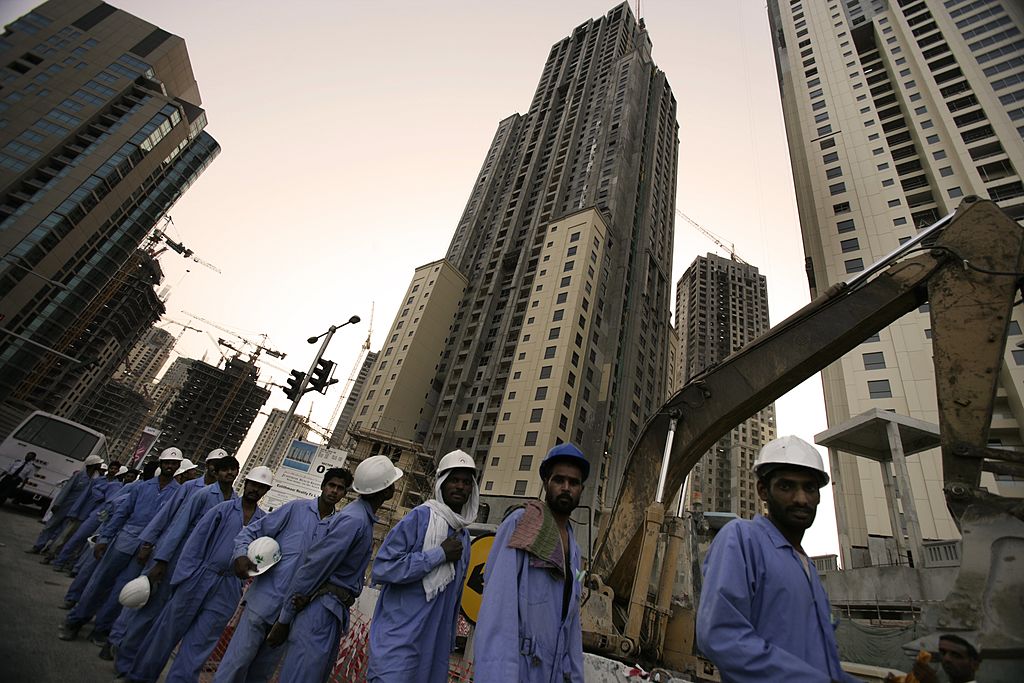
Migrant workers in the construction industry wait for their buses at the end of their working day on May 1, 2006, in Dubai, United Arab Emirates.

For Indian laborers, especially those from already marginalized communities, work in the Gulf States does not offer a break from the caste labor order at home. It is one of that order’s transnational extensions. (Brent Stirton / Getty Images)


All over the world, we can find Indian migrant workers subject to extreme forms of exploitation and abuse: dying in the Gulf states as a result of the US war on Iran, just as they died a few years earlier of heat exhaustion as they built the stadiums for the World Cup in Qatar; brought in to replace Palestinians on Israeli construction sites after October 2023; trapped in modern slavery on Italian farms or bamboozled into the Russian army.

This is not a coincidence but a structural design. To understand why Indians are so consistently available to do precarious work in the most dangerous places and on the cheapest terms, we have to begin in a Dalit basti in Bihar, a manual scavenger’s neighborhood in Andhra Pradesh, or an Adivasi village in Jharkhand.

The compliance that global capital values in Indian labor was first produced inside India itself. It operates through caste structures, landlessness, and the systematic informalization of work, codified by a social system that treats these workers as disposable long before they cross any border.

The Caste Labor Order

India’s informal sector employs somewhere between four and five hundred million people. This means they have no written contracts, no enforceable minimum wages, no sick pay, no maternity leave, no health insurance, no pensions, and no legal protection against arbitrary dismissal.

The Ministry of Labour and Employment’s e-Shram portal confirms that more than 94 percent of registered informal workers earn less than Rs 10,000 a month (roughly $105). Seventy-four percent of those workers belong to Scheduled Castes, Scheduled Tribes, and Other Backwards Caste communities that have historically been pushed into the most insecure and degraded forms of labor.

Commentators often refer to informality as if it were simply a developmental backlog in a transitional stage. In India, we can better understand it in terms of social order. Caste determines not only who performs the dirtiest, most dangerous, and least protected work, but who remains most exposed to wage theft, debt, humiliation, and industrial fatalities.

The consequences are evident in the data on workplace casualties. Between 2017 and 2020, India’s registered factories recorded an average of three worker deaths and eleven injuries per day. By December 2024, IndustriALL Global Union had documented at least 240 workplace accidents in the manufacturing, mining, and energy sectors for that year alone, causing over four hundred deaths and more than 850 serious injuries.

In June 2025, an explosion at a Sigachi Industries plant in Telangana killed at least fifty-four workers, mostly migrants from Uttar Pradesh, Bihar, and Odisha. The plant owner was a publicly listed pharmaceutical manufacturer that exports to dozens of countries. Families said warnings about outdated equipment had been ignored. The Telangana chief minister announced that there would be Rs 1 crore in compensation per worker. However, Sigachi argued in court that its liability was capped at Rs 42 lakh, with the state liable to pay the rest. Its subsidiaries abroad operated under much stricter safety regimes.

There are also deaths that the labor regime produces through despair. Suicides among daily wage earners have risen by 45 percent since 2019, with 129 deaths reported on average per day. According to the National Crime Records Bureau’s Accidental Deaths and Suicides in India report, 47,170 daily wage earners committed suicide in 2023.

These are only recorded cases. In a labor regime marked by subcontracting, underreporting, and weak enforcement, the real scale is higher. Climate change is now adding another layer. Heat-related deaths among outdoor workers, including agricultural and construction laborers and delivery riders, are not even reliably recorded.

This is why we cannot treat labor informality in India as if it were merely a technical or administrative problem. It is part of a caste labor order in which insecurity is normalized, responsibility is diffused, and industrial death is made politically bearable. As IndustriALL’s Gautam Mody put it, India remains “the most unsafe workplace with more industrial fatalities than anywhere else in the world.” Forty years after the Bhopal disaster, the architecture of impunity remains intact.

Legislating Precarity

In November 2025, the Indian government brought four new labor codes into effect, replacing twenty-nine existing labor laws. The official justification for the move was that it meant simplification, rationalization, and alignment with a changing world of work. But India’s trade union movement read the new codes in a different light, as a rebalancing of labor law in favor of employers, concealed beneath a facade of flexibility and convenience of business.

Even the Bharatiya Mazdoor Sangh, a trade union affiliated to the Hindutva paramilitary organization, Rashtriya Swayamsevak Sangh, opposed them. Resistance to the codes thus came from across the India labor landscape, including organizations that are not easily dismissed as hostile to Narendra Modi’s government.

Some of the changes are concrete. Under the Industrial Relations Code, prior government permission for layoffs, retrenchment, and closure is now required only for establishments with at least three hundred workers; the previous threshold was one hundred. The same legal architecture broadens the scope for fixed-term employment and gives employers more room to keep workforces temporary for an indefinite period of time. In practice, these measures reduce job security, weaken collective leverage, and make labor more disposable.

The new regime also changes the context of safety enforcement. The codes recast labor inspection toward a more compliance-oriented framework, while draft rules under the Occupational Safety, Health, and Working Conditions Code allow up to 125 hours of overtime per quarter. In a country already marked by industrial negligence and chronic under-enforcement, such “flexible” measures shift risk downward to the workers, rationalizing the legal reorganization of vulnerability.

As well as enacting the codes, the Modi government has repealed the rural employment law that guaranteed on-demand employment for workers. In December 2025, parliament passed the VB-G RAM G legislation, replacing the Mahatma Gandhi National Rural Employment Guarantee Act (MGNREGA) of 2005. The change transforms a system of demand-driven employment into a more centralized architecture of rural labor provisioning.

For nearly two decades, MGNREGA functioned, however imperfectly, as a support for the livelihoods of some of India’s poorest rural workers. It did not abolish caste oppression or dissolve landlord power. But it did give landless and caste-oppressed households a limited ability to refuse the lowest rural wages, especially during periods when agricultural employers wanted cheap labor the most.

Diluting that provision changes the social balance of power in the countryside. The result is a domestic labor regime in which workers are cheaper, more governable, and more disposable.

Disposable Labor

We need to look at the recent waves of Indian labor migration not only in terms of where workers are going, but also in terms of why they are needed there. In case after case, instead of simply filling a natural shortage, Indian workers are being inserted into unresolved labor, land, and political conflicts, where another workforce has been removed, excluded, or rendered politically inconvenient.

India and Israel signed an agreement in May 2023 to allow up to 42,000 Indian workers in construction and nursing. After October 2023, with Palestinian workers barred from large parts of the Israeli labor market, the recruitment of Indian workers acquired a new urgency, transforming its political meaning. Bilateral labor mobility in practice became the replacement of a dispossessed workforce with another drawn from a society that is already structured by extreme precarity.

In 2024, there were documented cases of Indian men lured to Russia with promises of civilian jobs or university admissions, only to be trafficked into military service for the war against Ukraine. According to Indian authorities, at least thirty-five men were sent through such networks. Several were killed, and India later acknowledged that four of its citizens had died in the conflict. Families described a pattern of deception, the confiscation of documents, and long periods without contact.

In the Gulf states, under sponsorship systems such as kafala, a worker’s legal status is bound to the employer, sharply limiting mobility and recourse to the law. For decades, this has allowed Gulf economies to recruit and exploit labor at scale while maintaining a steep hierarchy between citizens and migrant workers. For Indian laborers, especially those from already marginalized communities, the Gulf does not offer a break from the caste labor order at home. It is one of that order’s transnational extensions, a different legal form for the same social logic of expendability.

In the United Kingdom, following Brexit, England’s adult social care sector had to fill around 165,000 vacancies. The state expanded recruitment through the care worker visa route, but tied workers to sponsoring employers in ways that made abuse structurally easier. By the government’s own admission, over 470 care providers have had their licences suspended since 2022, leaving 28,000 workers displaced.

British political discourse initially celebrated these exploited care workers as essential but later transformed them into a symbolic rationale for a tougher migration regime. The fact that employers had abused workers, that the visa system itself was built around dependency, and that social care remained chronically underpaid receded from view. This is how disposable labor functions under neoliberal migration policy: recruit, bind, exploit, and discard.

Submission and Resistance

Trade architecture deepens these dynamics. Labor organizations criticized the UK–India trade agreement, concluded in 2025, for its weak labor provisions. The European Trade Union Confederation warned that language about workers’ rights in such deals is often toothless, aspirational rather than enforceable, in contrast with provisions over tariffs, market access, or intellectual property.

The global conversation around Indian migrant labor almost never names caste. This is the central evasion. The workers recruited into construction sites in Israel, pushed into coercive routes linked to war, governed under sponsorship regimes in the Gulf, or absorbed into Britain’s care sector, did not emerge from a social vacuum. They have been disproportionately drawn from communities for whom caste-based exclusion, landlessness, humiliation, and economic coercion remain part of everyday life.

Employers come to see a labor force trained to survive under conditions of profound unfreedom as flexible, resilient, and cheap. In that sense, the export of Indian labor is not simply a story of migration. It is a story of how a caste-structured social order is converted into transnational economic value.

Yet there is resistance at work in this story as well as submission. Recent worker protests in Noida and other industrial belts have shown that even in the face of deepening precarity, employer repression, and the steady erosion of labor protections, workers can still continue to fight. In some cases, they have done so even without formal trade union support.

The Indian state benefits from this system through remittances while offering workers uneven protection abroad and weakening protections at home. The labor codes, the recasting of rural employment law, and the trade deals with weak labor clauses are not separate stories. They are elements of a single neoliberal political economy, one that has decided some people are expendable.

Until we confront caste-based economic hierarchy as an international labor rights issue rather than treating it as a subcontinental cultural residue, the pipeline will remain open, and the movement and exploitation of disposable workers will continue.