The Fight Against Caste Oppression Can Unite Indian Workers
The Indian state of Punjab shows us that caste oppression owes far more to material interests than it does to inherited religious ideologies. A movement of Dalit rural workers offers a powerful example of how that oppression can be challenged today.
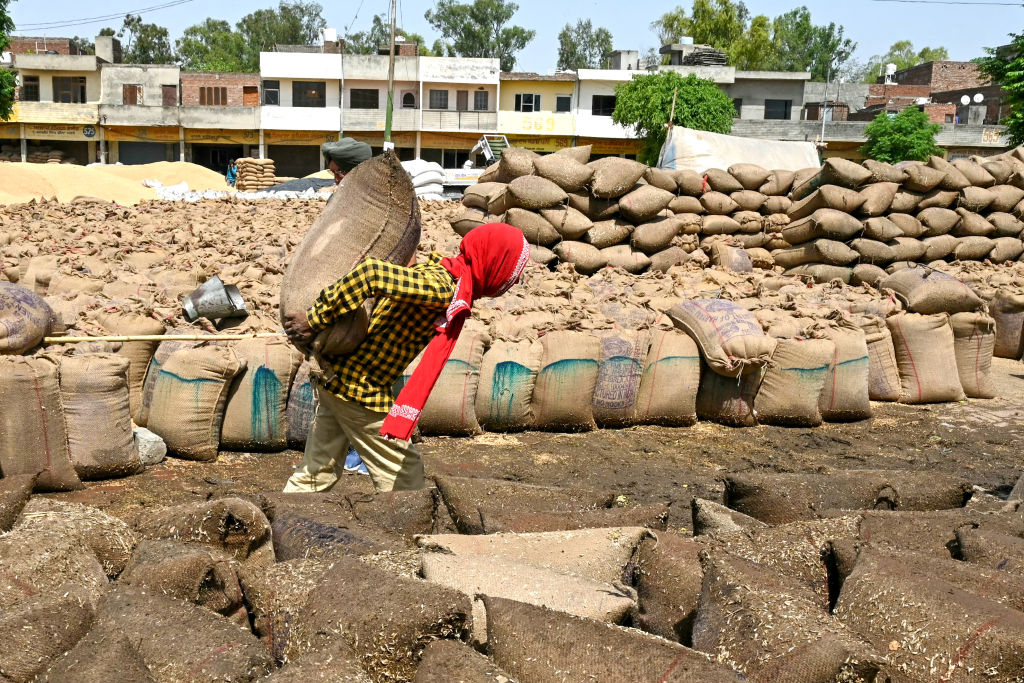
A laborer carries a sack of wheat at a wholesale market in Punjab on April 30, 2024. (Narinder Nanu / AFP via Getty Images)
The Indian state of Punjab, located on the border with Pakistan in the country’s northwest, has a population of twenty-seven million, the majority of which is Sikh. In recent times, Punjab has given rise to an important movement that seeks to organize the Dalits who comprise the poorest and most downtrodden section of rural society in the state.
More than two-thirds of India’s population still lives in the countryside, and 45 percent of the workforce is employed in agriculture. A closer look at the movement in Punjab can thus shed light on some of the most important questions for Indian politics and society, such as the relationship between class and caste, the extent to which India’s neoliberal turn over the past three decades has transformed its social structures, and the potential for mobilization of oppressed and exploited groups such as Dalits.
Virgin Soil Upturned
In 2008, Bahal, Amarjit, and a couple of other young Dalit men formed the Krantikari Pendu Mazdoor Union (Revolutionary Rural Laborers’ Union). Amarjit had been working for A. P. Solvex in the nearby town of Dhuri. As a child, he was a siri (a form of bonded laborer) with a family from the dominant Jatt agricultural caste for ten years.