India’s Migrant Workers Are Paying the Price for Trump’s War

Migrant workers have been fleeing from India’s cities as the US war on Iran sends fuel prices soaring. The scenes today resemble the exodus of migrant workers to their home villages during the COVID-19 pandemic, and the crisis is just beginning.
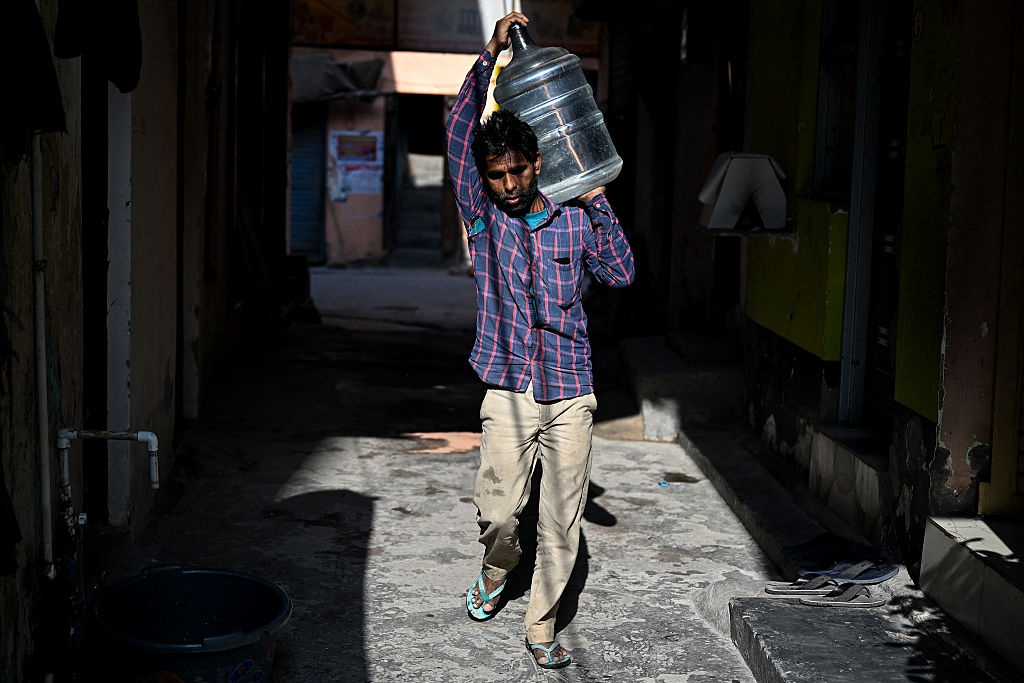
A migrant worker carries a water jug on his shoulder in an alley.

The current situation is just the beginning of a devastating long-term impact of the US war on India’s migrant workers. (Sajjad Hussain / AFP via Getty Images)


The US onslaught on Iran, and the resultant closure of the Strait of Hormuz, are having a massive global impact, and the consequences for Indian migrant workers are just one example. In recent weeks, with prices soaring, businesses closing, and fuel reserves rapidly running out, many migrant workers have been fleeing Indian cities and hurrying home to their villages in a desperate attempt to survive.

The current shortage of liquefied petroleum gas (LPG) cylinders and limited availability of fuel, along with major food price hikes due to the war, has forced many restaurants and other businesses in the big cities like Delhi to close. In fact, many people are increasingly struggling even to cook in their own domiciles due to the lack of cooking fuel, and some are returning home so they can cook on traditional firewood stoves, which is not possible in their cramped city lodgings.

Narendra Modi’s Bharatiya Janata Party (BJP) government has claimed that gas cylinders are still easily available, but this is often not the case. In fact, migrant workers in Delhi are unable to access domestic gas consumer cards, which allow people to book gas cylinders online, demonstrating the direct and disproportionate impact of the crisis on migrants.

Paying the Price

The scenes of workers traveling long distances in large numbers, while businesses abruptly close, are reminiscent of the first COVID-19 lockdown six years ago. In March 2020, as various lockdown measures were being imposed across the world, the Indian government swiftly opted for an extreme approach: shutting down transport connections nationally.

Meanwhile, factories and other workplaces were also abruptly being shut down, leaving India’s millions of internal migrant workers no choice but to walk thousands of kilometers back to their home villages. Many tragically died of exhaustion or heatstroke along the way.

This experience of migrant workers during the lockdown is captured by Neeraj Ghaywan’s 2025 film, Homebound. The final section of the film follows the journey of two workers, childhood friends Shoaib and Chandan, from a rural North Indian village as they attempt to walk home to their village through the scorching sun.

Loosely based on a true story, the film captures the fear of the virus, showing how truck drivers taking people home to their villages would demand individuals leave the truck if they appeared to be sick or coughing. This is the fate of Shoaib and Chandan: after Chandan becomes dizzy on the truck, they are dropped on the side of the road, with no option but to walk the remaining 400 kilometers to their village.

The focus of the current mass migration is different than that of the 2020 lockdown: this time around, food is at the heart of people’s decisions to migrate. There may not be the same kind of public health crisis, but millions are facing just as much of a struggle to meet their basic survival needs. Once again, Indian migrant workers are paying the price of a global economic catastrophe — this time, of course, caused by US imperial violence.

Last Resort

While the journey home is the climax of Homebound, the circumstances leading up to this point are equally central. Shoaib is Muslim and Chandan is Dalit; both of their families are poor, struggling, and reliant on the young men acquiring work.

Soaib’s father suffers from serious health problems and can’t work, and Chandan’s mother faces caste discrimination while toiling as a cook at a local school. These circumstances inform the series of events and choices that culminate in the pair taking jobs in a textile factory in the city, and their eventual return home during the lockdown.

Shoaib and Chandan’s stories represent the intersection of caste and religion with class under India’s current Hindu supremacist government. Their migration to the city happens relatively late in the film. Throughout the first half, their dreams of moving up within the system and obtaining state jobs are repeatedly crushed by reminders of their outsider status, which come from colleagues, superiors, and the very structures within which they are applying for jobs.

Despite not passing the police entrance exam, which both men take at the beginning of the film, Shoaib does manage to secure a “respectable” job in sales. Chandan’s father initially plans to take the textile factory job, while Chandan, having passed the police exam, waits for his appointment letter to no avail. Finally, after becoming disillusioned with the process, he decides to take the factory job in place of his father.

Sick of tolerating constant Islamophobia from his colleagues and superiors, Shoaib eventually resigns from his sales job. After showing up at Chandan’s house and crying on his shoulder in one of several heartbreaking scenes between the pair, Shoaib joins Chandan working at the textile factory, which is the option of last resort for both of them.

The film carefully traces how class, caste, and religious discrimination effectively force the two men into precarious low-wage labor. They have barely started the jobs when the factory shuts down for an indefinite amount of time, once the lockdown is announced.

Viewers can feel the transience of such jobs through watching montages of Chandan on video calls with his parents and sister. They think they will be finally able to start work on building a bigger house with the help of the money Chandan is sending them, but then the lockdown begins, and their collective sense of hopefulness swiftly collapses.

Discrimination and Disenfranchisement

Like Shoaib and Chandan, many migrant workers in Indian cities are from Muslim and Dalit backgrounds. The film subtly explores the weight of caste prejudice and discrimination in workplaces. There are reserved positions, known as reservations, for applicants from Dalit and lower-caste backgrounds in state jobs across India, in an attempt to balance out centuries of institutional discrimination. However, Chandan refuses to apply in the reserved category, knowing that revealing his Dalit identity is bound to result in further discrimination at work.

This is the bind many Dalit workers find themselves caught in: to declare your Dalit identity, even in order to claim what little the state has to offer you, is to make yourself vulnerable to a continuation of the treatment you have likely been subject to since childhood. Notably, private institutions are exempt from reservation requirements. Resistance against caste discrimination is continually taking place across Indian society — for example, the current anti-caste struggles led by students at Indian universities.

Muslim workers like Shoaib face Islamophobic prejudice, particularly the insinuation that they are not Indian and are actually from Pakistan or Bangladesh. This has escalated in recent months from taunts to become a chilling state-sanctioned policy through the special intensive revision (SIR) process. Rolled out across some Indian states in December 2025, the SIR is an exercise in recording voter eligibility that ultimately works to disenfranchise Indian Muslims as illegal immigrants.

For several months prior to this initiative, many Muslims from West Bengal were already being disenfranchised in this way. In summer 2025, hundreds of Bengali Muslims were unlawfully sent to Bangladesh (with many being subsequently readmitted). This campaign of harassment merely builds on the Citizenship Amendment Act passed in late 2019, which similarly sought to strip Muslims of their rights through propagating tales of illegal migration.

Forgotten People

The images of workers on their journeys today, like the scenes from Homebound, tell a story of those forgotten by a country, an infrastructure, a global system. Shoaib and Chandan, after joining one such group on a truck, are ultimately left behind and forced to complete the walk alone together, with Shoaib supporting Chandan as he becomes increasingly weak in the unflinching heat.

This is a poignant metaphor for their relationship throughout the film — the two men are the only real support system for each other. The solidarity in their shared struggles comes through in their use of “us” throughout the film. In different ways, the system is against them and will always try to keep them at the bottom.

On Sunday, April 19, thousands gathered at Udhna railway station in Surat, the same city in Gujarat where Shoaib and Chandan are working before they are forced to leave, waiting to board trains home to their villages in Uttar Pradesh and Bihar. As the fuel crisis deepens, it is likely that we will see workers once again walking long distances on foot due to trains becoming overcrowded or trucks running out of fuel. No doubt the current situation is just the beginning of a devastating long-term impact of the US war on India’s migrant workers.

In India’s current fascistic political climate, Homebound is a brave production that has been surprisingly well received, given its subject matter. It even made the shortlist for the Oscars earlier this year (though it wasn’t nominated in the end), just weeks before real life once again began to echo its scenes as the fuel crisis began.

The interplay between global imperialism and the far-right politics of India’s own government is responsible for the plight of migrant workers. Shoaib and Chandan’s agonizing walk home toward their village is not merely the product of the lockdown. It is the result of years of discrimination and lost hopes.

Importantly, migrant workers are fighting back. In April, there were protests across Northern India for better pay and working conditions, with thousands of factory workers, including many migrant workers, blocking roads in Noida, a city just outside Delhi. Solidarity with migrant workers in India like Shoaib and Chandan — and with people’s movements like the Migrant Solidarity Network — has never been more crucial.