Socialist Francesca Hong on Her Wisconsin Insurgency
Francesca Hong, the democratic socialist candidate for governor in Wisconsin, discusses organizing beyond Madison and Milwaukee, confronting the Democratic establishment, and rebuilding working-class power.
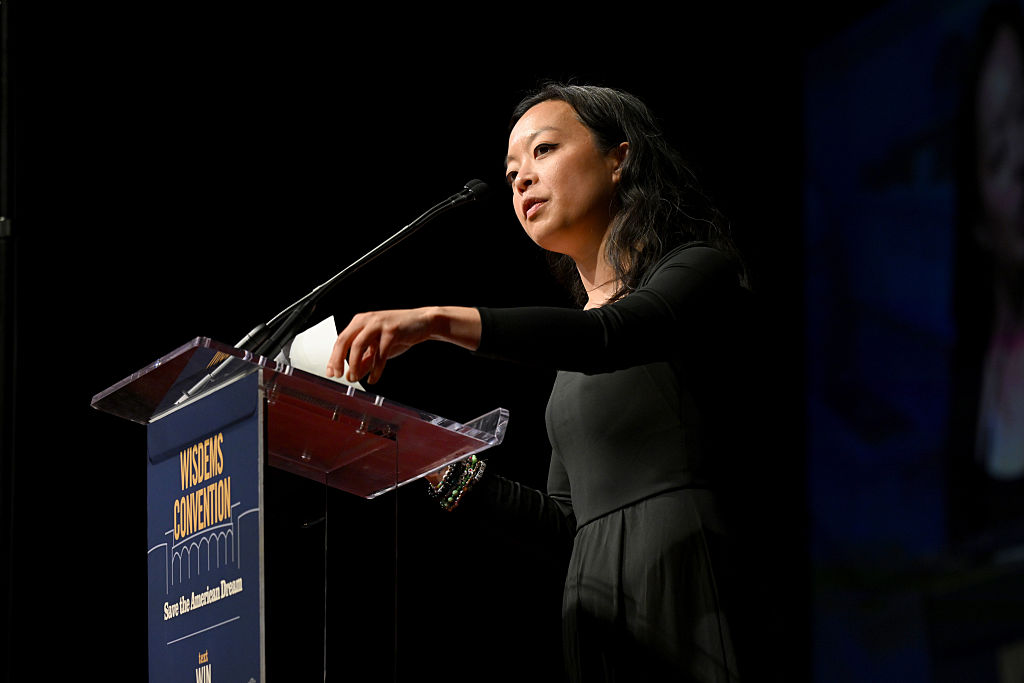
Wisconsin was the laboratory for Republican Governor Scott Walker’s antiunion politics. Francesca Hong wants to make it a laboratory for democratic socialism instead. (Daniel Boczarski / Getty Images)
- Interview by
- Daniel Denvir
Wisconsin has long served as a proving ground for American politics. It gave rise to Progressive Era reforms and Milwaukee’s socialist tradition, but it also became a laboratory for the Right under Governor Scott Walker, whose assault on organized labor helped reshape Republican politics nationwide. Today, with economic insecurity, corporate power, and rural decline fueling widespread dissatisfaction, the state remains one of the country’s most consequential political battlegrounds.
State Representative Francesca Hong believes Democrats have misread that discontent. A chef, small business owner, and democratic socialist, Hong is running for governor on an unapologetically working-class platform centered on universal childcare, labor rights, public education, and confronting corporate influence. Rather than moderating her politics to appeal to swing voters, she argues that bold economic populism is the best way to rebuild a durable majority across Wisconsin’s urban and rural divides.
For Jacobin Radio’s podcast The Dig, host Daniel Denvir sat down with Francesca Hong to discuss Wisconsin’s political contradictions, the legacy of Walker’s antiunion agenda, organizing beyond Madison and Milwaukee, challenging Democratic Party orthodoxy, and why she believes a democratic socialist campaign can win in one of the nation’s most closely contested states. You can listen to the episode (which also features conversations with a number of other left-progressive electoral challengers) here.
Daniel Denvir
Wisconsin is a swing state. It’s been home to Joseph McCarthy and Scott Walker, but also home to Milwaukee’s sewer socialists and Russ Feingold. How would you describe Wisconsin politics and the various divides — political, social, class, geographic — that shape those politics across the state?
Francesca Hong
Our politics are manic and beautiful. We are the state with Senators Tammy Baldwin and Ron Johnson. But I think Wisconsin ultimately is where progressivism was born — kindergarten, sewer socialism, unemployment insurance, environmentalism. I think that we can be a laboratory for democracy again. And the policies of the Walker era and Republicans have created divides. I would say they’ve manufactured urban-rural divides. And we have seen that what happens in Wisconsin is an indicator for what happens in the rest of the country.
When we saw the loss of manufacturing jobs, with our paper mills and our General Motors plants, to the growth of data centers and the defunding of public education, more and more people are realizing that our values as Wisconsinites who work hard to be able to live a life of dignity . . . this is being controlled and rigged by forces of corporate greed, corruption, and politicians who are bought and paid for. So our campaign is really about bringing working-class people together to go back to our progressive roots and remind folks across the state that we have a responsibility to imagine something better.
But we’re finding, whether it’s in Wisconsin Rapids, Beloit, Superior, Madison, or Milwaukee, that people are tired of the status quo. They’re tired of corporate greed and life getting so unaffordable, and they’re ready to be represented by a working-class champion for working-class people. I think that’s why our campaign has grown so much momentum. We’re changing hearts and minds. And it’s hard for Democrats right now, I think, to see how practical our campaign is, because we’re reaching people that many Democrats have failed to reach, and that’s working-class folks who don’t want their lives to be dictated by politics. They just want to get by and do well.
Daniel Denvir
I feel like when you are a socialist or progressive, left-wing candidate of any sort, you often have to convince a certain type of Democratic voter who likes what you have to say, agrees with everything you have to say, but is gaming out the hypothetical median voter in the swing state and how they’ll react to you. Are you encountering that still on the trail?
Francesca Hong
Every single day. I have a T-shirt that says “unelectable,” and the electability argument is one that comes from a place of fear. And I think it’s because you are nervous that your neighbor doesn’t feel the way that you do. We have so many folks who will come up and talk to me, on the fence, and say, “Look, I am so supportive. I love your message. I love what you stand for. I love the fight. But my neighbor saw this interview, and you said, ‘Defund the police,’ and you said, ‘Abolish ICE.’ And the Republicans are gonna attack you, and can you win in November?”
I think it’s unfortunate that we are nervous, that we don’t think we share values with our neighbors. Instead of the question of, “If you win in the primary, I’m going to back you,” it’s: “I’m nervous to vote for you now because I don’t know if you can win in the general.” And it speaks to how we are in a scarcity mindset and not an abundance mindset of how many more of us there are as working-class people. Populist policies are popular because they serve more people. And so we’re continuing to fight back. I’d fight back, but reminding them that I’m the only candidate who has held over 250 events across the state where we have folks who are independents, Republicans, young folks, older folks coming out not only excited and engaged but already hitting the trail with us,volunteering and organizing across the state. We have over five thousand people who have signed up to volunteer in our campaign, and so we’re bringing the organizing infrastructure to ensure that on August 12, after we win the primary, that we’re bringing infrastructure ready to go to make sure that we win in November.
Daniel Denvir
How do those conversations go in rural and small-town Wisconsin?
Francesca Hong
It really bothers me when folks in urban areas judge folks in smaller communities. Rural communities are not a monolith, and I always ask the question, “What are you most proud of in your community?” Because people genuinely want folks to see their communities as special. I’ll talk to voters in smaller communities, and they’re talking about schools, and they’re talking about data centers, and they’re pissed about property taxes, and that younger people are leaving their communities. And the policies that we’re fighting for — free childcare, fully funding our public schools, fixing our roads, fighting data centers, putting a moratorium on them — that engages rural voters especially because right now they’re seeing these threats popping up and schools are closing. Data centers are being proposed. People’s taxes are going up, and their wages are not. And they’re fed up, and they’re frustrated. And they don’t have any reason to trust politicians. But I’m approaching them and asking them to believe in something different because I am different. And I’m going to be a different type of governor who actually shows up for folks and won’t sell them out.
Daniel Denvir
Arguably, it can be helpful in winning over independents and Republicans to say, “Yeah, I’m also launching an insurgency against the Democratic Party establishment. I’m not pleased with the Democratic Party either.”
Francesca Hong
And it’s been surprising that Democratic donors have been very vocal about their frustration with the party. We have to do call time, and I have to reach out to folks who have been engaged with party politics. And there’s a frustration that there’s still so many people in the field. There’s a frustration that we, quote-unquote “can’t get our shit together” to make sure that we have our candidate ready to go August 12. And instead, we’re holding out on this big primary. And so I think even among more establishment Democrats, there is a frustration around why we can’t seem to mobilize and fall in line. And I remind them that if we haven’t had a candidate like me until now, that that complacency is, you know, we’ve all contributed to it. I say all the time that this is a year of the many and not just the money, and it’s because we have new voters who this will be voting for the first time in an election — folks who sat out in 2024, people who didn’t come out in the spring election, folks who are very disillusioned, now excited about actually supporting a candidate who stands for something.
Dems will say all the time, “We have to stop talking about who we’re fighting against and [start talking about] what we’re fighting for,” and then there’s this awkward pause. And we’re fighting for working-class people to have more economic freedom because there’s free childcare, there’s paid leave, we’re funding our schools, we’re fixing our roads, and we’re gonna make sure that we tax the wealthy, we tax the billionaires, and the corporations so that we can finally make these investments for ourselves and our communities.
The infrastructure that we’re building for the Dems is one that’s more powerful, because it’s with people who have not volunteered for the Democrats before and who are ready to ensure that there’s a democratic socialist, a single mom, someone who is actually speaking to working-class issues right now as a working-class person, as a renter, someone who has debt, has owned a business, and has seen how much this state has failed working-class people.
Daniel Denvir
What do the nuts and bolts, the operations of your campaign look like for organizers who are listening? Are you running a campaign that’s different from a standard campaign? Obviously, your politics and policies are different, but is your campaign different? How is it organized?
In particular, what is it like for Democratic Socialists of America (DSA), which is such a local chapter–based organization everywhere in the country, to run a candidate for statewide office like this. I think you would be the first statewide DSA elected win in the nation, at least in the modern iteration of DSA.
Francesca Hong
Yes. I’m proud to have the endorsement of my home chapter, Madison DSA, and then DSA Milwaukee, as well as the DSA chapters across the state that are growing: Coulee DSA, Rock River DSA, and Northeast DSA, as well as multiple Young Democratic Socialists of America chapters. We’ve just built our regional committees and, as I said, over five thousand people have volunteered.
We have a strong presence in Madison, Milwaukee, and that’s thanks to the DSA chapters’ already built-in organizing infrastructure. I think what makes a campaign different is always the people. I wanted to make sure our campaign team were folks who have the institutional knowledge of working on statewide campaigns and for the party, as well as people who haven’t worked on campaigns before, so that we are bringing in the perspective of folks with not only different lived experiences and work experiences, but what it’s been like for them as voters in Wisconsin, not having just been in the funnel.
I’m in that bubble now, having been an elected official for the last five years, but that means that we have new ideas, that we are disciplined about being innovative. There is such a lack of creativity and innovation in politics and government And starting with that in our campaign, whether it’s with fundraising, going on Twitch streams, hosting . . . we had Home for the Holidays telethon-style live stream for our end of month fundraiser where I brought in different guests; Mike from PA had me back on; and we do ramen pop-ups. I’m doing a cooking demo fundraiser live stream. We want to make sure that we’re meeting and engaging new voters and supporters in different digital spaces as well.
Our last town hall in Wisconsin Rapids was on the front lawn of a volunteer, and it wasn’t advertised as a home campaign event. I went in to talk to the community about how they could organize to fight back against data centers, how to give a strong public testimony at a city council meeting, how to mobilize and get press involved in the actions of the organizers.
And so our campaign, from the people to our fundraising, our building, our organizing infrastructure, and how we show up in communities is different, because we are focusing on building community first. And I think That’s really been a superpower for us.
Daniel Denvir
In your early twenties, you joined your parents in the massive 2011 protests at the Wisconsin State Capitol against Act 10, the antiunion legislation gutting collective bargaining rights for organized labor, signed by Republican Governor Scott Walker. Act 10 was really, on a national level, this important opening act in the Tea Party’s war against organized labor. And then conversely, for the Left, the mass protests against Act 10 at the Wisconsin State Capitol were really some of the first major left-wing protests to emerge in the wake of the financial crisis.
It was, in a sense, anticipating Occupy Wall Street in many ways. I remember the flood of relief I felt seeing it erupt, because the financial crisis had been hitting for years at that point, and the only real response had been from the far right, which was pretty unpleasant. Looking back, how did Scott Walker mess up Wisconsin? And how did the experience of coming of age under his governorship shape your politics and shape what sort of governor you are running to be in the future?
Francesca Hong
Scott Walker made Wisconsin a petri dish for anti-worker, anti-public, antidemocratic policies to be tried out and passed in Wisconsin, and then we saw the American Legislative Exchange Council, and other right-wing institutions and think tanks like the Heritage Foundation continue to push for policies that they tried out in Wisconsin first across other states. My dad is a researcher at the university and my mom was a public schoolteacher. She’d actually just started her student teaching when Act 10 happened, To see my parents who had worked so hard to build a life for my sister and I in a state where they wanted to be teachers and educators, to see those attacks and then to come through a Walker area to try to open a business and run a business and see how much they failed to respond as a government during COVID, where my son right now is going to a public school where there is no air conditioning, and the teachers, the special education assistants, our food nutrition workers are so vastly underpaid with shitty benefits . . . I think that the governor that I want to be is one who ensures that Wisconsin is an unapologetic champion for pro-public, pro-worker, pro-family policies that ensure that everyone can live a life of dignity.
And because I’m a democratic socialist, that means my principles are rooted in democracy, in fairness, and in human rights. And I’ve seen through the Walker years, and even with the Democratic governor — Governor Evers has been a goalkeeper. But what that has meant is that so many people have forgotten about our progressive roots, and we have to reimagine not just undoing the harm of the Walker era but making sure we have a governor who’s going to ensure that we never come back to this again, that we put a stake in Act 10, that it’s in our constitution to be able to collectively bargain and unionize, that we follow our constitution in fully funding public education.
And we have to have a governor that’s going to meet the urgency of this time and make sure that working-class people have a government that’s actually going to deliver, so that they can feel the material conditions of their lives change and improve. And that’s going to require someone who comes in not with incrementalism at the forefront, but with a bold vision to ensure that everyone has their basic needs met.