Socialist Francesca Hong Could Be Wisconsin’s Next Governor
Currently leading in the polls in a major swing state, democratic socialist Francesca Hong has a good shot at becoming Wisconsin’s next governor — and the first socialist governor in US history. We spoke to her about her campaign.
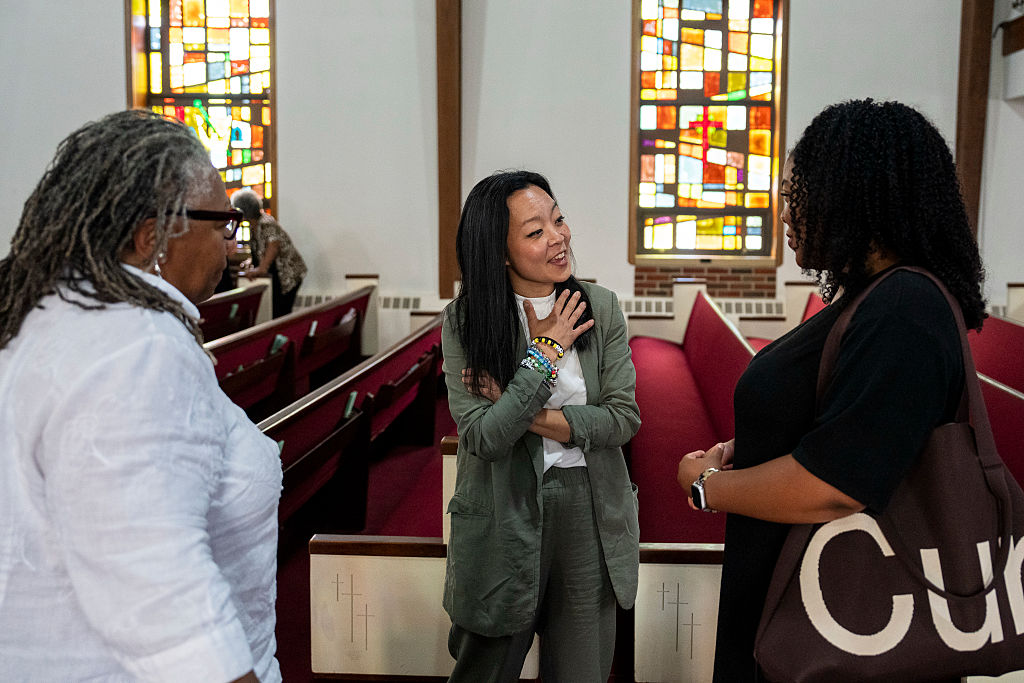
A daughter of Korean parents who immigrated to the United States in the 1980s, Francesca Hong grew up in Wisconsin. If elected governor, she will become part of her home state’s rich socialist history. (Sara Stathas / the Washington Post via Getty Images)
- Interview by
- Raina Lipsitz
Wisconsinites have a high-stakes decision to make in the Democratic gubernatorial primary on August 11: whether or not to elect the first socialist governor in the state’s history, Francesca Hong.
A Democratic Socialists of America (DSA) member and college dropout who, before she was elected to the state legislature in 2020, had worked as a dishwasher, line cook, bartender, and chef, Hong is the front-runner in the race, though many voters are undecided. She has the support of a number of progressive organizations and unions across the state. And she seems to be outworking her opponents, none of whom have generated as much enthusiasm, assembled as many statewide volunteers, or received as much money from Wisconsin donors.
A daughter of Korean parents who immigrated to the United States in the 1980s, Hong grew up in Wisconsin. If she wins, she will become part of her home state’s rich socialist history. From 1905 to 1945, the Wisconsin legislature passed over five hundred pieces of legislation authored by socialists, and Wisconsinites sent a socialist to Congress and elected socialist mayors. In 2011, when Hong was in her early twenties, conservative Republican Governor Scott Walker gutted the state and wrenched it rightward, depriving tens of thousands of workers of long-held collective bargaining rights, crippling unions through a right-to-work law, and slashing aid to local schools and governments. Hong’s parents were public sector workers, and her family joined mass protests against Act 10, the 2011 law Walker championed that stripped most public sector workers of their collective bargaining rights.
We are now in what Hong calls a “movement moment.” Democratic socialists have won numerous races throughout the country. In June, New York City DSA, of which I’m a member, won nine out of the ten races in which it endorsed, including two congressional primaries. In western New York, DSA-backed Buffalo attorney Adam Bojak won a state assembly seat, and DSA member and Syracuse-based county legislator Maurice “Mo” Brown beat out one of the longest-serving Democrats in central New York for a seat in the state legislature. Brown’s opponent and allied groups outspent him five to one.
Democratic socialist Melat Kiros toppled a fifteen-term congresswoman in the primary in a district that includes Denver, Colorado; democratic socialist Chris Rabb won a primary for a House seat in Philadelphia; and democratic socialist Janeese Lewis George is poised to become the mayor of Washington, DC.
Some fear that running a democratic socialist like Hong in a state as politically mixed as Wisconsin will hand the governor’s race to Tom Tiffany, the presumptive Republican nominee. But lately it seems that running as a democratic socialist — and earning a DSA endorsement — can help candidates more than it hurts them. Hong has been endorsed by a number of Wisconsin DSA chapters, including Madison, Milwaukee, and Northeast Wisconsin.
The Democratic Party establishment is deeply worried about these developments. Their preferred candidates are failing to catch fire with voters, and top Democratic officials and consultants are panicking. Just a few weeks ago, desperate to stop Hong, they were urging candidates and voters to coalesce around Lieutenant Governor Sara Rodriguez. Rodriguez has since dropped out amid a scandal over her ex–campaign manager’s financial mismanagement, and Milwaukee County Executive David Crowley (also known as “Dirt McGirk”), who had dropped out to back Rodriguez, is back in with Gov. Tony Evers’s blessing. Now that the establishment is lining up behind Crowley, he is gaining in the polls but still lags Hong.
If elected, Hong has vowed to enact universal childcare and paid leave, tax the rich to better fund public schools, lower health care costs and expand Medicaid, provide free school meals to students statewide, establish a state-run public bank, and implement a moratorium on data center construction. Like her predecessor Scott Walker, she could transform the state for decades to come — this time, in a way that could return power to millions of working-class people in Wisconsin and beyond.
Jacobin contributor Raina Lipsitz recently sat down with Hong to discuss those possibilities. The conversation has been edited for length and clarity.
Raina Lipsitz
You’re serving your third term as a state legislator. What made you want to run for governor?
Francesca Hong
This is a historic moment for our state. It’s a movement moment, and a time where more and more working-class people are realizing that the economy is very much rigged against us. We need a government that is willing to make government a force of good, to help people get more democratic control of the economy.
Raina Lipsitz
I live in New York. I was involved in Zohran Mamdani’s mayoral campaign, and I remember when Zohran started running, he did this video where he asked Donald Trump supporters in the Bronx, “What made you vote for Trump? What are you frustrated about?” I know you’ve done similar outreach.
What do you think is important to understand about folks who voted for Trump, and where are you seeing areas of common ground between you as a socialist and people who supported the president?
Francesca Hong
I think people are feeling screwed over by their government and rightfully frustrated. We’re finding common ground on raising wages, taxing the ultrarich, talking to small business owners who know that megacorporations are getting tax breaks and credits while we’re struggling to keep our main streets open. We’re the only campaign to support a moratorium on the construction of data centers; many people support this position, and I think it has a lot to do with feeling like they’re losing control of their communities. Big Tech and surveillance are coming in to ruin their way of life. This is a lot about people wanting to be a part of big change.
Raina Lipsitz
Tell me about the campaign you’ve built.
Francesca Hong
We’re a community- and grassroots-powered campaign. We’ve built this incredible volunteer community that people are bringing joy into. Folks are hosting playdates, dance parties, talking about why it’s so important to get out and vote on August 11 and November 3 and demand more of their government.
Big money in politics is a challenge. Fundraising is always a challenge. But we’re proud to have the most individual donations and unique donors. I think that shows that this is an opportunity for the many and not just the money.
The working class is the majority, and we should have a bigger voice in our government and be the ones to shape the policy. The majority of working-class folks here in Wisconsin want to feel safe, to be able to afford to live. No one should be too poor to live in our state. Good wages, great public schools, free childcare, quality health care, especially in our rural areas — that’s what the majority want.
Raina Lipsitz
You’ll be outspent, I’m sure. But what’s most difficult about breaking through with a message like yours?
Francesca Hong
I think it is breaking through. Things like health care, public education, lowering costs — we need to be building permanent affordability. We should be trying something new. And I think folks get caught up in labels and not solutions. People hold multitudes. I really struggle with folks shaming people who are working and living under a system that’s not serving them for who they may have voted for in the past. I’m talking to Trump voters [who agree that] it makes more sense that everyone should have health care, and that the millionaires and billionaires shouldn’t be paying a lower tax rate than working-class folks.
Raina Lipsitz
What do you see as the biggest stakes in this moment, in this election?
Francesca Hong
I keep going back to making government a force of good. Sixteen years of Republican rule and Democratic complacency has led to dysfunction and defunding of public services and state agencies. We have to make sure that the state is there when you need it, with social insurance programs that will make your life easier. When we have politicians who are not acting in the interests of working-class people, it leads to everyone out on their own.
What’s most at stake is winning a Democratic trifecta in the state legislature, so that we can work together to write our democratic values into law. Public education, health care, and shared revenue are some of my top priorities, because I think that’s where we can make aggressive investments to change the material conditions of people’s lives the quickest.
Raina Lipsitz
Do you see Minnesota as a model? When they had a Democratic trifecta, they did a lot very quickly. How would you duplicate that success in Wisconsin?
Francesca Hong
It’s great to see what worked and what didn’t work with a slim majority in Minnesota. We want to maintain the majority when we have it, and that is going to require all of the state legislature, the executive branch, and all of our state agencies to work collectively.
I want to see additional investment in agriculture. Both Minnesota and Wisconsin have a strong agricultural heritage, and our farmers are really struggling. I’d like to ensure that our agencies like the Department of Agriculture, Trade and Consumer Protection, and the Department of Natural Resources are funded to make sure we’re helping folks navigate additional programs available from the state to help them, especially when Trump is implementing tariffs and jacking up fuel prices while our tax dollars are going to forever wars. Wisconsin can make sure that, regardless of zip code, you have support and opportunities to navigate whatever level of crisis you’re going through because of the federal government.
Raina Lipsitz
Only fourteen US states are run by women. Has gender been a factor in your campaign?
Francesca Hong
A lot of people I talk to are pretty excited to elect our first woman governor. I remind people who may be skeptical to look at where we are. We’ve only had male governors and a male-dominated legislature. Maybe it’s time to elect a woman.
Raina Lipsitz
How has being a child of immigrants affected your politics?
Francesca Hong
My parents came here to pursue education. At the time, Korea was also going through political upheaval. I take being a public servant very seriously. I prioritize sacrifice, service, and community. And I owned a restaurant for seven years. I still work in the service industry. I think the dishwasher is one of the most important people in a restaurant.
In Wisconsin, we take care of our neighbors. Those are our values.
Raina Lipsitz
Representative Alexandria Ocasio-Cortez famously was a bartender before she was elected to Congress. You’ve talked about working as a dishwasher and a line cook. What skills have you transferred from those jobs to the campaign?
Francesca Hong
Working collaboratively, understanding that every position in the restaurant is important and contributes to the success of having a good service. At Friday night service, you have everything from the host, who is the first person you may see, to the line cook, who is turning out the lights at the end of the night — everyone plays an important role. I’ve worked with a lot of chefs who may have had more ego, and I think it’s important to put that aside, especially in government.
I’ve learned to out-hustle folks. I didn’t go to culinary school, so I had to make sure the chefs I was working for saw my work ethic, my willingness to learn, and to actively listen to people around me. I think service industry folks are built different, and you see the best and worst in humanity in restaurants and how people can treat each other. I’ve learned a lot about how important it is to treat people with respect and honor who they are.
Raina Lipsitz
You’ve mentioned that people are more than their labels. People are hung up on the democratic socialist label. Why do you use that term? Why not just run as a progressive? What’s important to you about defining yourself that way?
Francesca Hong
The word “democratic.” Being a democratic socialist means that my values are rooted in democracy, fairness, and human rights. It’s why I’ve been vocal in organizing, I’ve been vocal on Palestinian rights, and I’ve been fighting to have fair taxation, taxing the ultrarich and the megacorporations. I want everyone to have a say in what shapes their lives. The numbers are showing that especially our young people are supportive of democratic socialist policies. Bernie Sanders won seventy-one out of seventy-two counties here in Wisconsin in 2016.
It’s more about the solutions than it is the labels. When I’m talking to folks on the trail about it, I go back to fully funded public schools. I go to the three Ps, popular things in our state that have socialist roots or socialist policies: the Green Bay Packers, public schools, and potholes. The Packers are a publicly owned football team; we have a constitutional obligation to ensure every child has a sound and good public education. And potholes — everyone’s thinking about potholes. They see them. They drive on the roads that we all pay for, and we need to be giving our local governments more money so that we can help them fix the roads, and that comes from distributing wealth, and that has to come with people paying their fair share of taxes.
Raina Lipsitz
When did you join DSA, and when did you start to think of yourself as a democratic socialist?
Francesca Hong
I didn’t really even know what community organizing was as a term; I’d read a little Saul Alinsky. To me, the label “community organizing” made more sense. It’s building relationships. When I joined DSA in 2020, it was because the things that they were fighting for and talking about were things that I align with when it comes to raising wages, racial justice, and fighting for working-class people and not the oligarchs.
Being a member of DSA, and the community organizing it’s doing, is so important. Look at the work that DSA is doing on the ground. That is a big part of our campaign. We’ve already hit tens of thousands of doors and had thousands of conversations, and sometimes it’s more the messenger than just the message. And to have folks who identify however politically, but then to talk about free childcare, a data center moratorium, and fully funding our public schools — when you’re hearing it from your neighbor as opposed to a politician, it hits different.
Raina Lipsitz
Wisconsin has a rich socialist history, but it also has a history as a laboratory for the far right. How do you plan to reverse the structural damage that politicians like Scott Walker did to the social safety net and public institutions? And how do you do it in a way that’s not just going to reverse that damage, but solidify those gains so they can’t just be undone again in the next election?
Francesca Hong
Take Act 10 [the Scott Walker law which severely restricted public sector collective bargaining rights]. It’s not enough just to repeal Act 10. It should be in the state constitution that everyone has a right to collectively bargain or unionize. So putting a stake in it means let’s take it to the people, a ballot referendum question, and ask. If it’s in our constitution, it’s much harder to repeal. We still have an abortion ban on our books in the constitution that we should have repealed a long time ago.
And then the funding piece. It’s important that these programs I introduced — I’m the lead author of Paid Leave for All, and the way that the program would work is very much like unemployment insurance, where it starts to pay for itself. [Hong introduced a bill that would expand Wisconsin’s family and medical leave law and establish a family and medical leave insurance program. Like the state’s unemployment insurance program, it would be funded by corporate taxes, which means payroll contributions from participating employers and employees would cover the program’s costs.] They know that it’s there when they need it, and it ends up being a program that can pay for itself and also ensure that folks have twelve to fourteen weeks of paid family or medical leave.
Undoing structural damage comes with building something new that’s lasting, and that has to be both through funding, through statutes and our constitution, and in shifting the culture and the narrative around why we deserve these things.
Raina Lipsitz
There’s a lot of fear out there about electability. A lot of folks who say things like, “I really like what you’re saying, but I need to back the person who can win in the fall.” How do you address those fears?
Francesca Hong
The person who is most electable is the person who wins the most votes. When people fear that their neighbor may not be voting the same way they are because they’re scared of a candidate that they want to vote for but have hesitations about, then we’re never going to get the candidate that we want. That’s why organizing is so important, because it’s both telling and showing the power of a movement. We’re showing that, whether it’s with poll numbers, number of volunteers, the press that we’ve been getting. But also that these policies we’re fighting for have broad appeal to Republicans, independents, and moderates — there’s an opportunity to build the coalition that’s strong enough to win.
And I’m going up against a candidate who is an election-denying traitor, a pedophile protector, someone who supports gutting health care from Americans and ripping food away from our kids, and an abortion ban nationwide. But I want folks to know, even if you don’t vote for me in the primary or in the general, I want you to have good health care and great schools.
The electability question — you can combat that fear when you see community being built and folks talking about hope.
Raina Lipsitz
I’ve been thinking about a speech Zohran Mamdani gave before the primary election a year ago. He said, “The days of moral victories are over.” People were electrified by hearing someone say “I have a responsibility to you to win.” Is that something you think about? Do you see it in those terms?
Francesca Hong
We are running to win. I would not have come into the race if I didn’t think I could win. We are running to build power for working-class people, and we are running to deliver for Wisconsinites. This is about policy that will improve lives and make life easier for everyone in our state.
I don’t think Democrats talk enough about power. We can’t be afraid of it. We have to reclaim it, and this is the opportunity for Wisconsin to do that, where we win the trifecta and move with urgency to respond to a time of crisis and chaos. I hear a lot about fighting Trump, but that also has to mean fighting for the people of Wisconsin by making sure the government gives them what they need to be able to take care of themselves, in a time where the regime does not care about you, Trump does not care about you. I want you to be able to take care of yourself, your loved ones, and your community. It’s about freedom and power, and that means Democrats have to win.
Wisconsin’s a bellwether state. As goes Wisconsin, so goes the country. And, like Mayor Mamdani, we’re seeing across the state other election wins for democratic socialists and progressives. I think if we can do this at the statewide level, we’re going to change politics across the country.