Socialist Juliana Bennett Is Running for Wisconsin State House

Juliana Bennett

In Wisconsin, the birthplace of “sewer socialism,” socialists are again building their forces and making a bid for the governor’s seat. Juliana Bennett, running in the 76th District in Madison, hopes to join the growing socialist caucus in the state house.
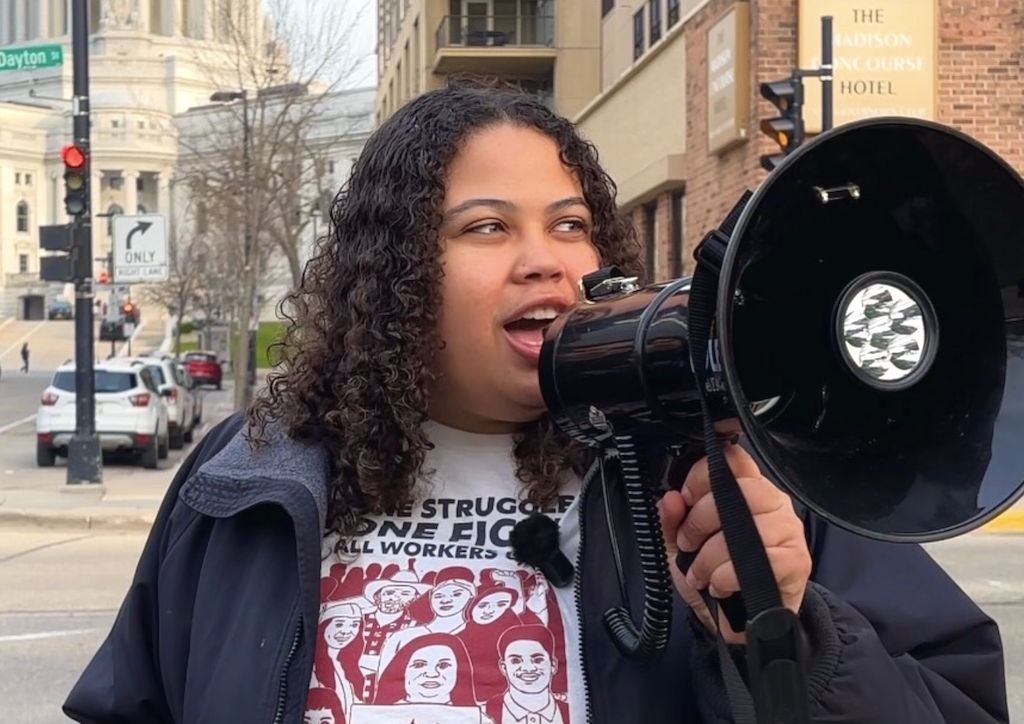
Juliana Bennett speaking into a megaphone.

Juliana Bennett speaks to a group of antiwar protesters outside the Madison Concourse Hotel on April 7, 2026, in Madison, Wisconsin. (Courtesy of Juliana for the People)


Interview by
Sara Wexler

New York’s democratic socialists typically get most of the national media attention. But socialists have also been quietly winning elections across the Midwest over the last few years.

That includes in Wisconsin, one of the Socialist Party’s early-twentieth-century strongholds and the birthplace of “sewer socialism.” Socialists now have a four-person caucus in the state legislature, and one of its members, Rep. Francesca Hong, is now running for governor. (Polls suggest she has a real shot at winning the Democratic primary.)

Juliana Bennett, a socialist former alder for Madison who has been endorsed by the city’s Democratic Socialists of America (DSA) chapter, is running for Hong’s current seat in the Wisconsin State Assembly’s Seventy-Sixth District. Jacobin recently spoke to Bennett about what inspired her to become an elected official, the crisis of affordable housing affecting the district, and what socialist victories in Wisconsin might mean for the movement nationally.


Sara Wexler

Why are you running for state assembly?

Juliana Bennett

I’m running for the Wisconsin State Assembly to succeed Francesca Hong because I believe that having a savings account shouldn’t be a luxury.

The situation that made me first decide that I wanted to run for the state assembly happened three years ago while I was a City of Madison alder. My dad experienced cardiac arrest. He had a six out of a hundred odds of winning; he survived. But it came at the cost of a $500,000 medical bill, and he got evicted from just being laid up in the hospital.

It goes without saying that no one should have to experience that. And being an alder at the time and someone who had just graduated from the University of Wisconsin with degrees in real estate and political science, there was nothing I could do, because this is a state-level issue.

That’s one specific experience, but it’s also just growing up knowing what it’s like to be homeless or move across town. And then there’s the professional experience for me. As someone who has worked in the state capitol, I know the difference it makes to have a leader in this seat, which is the most Democratic seat in the state, who is actively leading and taking those moral stances that the Democratic Party needs — especially when we’re considering other areas of the state that are more red or purple.

I’m not going to ask for permission to do the right thing; I’m just going to do it. And we need people that are ready to fight in that way. Right now, people in our state are experiencing the consequences of fascist Republican leadership for the past decade. We’re running to change that.

Sara Wexler

You started touching on this already, but what are the main issues you’re running on? It sounds like affordability is very important to your campaign.

Juliana Bennett

Indeed. We’re running to lower property taxes, lower rent, fund public schools, and raise wages. Those should be very simple things that we’re looking to deliver on for working people. They are the things that I constantly hear about at the doors that people are suffering from.

In Madison, our rents have nearly doubled in the past five years. Our property tax bills have increased by $300 to $700 every year since 2020. That is a direct result of Republicans hoarding our money at the state level, forcing us to go to endless property tax referendums.

Zooming out a little bit from Madison, it’s not just a liberal bubble issue. Over seventy-five localities in Wisconsin held referendums in the April election. It’s really hard for people to get by. It’s really hard for people to simply buy homes or stay in their homes and to afford basic necessities.

Sara Wexler

You’re running in an open Democratic primary. What would you say differentiates you from the other candidates?

Juliana Bennett

The term “progressive” in our city is used by everyone. It’s hard for people to differentiate themselves when we are all using that term.

I will say that I am the most experienced, the most accomplished, and the most progressive. By that I mean I’m the only candidate with experience working at the local, state, and federal level. I’ve been a Madison alder; I worked as a federal legislative liaison at the Wisconsin Housing and Economic Development Authority and as chief of staff for a state representative.

I’m the only candidate that has drafted and passed multiple items of original legislation. I’m not someone who just takes someone else’s marching orders. I take action when people ask me to, like a decent legislator should.

And I’m the only candidate who only openly identifies as a socialist, who actively sought and eventually received endorsement from Madison DSA. When we use the term “progressive” in this race, there is a difference between being a liberal versus being a leftist.

There’s a real difference between standing up for Palestinian Wisconsinites, having a clear stance on abolishing Immigration and Customs Enforcement (ICE), and passing policies that will make a material impact on people’s lives and give power back to the people — and what we’re seeing from having an agenda that is outlined by centrist Democrats.

Sara Wexler

Has ICE been very active in Madison or Wisconsin in general? How has that played a role in this campaign?

Juliana Bennett

It’s really sad. I’m sure it’s harder for those of you out there in New York. And a lot of Wisconsinites are seeing the impacts of ICE activity at our neighbors’ doorsteps in Minneapolis.

There is ICE activity here in Wisconsin. A few months ago, there was an ICE raid across the street from where I live on the north side of Madison. They said it was routine. There are ICE agents going to farms and other places of work in different areas of Wisconsin.

I think the only thing insulating us from more mass attacks by ICE is that Wisconsin voted to elect Donald Trump, which is very sad. But the administration knows that if it does here what it did in Minnesota, the consequences would be even more devastating than they already are for its party.

Sara Wexler

What does democratic socialism mean to you? How does it inform your campaign and the issues you’re running on?

Juliana Bennett

I am proud to have received the Madison DSA endorsement. I consider myself a sewer socialist. Sewer socialism was a term coined in Milwaukee, Wisconsin, at a time when capitalists were literally throwing their sh-t in the river and making it someone else’s problem down the road, someone who didn’t have the money and political leverage to change that — until Milwaukee sewer socialists stepped up and elected the first socialist mayor in a major city and later the first socialist member of Congress.

I like to take that and put it in a modern perspective. Our sewer is the economy. Our sewer is those people who are working two and three jobs, not making enough money and still having to come home and make hard choices about whether to pay for rent or electric bills or food.

Our message is resonating not just in this liberal bubble of Madison, which is what some people call twenty-five square miles surrounded by reality. Representative Francesca Hong, who currently holds this seat, is leading in the polls for the governor election because she’s bringing sewer socialism to northern Wisconsin, and people are resonating with that.

That makes me very excited. And the Madison DSA chapter has so much new energy that has come into the chapter. We have ballooned in the past year with [Donald] Trump getting elected and then seeing Zohran Mamdani get elected as well. We have people in our chapter who are ready to take action, to build a Zohran-esque campaign out here and to meet people where they are.

Sara Wexler

You attended University of Wisconsin–Madison, a public university. Recently the University of Wisconsin system instituted the Wisconsin Tuition Promise program to help families earning under the median income to afford tuition. What do you think of this program? And what is your vision for public education in the state?

Juliana Bennett

I’m someone who benefited from a program like it. A major factor in why I was able to attend UW Madison is that I received a full-ride scholarship. All my tuition was paid for through the Business Emerging Leaders Program, and UW Madison has the FASTrack and BANNER programs that work to help students whose family contribution is less than $20,000 a year. Without it, I do not know where I would be right now.

It shouldn’t be shocking that when we [provide public funding] for things like higher education, more people are able to get a good education. My plan for higher education is expanding that tuition promise to all working families in Wisconsin. The tuition program is for people whose family contribution is less than $55,000. That’s still pretty low compared to the need spectrum in Wisconsin.

The University of Wisconsin system has a real issue with delivering on what we call the Wisconsin Idea. The Wisconsin Idea is a term that was coined by other socialists that refers to the idea that the work that we do at the university should make a material impact on people’s lives throughout the state. At a time when the university is underfunded, we have local schools closing across the states and significantly reducing their programming. And we have, at least at my alma mater, people living tripled or quintupled up in the same bedroom; we have three or five or more people living in a space that was designed for only two people. That’s a real problem. And it’s because Republicans are hoarding our money.

The other problem is that we have taken power away from the people. Under Republican leadership, the right for students to have shared governance was stripped away. Wisconsin law says all decisions are subject to the chancellor. The chancellor is appointed by the Wisconsin Board of Regents, and only the governor has the ability to appoint the board of regents.

What that looks like on the ground is faculty, staff, and student government bodies pass resolutions, the chancellor basically ignores them. For instance, the student governing body recently approved a resolution around ICE, and the university administration immediately ignored it. The administration labeled it as unrealistic and illegal to have basic standards around how we will handle ICE activity on our campus. So we need to reinstate our rights to shared governance and take down the undemocratic structure by which we hire chancellors and appoint the board of regents.

Sara Wexler

Wisconsin has a pretty bad housing shortage. I believe it’s about two hundred thousand units. What do you think it would take to fix this?

Juliana Bennett

We do indeed have a shortage of two hundred thousand units. I don’t think that there is a single fix; it’s going to take a lot of things.

Wisconsin is very good at building affordable housing for those making between $50,000 and $80,000 a year through the Low-Income Housing Tax Credit program. Actually, in my city, we have a surplus of housing for people making $50,000–80,000 a year. We do not have enough housing for people making more than that. People who are ready to invest in a condo or buy a home or something of that nature can’t find housing that they can afford, so they’re renting down and taking units away from people making less than them.

And then, people making less than $50,000 a year also can’t find housing that’s affordable for them. So they’re paying way more than what they can afford and competing with those same people who are making more than $80,000 a year.

What it will take is, first, investing in deep and permanent affordable housing. That looks like having a statewide housing voucher program or making it easier to have cooperative or cohousing living situations. It also looks like us expanding homeownership opportunities by having a statewide public bank and community land trusts.

I don’t think that we can solve our housing crisis without solving our school financing issues. Our rents and property values are just skyrocketing because we are hoarding money at the state level, and the only other way to finance public schools is through property taxes. It should not be that way. I’m very proud of Representative Hong and the Socialist Caucus for introducing legislation that would lower property taxes by 44 percent by funding our schools and taxing those making over a million dollars a year. I would love to work with a Governor Hong and whomever else to get that done.

What hasn’t worked is GOP leadership and the housing laws that it has passed. Republicans passed over a hundred pro-landlord bills in the past decade. Those bills include prohibiting municipalities from doing routine building inspections; they include prohibiting rent control and other mechanisms to tamp down how much rent increases over time. We’re seeing the real impacts of that where people are living in slums in Madison. There are people living with cockroaches and rats and poor heating systems in our cold Wisconsin winters, and it’s very difficult to get out of those housing situations.

That’s why I would love to pass a Tenant Bill of Rights. We’ve seen other models of that. It’s a simple solution to say, hey, every tenant deserves the right to a decent living situation, the right to fair leases, and to have human dignity in their housing and living situations.

Sara Wexler

What organizations have been involved in your campaign? You mentioned DSA.

Juliana Bennett

Madison DSA has been awesome, as has Our Wisconsin Revolution, which recently endorsed our campaign. There is also a grassroots movement that can’t really be quantified or can’t really be articulated under just one organization but is just groups of people coming together to help our community. It’s been really helpful to connect with organizers on the ground who are helping our unhoused community, helping our immigrant and undocumented community, and helping Palestinian Madisonians. They’ve also been working with our campaign.

Sara Wexler

If you win the election, what do you see as the biggest challenges you’ll face? How do you envision your role as a socialist elected official?

Juliana Bennett

I keep saying that I don’t think that the biggest challenge is Republicans. I know they hold the power, but I kind of expect trash from them. The biggest challenge is the Democratic Party moderating itself. I think that there are really good, well-intentioned people who want to seek a compromise but have become compromised on our values and on the people.

What I bring to this race is the perspective of someone who has seen the impacts of our legislation on the ground and knows what it takes to make a difference. I do intend to cut through those who might not be willing to take bold action right now. I think that there are ways that we can deliver in Wisconsin on a bipartisan basis. And dear God, I hope that we have Francesca Hung or another Democratic governor to work with to deliver on the promises that we’re making to the people. So I think that’s the big challenge right now.

The role I envision for myself as an elected representative is that, when the people elect me, they’re also elected. I’m not running because I think it would be cute to have my name on the door. I’m running because I want to deliver for the people that elected me.

That looks like fighting every day to introduce and pass bold legislation and also being ready to advocate on behalf of our needs. For instance, UW Health Kids and Children’s Wisconsin recently stopped providing gender-affirming care to those under the age of nineteen. They didn’t need to do that; that was a preemptive measure because they were scared of the Trump administration. A representative in this seat should be ready to hold those that make those kinds of unnecessary and harmful decisions to account — and really fight on behalf of people with more than just strongly worded letters and curated messaging.

Sara Wexler

Anything else?

Juliana Bennett

What’s really exciting about us leading as socialists — and by us, I mean myself and Francesca Hong and DSA in general — in Wisconsin is that we are showing that socialism is no longer something that’s exclusive for the coastal elite people. It’s something that is really resonating here in the swingiest of swing states.

So I am very excited because if and when we win — and personally I believe that we’ve already won by just showing up and showing out and showing that we have a real base here — we’re changing the narrative in real time. So that’s really exciting.