How I, a Norwegian Socialist, Learned to Love Haaland

Erling Braut Haaland might seem like an especially showy millionaire footballer. He’s also the product of Norway’s inclusive, publicly funded model of kids’ and youth football — a system the United States can still only dream of.
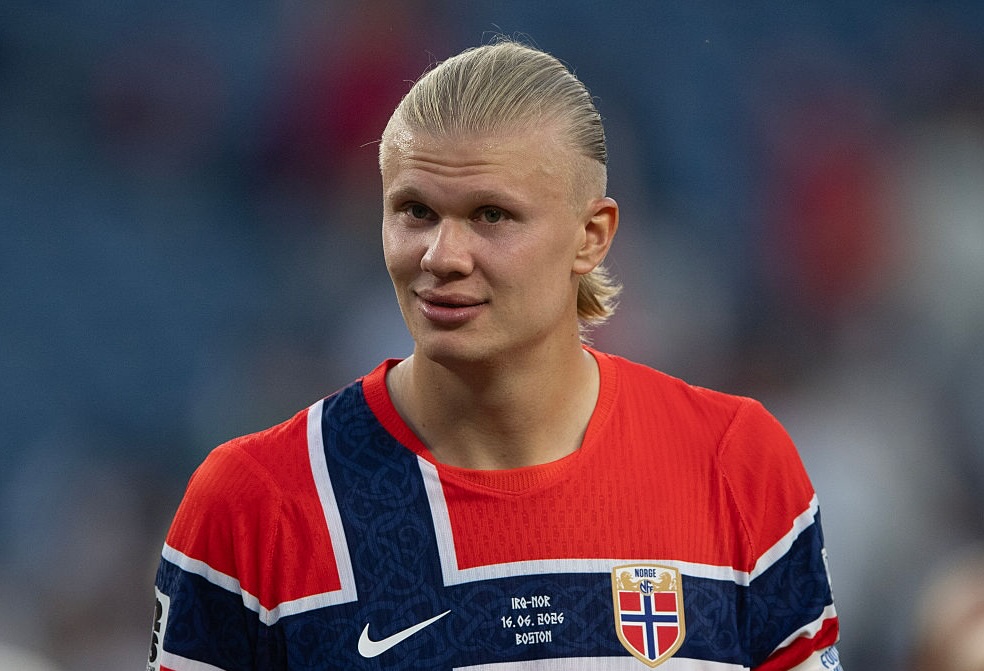
Erling Haaland smiles after match

Erling Haaland of Norway smiles following victory in their World Cup 2026 match against Iraq, Boston Stadium, June 16. (Joe Prior / Visionhaus via Getty Images)


I’ve been coming to the United States as a journalist for fifteen years. But I’ve never felt the same excitement over here as I did last week, when I was hugging sweaty, beer-chugging strangers after watching Erling Braut Haaland score Norway’s first goal against Iraq in Boston.

I’m a reporter for the Norwegian socialist newspaper Klassekampen (Class Struggle) and I’ve come here both to cover the World Cup and to investigate what is happening in this country. It’s an America where socialists are now elected mayor of New York, wars are ended by capitulation, the Knicks win championships, and MMA is fought on the White House lawn. Most of all, I’m just one of over ten thousand football-mad, Viking-helmet-wearing Norwegians who have come to chase new moments of national euphoria, many of whom have emptied savings accounts and maxed out credit cards to visit the proud birthplace of greedflation and FIFA’s “dynamic pricing.”

It was a price most of us were willing to pay, even if it meant going to a country that many Norwegians had once associated with freedom and security but today, with its Trumps and Thiels, is increasingly perceived as a threat, both to football — through commercialization and ad-driven inventions like water breaks and video-assistant-referee tech — and to the values we once naively believed the United States upheld.

We are desperate for new memories. My generation has grown up chewing on the same old tales from our last World Cup in France, in 1998, and here in the United States, in 1994 (our first since 1938), when we were led by our communist head coach and national hero, Egil “Drillo” Olsen. His squad included several of the fathers of the 2026 players, such as Alf Inge Håland, a man who, on a day in the year 2000, would hold his newborn son, Erling, in his arms.

That son has grown into a formidable weapon — and he’s also the main reason why our enthusiasm and expectations this year are greater than ever. Erling Braut Haaland is Norway’s most valuable commodity since oil, salmon, and the tripartite cooperation between trade unions, employers, and government. He’s our biggest national icon since painter Edvard Munch, writer Henrik Ibsen, and the radical social democrat Einar Gerhardsen, our first working-class prime minister.

Haaland, the blond, long-haired Manchester City striker, who scored a record-breaking sixteen goals for Norway in qualifiers where we humiliated both Italy and Israel, is our new national icon. Haaland, from the agricultural area of Bryne, western Norway, is also becoming a global superstar on the same level as David Beckham, Zlatan Ibrahimović, and Lionel Messi. He’s one of those footballers known even to people who don’t follow football.

Even as we now cherish secret hopes of reliving the euphoria from the tournament in 1998 — when Norway beat Brazil and qualified for the round of sixteen — some people back in Norway still argue that our national team is not so easy to fall in love with. Some of you might have seen the picture of our squad dressed up as Vikings in a fjord. Even as the picture went viral all over the world and poured even more fuel on the fire of our expectations, some called it aesthetically problematic and claimed it reeked of hypermasculinity and fascism.

Others felt that the team, like Norway itself, had become too rich and too spoiled. I blushed as our die-hard supporters, Oljeberget (The Mountain of Oil), sang, “We can buy the whole of Sweden if we want to.” The irony one might hope to find in their eyes was not there.

Not only that, but I had myself argued that Haaland, often perceived as arrogant, represented a version of Norway I struggled to identify with. And yes, he seems almost designed to annoy me, a socialist journalist. He has changed his name from Håland to make international branding easier and was playing for a club owned by Gulf autocrats. He has promoted the energy drinks of Trump-supporting American influencers. And when he showed up for the flight to America, he brought a handbag priced at $45,000, around two-thirds of the median Norwegian salary. Every year, he rakes in as much as twenty-one of the other players in Norway’s squad added together. His reputation has not been helped by his father, Alfie Håland, now a tax deserter, one of many rich Norwegians who have left for tax-haven Switzerland.

The contrast to the father of our Arsenal captain, Martin Ødegaard, is stark. Arsenal fan Zohran Mamdani would probably be pleased to know that Ødegaard’s father declined, when Martin played at Real Madrid, to take advantage of tax loopholes and instead insisted that he and his son paid their fair share to Spain.

But of course, most Norwegians, in our hunger for goals, glory, and national community, still embrace Haaland — his somewhat clumsy and teenage-like aura off the field, and his incredible ability to find the back of the net on it. At the same time, as I’ve been following Haaland and the team more closely, I’ve realized I was partly wrong about him. What seemed like arrogance was probably mostly young insecurity. Within the squad, he is today not only the star but a well-liked guy who just really loves to play football, a vital part of a well-functioning community.

In 2026, our national team is no longer led by a communist. However, our national coach, Ståle Solbakken, a sworn social democrat, has managed to create a strong collective with a leadership group where high rollers like Haaland can be held responsible to lesser-known figures like Bodø/Glimt midfielder Patrick Berg. The impressive results and the harmonic atmosphere surrounding the national team are often attributed to such communal qualities.

The Norwegian success has also been built on an inclusive and publicly funded model of kids’ and youth football. Haaland is the result of all the hours he spent on a free, public indoor field and a youth coach who resisted the temptation to professionalize too early and who talked about the way playing together with weaker players makes you better.

Erling Haaland celebrates goal
Erling Braut Haaland of Norway celebrates scoring his team’s first goal during the World Cup match against Iraq in Boston, June 16. (Justin Setterfield / Getty Images)

This is in many ways the opposite of the American pay-to-play model. Even though the USMNT is off to a good start, taking a look at its World Cup squad, I realized that very few if any of the American players (maybe not even the Trump-dancing forward Christian Pulisic) would be sure starters for the Norwegian team. That’s a testament to what Norway has built. But perhaps even more, it mirrored the weakness of the American capitalist system, where football, such as health and everything else, has been turned into a profit machine for billionaires, and where skyrocketing prices exclude the working classes, making sure the US will never reach its true potential, neither on nor off the pitch.

Today’s America is often bleak. I come here with questions like: What comes after Trump? Can it escape a future under someone like Tucker Carlson, who seems to be quite cleverly exploiting the populist moment — the hate toward AI and data centers and the rightful anger toward Israel?

I find some hope in the achievements of Mamdani, and I cross my fingers that the success of someone like Graham Platner, the Bernie Sanders–supported candidate for Senate in Maine, shows that left-wing populism can win outside of big-city liberal bubbles, and that a more social democratic American future, perhaps even a more socialist one, is not the sci-fi story it’s often made out to be. The way Platner has so far managed to use his politics to overcome his own scandals and imperfections seems to me like one of the most important stories in America right now.

It also makes me think of Haaland and the discussion we had back in Norway before the tournament about whether the aesthetics of runes and Vikings, which dominated our kits and many newly made World Cup songs, were problematic. Parts of the intelligentsia of Oslo did not care for such branding, which they found problematic and chauvinistic. Others on the Left argued this was humorless and that we should not leave such powerful cultural national iconography to the Right. Maybe we should instead embrace it and reclaim it for ourselves. And maybe it was a good thing when players like Antonio Nusa and Oscar Bobb, with roots in Nigeria and Gambia, appeared as natural Vikings just like the blond Haaland and Ødegaard?

At the same time, feeling and seeing what joy Haaland and his goals can bring to a whole nation has made my own dislike for Haaland fade fast. And after hugging strangers in Boston, I was thinking that if we can’t embrace people with weaknesses and qualities we don’t like, whether it’s Graham Platner or Erling Braut Haaland, both imperfect vehicles for collective aspirations, we’ll probably be doomed to boring defeats and loneliness forever.

In this world of digital solace and fragmentation created by our tech overlords, the moments of physical camaraderie that football (and yes, New York basketball too) creates in stadiums, pubs, and streets — a common communal experience that binds us together across lines of geography, race, and gender — can hopefully also remind us of what makes our communities and countries strong. It helps us remember what we are fighting for, and what we, whether in Nebraska, New York, or Norway, need to defend in a world full of Thiels, Trumps, and Netanyahus.

In that world, maybe someone like Haaland is not such a bad icon after all, and now he’s here to conquer America.