Zohran Mamdani’s 100 Days of 21st-Century Sewer Socialism
In his first one hundred days as mayor, Zohran Mamdani has realized that New Yorkers — and all Americans — need to see the government working for them.
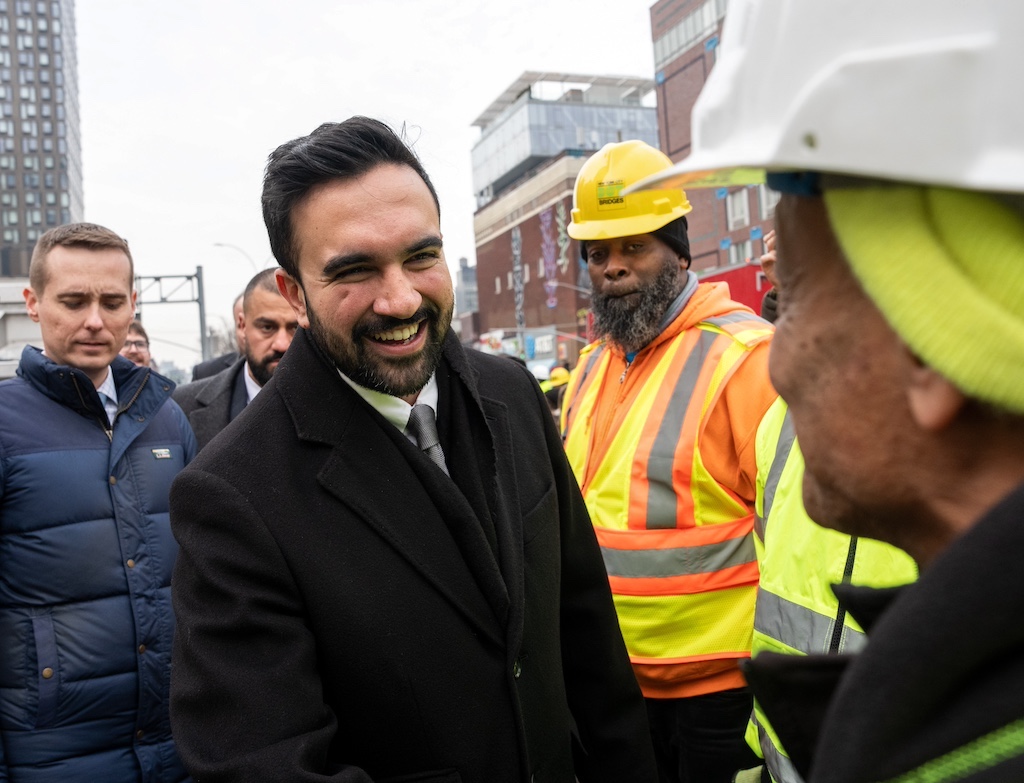
Zohran Mamdani greeting workers at the site of the Williamsburg Bridge bump. (Adam Gray / Bloomberg via Getty Images)
March Madness is over, spring is here, and Morrisania, a neighborhood in the Bronx, is getting a resurfaced basketball court. The Lower East Side in Manhattan is getting a water fountain repaired, Sunset Park in Brooklyn is getting dispensers for dog poop bags, playground fencing in Morris Park in the Bronx is being fixed, a handball wall is being painted in East Harlem, Staten Island tennis courts is getting windscreens, and the illegal dumping in Soundview in the Bronx is being cleaned up.
It’s all part of “Municipal Madness,” which the mayor announced in a video called “The Fix Is In,” costarring WNBA star Natasha Cloud, set on a basketball court with a broken hoop. It was a competition — but not one in the Hunger Games–style — of the city’s annual participatory budgeting, in which neighbors devise elaborate marketing campaigns to see who will get a new swing on their playground.
Mamdani’s plan is for all sixteen of these problems, nominated by New Yorkers, to be fixed. Over 21,000 people voted on which of these tasks Mayor Mamdani would perform himself on his one hundredth day as a democratic socialist mayor of America’s largest city. The winner: cleaning up illegal dumping in Soundview.
The initiative shows how Mamdani turns mundane governance into great showmanship, spotlighting the small and often uncelebrated ways city government can improve our daily lives. Think of a water fountain at your kid’s school, a trash can on the street, an open bathroom in the park: things you barely notice when they’re there but when you need them and they’re absent, you fume — and lose a little more faith in your government.
This is Mamdani’s version of “sewer socialism,” a phrase that comes from Milwaukee’s long reign of municipal socialist governance last century. Mamdani has cited Milwaukee as an inspiration, but the term is more than a metaphor: the city is making a $108 million investment in upgrading the city’s sewer infrastructure, to protect the city from flooding by modernizing more than 6,700 catch basins over the next decade.
In a recent press release, the Mamdani administration does describe its approach as “sewer socialism,” but it also uses the term “quality of life,” a phrase that became right-coded during the Rudy Giuliani era, when it meant harshly policing minor infractions like graffiti. By contrast, under Mamdani, that phrase implies an effort to renew American faith in government and make our daily lives better through care for the commons.

This focus on the small details of our shared municipal experience began almost immediately after Mamdani’s inauguration. Five days into his mayoralty, he put on a pair of work gloves, and, with a Department of Transportation crew, fixed an infamous and dangerous bump on the off-ramp of the Williamsburg Bridge’s bike lane — one that cyclists had long complained about.
The repair was the beginning of a larger planned effort, a $70 million redesign of that area, among other cyclist safety initiatives, including upgrading a bike and pedestrian entrance to the Brooklyn Bridge and restarting construction on numerous other bike lane projects that had stalled under the previous administration.
The mayor has also activated red-light cameras at 250 intersections and established new slow-speed zones at eight hundred school locations, which will ease parents’ worries and save lives.
A few days after fixing the bump on the Williamsburg Bridge, Mamdani announced that he was expanding public bathrooms across the city. Since then, he’s announced crackdowns on illegal and predatory towing. Tow truck companies (often unlicensed) prey on people in emergency situations through deceptive or exploitative practices, including over-charging, towing without the driver’s consent, and holding the vehicle hostage until the victim pays the wildly unreasonable fee.
Such abuses have been on the rise nationwide over the last few years. The Mamdani administration has been filing lawsuits against some of the perps and issued warnings to at least three hundred of them. The city has also gone to war against unsightly construction sheds, proposing new rules to cap the length of time such sheds can stay up and curbing the amount of public space they can occupy.
All this has been an effective way for Mamdani to signal that he is serious about taking responsibility for the small things that almost everyone cares about. Like potholes.
During a single weekend in March, the city repaired more than 7,000 potholes. But that was only a small portion of the potholes fixed since Mamdani took office: on Monday, April 6, the mayor personally joined the Department of Transportation crew to fill pothole number 100,000, the largest number in the first three months of any administration in years.
Every administration fixes potholes, but Paul Williams of the Center for Public Enterprise showed that in March 2026, New York City filled far more of them than in any month since at least 2020, commenting, “We now have an answer to the question of ‘is NYC just doing good social media posts about service delivery, or is service delivery actually changing?’”
Of course, the socialist movement’s aims are more ambitious than this. Simply filling potholes and fixing a dangerous bike bump here and there won’t add up to a transformative or successful mayoralty. The original sewer socialists didn’t just spruce up Milwaukee here and there; they established major publicly owned systems for electricity, water, public health, and new parks. Mamdani, too, ran on enacting much bigger policies, including fast and free buses, building more affordable housing, enacting universal childcare, freezing the rent, and fighting for a tax on the very rich.
That last issue is crucial to any assessment of Mamdani’s first hundred days. If Governor Kathy Hochul does not agree to tax the rich in the state’s overdue budget, as she has thus far refused to indicate she will do, the resources for these bigger plans will be scarce, and Mamdani could fall behind in fulfilling some of his campaign promises.
This likely defeat, however, is balanced by a good start with the governor in rolling out the beginnings of universal childcare (though there is still a long way to go) and by the appointment of allies on the Rent Guidelines Board, who are likely to support a rent freeze.
And if he and his supporters continue beating the drum for the necessity of taxing the rich, and pressuring the governor to do so, Hochul may end up changing her tune come budget time next year.
The administration’s “sewer socialism” approach takes on particular importance in this context. It’s popular and, from a public relations perspective, a distraction from the difficulties and uncertainties of budget season. Fixing things is not controversial. While New Yorkers may disagree on how to get or fund a functional government, everyone wants the potholes to be filled.
The current blitz of conspicuous municipal competence also supports the rest of Mamdani’s agenda. Clean, attractive streetscapes with fewer rats and working sewers could strengthen his case for a robust, well-funded government and give him credibility as a steward of our tax dollars, including a future infusion of new public resources obtained by taxing the rich. The rhetoric writes itself: Does a billionaire deserve a new private jet more than a child in the Bronx deserves a basketball court, or more than we all deserve to find a toilet when we most need one?
The narrative behind this barrage of pothole-filling is not just about Mamdani, however. It also makes the Left’s most fundamental argument, the only one that is likely to ever help us defeat Trumpism’s authoritarian warmaking and xenophobia: that the government can be a force for good in our lives.

Even before Mamdani, New York City’s government daily accomplished amazing things despite meager budgets: running America’s best subway system, responding to complaints to the city’s 311 service, feeding free school lunch to nearly a million children, and maintaining world-class parks. In his video announcing “Municipal Madness,” Mamdani emphasized that the proposed fixes touted by the campaign were just a few out of “thousands of small problems” city workers fix every year.
Similarly, Mamdani’s videos during the brutal snowstorms earlier this year celebrated the sanitation workers working twelve-hour shifts to plow snow from the roadways, the kind of work that is nearly always done well in New York and deserves recognition. He got lots of attention for his emergency snow-shoveling program, which allows New Yorkers to earn money after big winter storms by clearing snow. That program has been around since 1987, but Mamdani vastly increased participation by promoting it well and increasing pay to $30 per hour.
This administration is providing an upgrade in basic services, and they want us to know it. But they’re also celebrating a public sector workforce that has constantly borne the brunt of austerity and demonization for decades.
Both parts of this — acknowledging what the government does and improving upon it — have largely been missing from the Left’s and center’s responses to our demented oligarch president. In our national discourse, the Left has in recent years demanded Medicare for All and an end to the war in Gaza. The center has warned that we could lose democracy. But neither has done much to explain or uplift the crucial work that public servants do every day preventing disease, caring for our public lands, protecting the environment from rampaging polluters, running our schools and libraries, and much more.
Trump and the architects of Project 2025 have taken advantage of that error. In his first one hundred days, Mamdani has helped to undo it, one pothole at a time.