Norway’s Vikings Are Reclaiming Valhalla at the World Cup
The far right spent a century claiming the Vikings. Norway’s World Cup team — horned helmets, runes, a viral row-chant and all — just took them back.
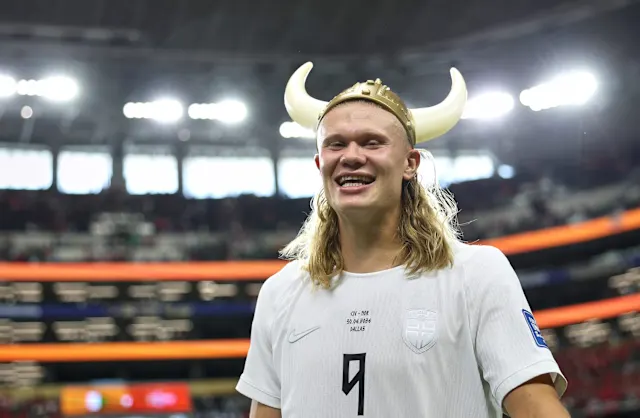
The goals of Erling Haaland and the victories of the national team in the United States have become a symbol of what the striker himself called “togetherness,” binding people of all backgrounds together in pure footballing euphoria. (Julian Finney / FIFA via Getty Images)
“Lastly, to my brother Charlie Kirk. Rest now, brother. We have the watch. See you in Valhalla.”
These were the words used by FBI Director Kash Patel during a press conference following the assassination of MAGA activist Charlie Kirk. The choice of words was curious: Patel is a Hindu, and Kirk was a devout Christian. There are neither ethnic nor religious reasons to believe that either of the two would adhere to the ancient Norse gods, nor that either of them would be welcomed by the All-father Odin in the halls of the Viking dead in Valhalla.
However, Norse mythology and Viking heritage have been something of a cultural obsession for the far right for more than a century. The myth that the Vikings wore horned helmets can be traced back to the Norse operas of German composer Richard Wagner, later a favorite of Adolf Hitler. Hitler’s dreaded Schutzstaffel units organized the Holocaust wearing stylized Norse runes in the form of two lightning bolts — SS.
In more recent times, the Viking rock scene was central to the formation of the far-right Sweden Democrats, while Elon Musk has frequently made references to both Valhalla and Norse heritage, both remarking that his SpaceX Starship 10 was headed for Valhalla when it blew up, and sparking a movement of meme Vikings online by giving his Shiba Inu dog the Old Norse name Floki.
The Footballing Vikings of Norway
Against this backdrop, it sparked a fair bit of controversy when the Norwegian national team embraced our Viking heritage at the ongoing 2026 FIFA World Cup. Star striker Erling Braut Haaland, famed not only for his goals but also for his long golden locks, had already posed as a Viking with kitsch photographer David Yarrow. Now the entire national team was dressed up as Vikings and superimposed in front of a backdrop of a Norwegian fjord. On the official team jerseys, the numbers and the lettering were done in stylized runes similar to the ones once used by the Nazi SS.
The Norwegian supporters’ group, for its part, chose the song “Vikingblod” (“Viking blood”) as their official anthem, and traveled to the United States dressed up in horned helmets, equipped with a replica of a Viking war horn to kick-start their now famous row-chants. No one seemed to even faintly remember the principle of “less is more” at this point, but whoever does in a European country on the verge of its first World Cup in twenty-eight years?
There were, however, several critics of the ways the Norwegian team embraced Viking culture. Some of them were purely aesthetic, claiming that the song “Viking blood” was tacky (which it sort of is). But others were of a more political ilk. A professor of religious studies wrote of the team’s jerseys that they were “right-wing extremist and hypermasculine” (God forbid masculinity intrude into the men’s World Cup!).
The cultural editor of liberal weekly Morgenbladet, Bernhard Ellefsen, wrote that “Viking blood” reminded him of “the kind of corny neo-Nazism that hid in the dark corners of the internet and the rurality of Norway when I was young.” International voices chimed in too, with Oxford Professor of European Politics Tarik Abou-Chadi asking on Bluesky:
Look, I like a bit of [Leni] Riefenstahl aesthetics for athletes as much as the next gay. But seriously, what the f — k? Is everyone now just actively trying to turn this into the white supremacy World Cup?
Taking Back Our Heritage
However, Norse mythology and Viking history are more than just a right-wing meme. They also happen to be the actual cultural heritage of the Nordic countries. Leaving this history to the far right would be a grave mistake, giving them powerful symbols that often hold far greater appeal than their policies.
Ever since its beginnings, the far right has stolen both imagery and political rhetoric. The Left should know this better than most. Hitler named his party a socialist party even though he was a strong friend of capital and a lifelong enemy of the Left. Should we, because of Hitler’s misuse of the term, refrain from the use of socialism going forward? Of course not. Then why should the Norwegian national men’s team refrain from using stylized runes because they were once misused by the SS?
At its core, this question becomes almost existential for the people of the Nordics. What to do, when a neo-Nazi clothing line uses the Norwegian flag on its hate-sewn garments? Giving up the flag and leaving it to the Nazis seems to be an unwise response. My own given name, Mímir, comes from the Norse god of wisdom, known to most today as an antagonist of the blockbuster video game “God of War.” What am I to do with my name if some right-wing movement in Germany or the United States decides to use it as their rallying point? Changing it is not an option.
The fundamental requirement of multiculturalism is a diversity of cultures. For multiculturalism to work, nations and regions all over the world have to preserve their distinct cultures. The alternative to this is not progress but a global monoculture driven by hypercapitalism and American cultural imperialism. For the Nordic countries, this means that we have to fight to preserve our language, our heritage, and our history in a world that is ever more dominated by the English language and global internet culture. And this is precisely what we at least attempt to do when our national football team dresses up in runes, and our fans cosplay as Vikings.
The FIFA World Cup is a highly corrupted version of the beautiful game, driven more by the yearning for money than the love of football. But neither FIFA President Gianni Infantino, FIFA Peace Prize winner Donald Trump nor any of the multibillion-dollar companies that control the game has been able to corrupt this particular aspect of the World Cup, that it unites forty-eight countries from all over the world in a celebration not only of their shared passion for football but also of their differences. The World Cup would be a more boring, less culturally diverse event if the Scots didn’t wear kilts, the Brazilians didn’t dance samba, and the Norwegians didn’t row dressed up like Vikings in the stadiums.
An Elitist Fear of Populism
There is also another point to be made here about national culture. The Mexican team came to the World Cup in shirts referencing the Aztecs, while the Japanese men’s team is nicknamed “The Blue Samurai.” Egyptian fans often attend their team’s games dressed up as pharaohs. For the intellectuals who have been critical of the Viking aesthetics of the Norwegian national team, this seems to be entirely unproblematic. Which is strange, taking into account that the Aztecs, the Samurai, and the Egyptian pharaohs were every bit as violent as the Norse Vikings.
The concept that the cultures of other nations are immensely valuable and intriguing, while one’s own is tacky and potentially right-wing extremist, is not new in the Nordic countries. Swedish Social Democratic leader Mona Sahlin is still quoted frequently for saying, back in 2002, that she “couldn’t say what Swedish culture is. I think that’s why Swedes are so jealous of immigrants. You have a culture, an identity, something to tie you together. And what do we have? Midsummer’s eve and that kind of stupid stuff.” Four years later, she was one-upped by her conservative rival Fredrik Reinfeldt, who said that “the only thing that is quintessentially Swedish is barbarism. Everything else came from abroad.”
At the heart of sentiments like these lie not only a fear of national chauvinism but also a contempt for the common people. While the footballing fans of Mexico, Japan, and Egypt are at a comfortable distance, the Norwegian and Swedish fans are uncomfortably close to home. It is no coincidence that the critique of the Viking theme of the Norwegian men’s team has been half-aesthetic and half-political. The very same people who are politically concerned by the use of Viking symbolism also happen to find the same symbols, not to mention the people who wield them, both tacky and vulgar. The original meaning of vulgar, of course, is common. In this way, the skepticism toward the whole Viking thing mirrors a classical anti-populist sentiment common among elites who distrust any form of organized mass movement, be it a labor union or a fan fest, as the first step toward totalitarianism.
In Norwegian political history, the national movement has deep progressive roots. For over four hundred years, Norway was a part of Denmark, subjugated to an absolutist king in Copenhagen. From 1814 to 1905, the country was part of Sweden. During the struggle for independence, especially in the 1800s, Viking history was instrumental in building a national identity enabling us to free ourselves from the Swedes. This movement of national romanticism was deeply entwined both with the farmers’ movement and the populist struggle for democracy. Later, the labor movement also joined in on what should be regarded as a more inclusive and progressive form of nationalism than that of the old European colonial powers.
Nevertheless, this national history has always been distrusted by an important part of Norway’s urban elites, who not only seem to believe that the country is too small for them but also are distrustful of the country’s populist history. It is no coincidence that the skepticism of the national team and their Viking aesthetics often overlap with more elitist, pro-EU sentiments. As the political editorial of Norway’s largest newspaper, the liberal-conservative and staunchly EU-friendly Aftenposten (a paper that supported the “union” with Sweden up until six months before the national referendum of 1905), recently wrote: “The whole World Cup thing is just ‘too much Norway.’”
Reclaiming Valhalla in Times Square
Five games into the World Cup, with Norway preparing for a historic quarterfinal against England in Miami, we now have some evidence of how the Viking footballers of the North have been received both at home and internationally. The fears that Haaland the Viking and the Norwegian fan rowers would spark some kind of right-wing surge seem not to have been realized. On the contrary, the Viking row-chant has gone viral all over the world, and the Norwegian team, mostly because of its football, has become the darlings of the championship.
I have yet to see any right-winger try to appropriate the Norwegian national team or the Viking row in their propaganda. But I’ve seen footage of Palestinian children rowing in a refugee camp before the game between Norway and Brazil. I’ve also seen French fans do the Viking row themselves in our heavy 4–1 loss to France in Boston. This is World Cup multiculturalism at its most beautiful, fans from all over the world connecting to each other’s cultures through their common love of football. It may still be tacky, but it is in no way exclusive or chauvinistic.
At home in Norway, this is even more true. When Erling Braut Haaland scored two goals to conquer Brazil, one hundred thousand people were in the streets of Oslo — a city of only 720,000. The fans storming up to the Royal Palace were of all colors and political predispositions. Similar to what the Knicks’ victory meant for New Yorkers of every flavor, the goals of Haaland and the victories of the national team in the United States have become a symbol of what the striker himself called “togetherness,” binding people of all backgrounds together in pure footballing euphoria.
What’s more, the national team’s heavy use of runes and horned helmets has reclaimed Viking aesthetics from the far right, proving that Valhalla does not belong to Kash Patel or Elon Musk but to the people who inhabit the Nordic countries — whatever may be their ancestry. In this, the Left may also learn a valuable lesson, that we should not surrender symbols or slogans to the far right but fight for them.