Everyone Loves the Knicks. Everyone Hates James Dolan.
The awful billionaire James Dolan’s stranglehold on one of sports’ greatest franchises is holding the New York Knicks back. The solution? Yes, that’s right: public ownership of the Knicks.
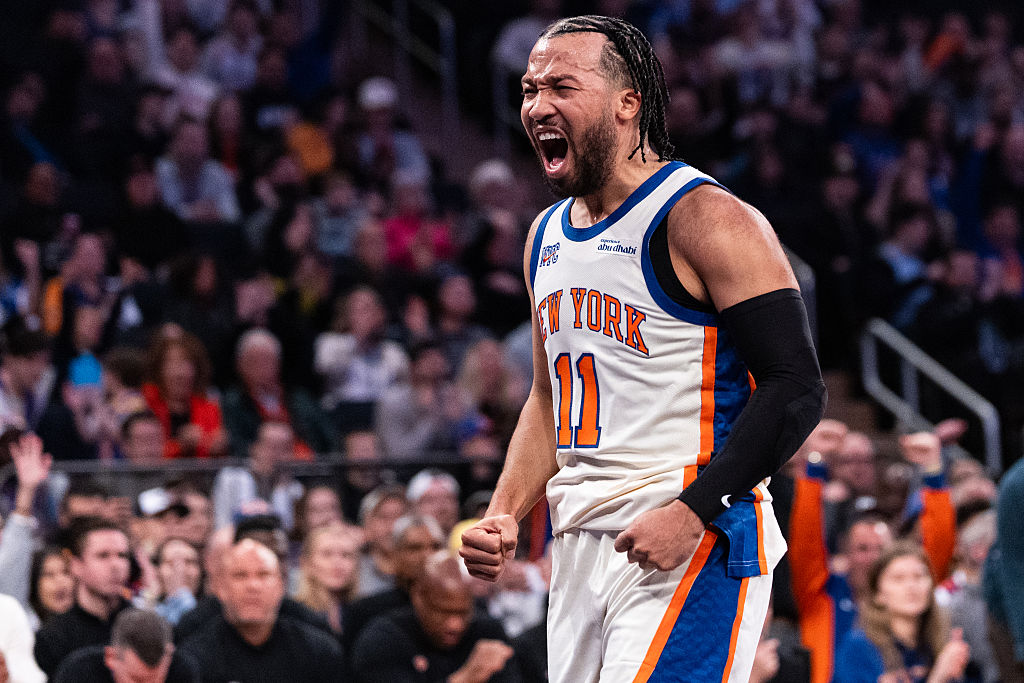
The New York Knicks are in the NBA Finals, and the vibes are immaculate. It’s a great time to be a Knicks fan, with one major caveat: the billionaire at the top. (Dustin Satloff / Getty Images)
For the first time in twenty-seven years, the New York Knicks are in the NBA Finals, and the vibes are immaculate. They have one of the most likable rosters in the league. Knicks supporters — some of the most passionate in all of sports — have electrified the NBA’s content economy with on-the-street antics and unforgettable catchphrases (“My Mayor Muslim/My bagels Jewish/My Christian Dior/Knicks in four”). Even their matchup, the San Antonio Spurs, largely fits the ideal of “ethical” basketball. It’s a great time to watch the league. It’s the greatest time to be a Knicks fan, with one major caveat: the man at the top.
The New York Knicks are majority-owned by Madison Square Garden Sports Corp (MSGS), under the day-to-day control of billionaire CEO and Executive Chairman James Dolan, who inherited the franchise from his father in 1999. The Dolan-era Knicks — a team whose valuation has only grown year over year to become one of the ten most valuable sports franchises — have been middling at best and catastrophically bad at worst. This current finals berth is an outlier. Chants of “Sell the team” have been ubiquitous for decades.
Dolan himself is far from just an incompetent executive. He’s alleged to have covered up sexual misconduct within his organization and faced allegations of sexual misconduct himself. His surveillance apparatus has stalked fans and political enemies alike. A long-standing friendship with Donald Trump has single-handedly harshed the vibe for home games, especially in game three at MSG last night, to say nothing of how he’s squeezed fans. The Knicks are the league’s most expensive ticket, and, at the time of writing, nosebleed seats for the finals start in the $7,000 range.
There’s no reason that the Knicks, one of sports’ most storied franchises, and a major driver of the city’s identity and economics, should be owned by anything but the public itself.
Not Without Precedent
Germany’s Bundesliga, renowned as one of Europe’s most stable leagues, has long operated under a unique 50+1 rule. Under this arrangement, club members — with certain exemptions — must maintain majority voting rights, giving them a controlling interest in decision-making.
Membership fees in this model range from €30 to €132 annually. At the high end, it’s less than an annual Netflix Premium subscription and affords members a direct say in their team’s direction.
The results are visible at every level of the sport. The Bundesliga maintains the highest average attendance across all major European soccer leagues, alongside the lowest overall ticket prices, all while generating a healthy profit and paying billions into federal taxes. Bayern Munich — the Bundesliga’s most successful team — also sports the highest share of member ownership.
The league has grown year over year, and a welcome feature of this system is that it, by its very nature, insulates the league from corporate capture. Despite numerous campaigns for reform, Bundesliga clubs have, as democratically directed by the fans, voted overwhelmingly to keep the 50+1 rule in place. The degree of engagement is clear and has led to other spillover effects that reflect not just a municipal identity, but a political one. In 2023, membership anger led Bayern Munich to terminate a Qatar Airways sponsorship. Club matches are increasingly visible front lines in fighting Germany’s far-right Alternative für Deutschland (AfD) surge. For better or worse, German football is an extension of members’ political values.
Germany is the clearest example of this, but similar systems persist elsewhere. The Green Bay Packers are famously fan-owned, though the rule allowing this model to repeat itself was changed in 1980. Four clubs in Spain operate under the “socio” model of member control, including Real Madrid, the most successful team in all of European football.
Contrast this with the Knicks, whose ownership is highly at odds with its fans, both in its historical decision-making and the political position of the city it exists in. It becomes easy to see why a member-directed model would not only deliver the kind of long-term stewardship that has been largely absent under James Dolan, but also further entrench the Knicks as New York’s team — not just in legacy, but in how it embodies the ever-evolving values of the city itself.
Municipal Ownership
There is an argument for viewing sports teams as public utilities rather than mere entertainment. Teams like the Knicks are economic juggernauts that build and reshape city landscapes through policy, economic decision-making, and municipal negotiations — often for the worse.
Madison Square Garden exists directly above Penn Station, one of the busiest transit hubs in North America and an enormous economic anchor for Dolan’s empire. Despite this relationship, none of Dolan’s businesses are contributing money to Penn’s $8 billion rebuild. Conversations about relocating MSG were quickly shut down and put entirely in the hands of the federal government, shutting locals out of the transparency process and effectively relieving Dolan of any financial risk for the megaproject.
According to its own financials, MSGS — independently of Dolan’s other MSG corporations — operates at a relative breakeven after factoring in executive salaries and corporate bloat. It, like so many other billionaire-owned sports teams, is a vanity project that pays for itself — and continues to increase in value. This doesn’t factor in current playoff success either. Estimates put the Knicks’ profit margin for this finals run at 55 percent, to say nothing of knock-on effects for the local economy.
Even discounting higher-than-average base prices jacked up in magnitudes by resellers, it’s worth considering that ticket sales account for a minority of team revenue. The league itself operates under a revenue-sharing agreement between teams that one could easily describe as “socialism for billionaires.” There’s significant financial incentive and little financial risk in bringing sports teams under public ownership — particularly in a city as attractive as New York.
The idea of public ownership — and the immense costs associated with it — make it far less common than fan ownership of teams, but examples do still prove its worth. While private equity has pillaged almost half of minor league baseball teams, the Columbus Clippers remain an outlier. Owned by Franklin County, the team is both a local treasure and boasts an outsize record of success. Instead of being extracted by owners, profits are reinvested into the team, helping to keep costs low, establishing the team as a vital civic institution.
There is a stark difference between a minor league baseball team and a major NBA franchise, yes, but when billions in public funds are already allocated to sweetheart stadium deals with little to no promise of return, the arguments against public ownership begin to break down. Particularly when the team in question is the New York Knicks.
The Knicks Belong to New Yorkers
For the time being, any public ownership of the Knicks — or any major American sports team not from Green Bay, Wisconsin — remains something of a pipe dream. It’s highly unlikely the NBA Board of Governors would ever go for such a thing. Attempts to replicate the Green Bay model have historically been shut down.
But billionaires are fickle. Even the biggest fans-cum-owners sell their teams. Nothing is permanent. Capital changes hands freely in elite circles, and ultimately, the communities these teams serve would be better off having a piece of the pie. One day, James Dolan or any of his progeny will sell the Knicks. And the team shouldn’t just go to another mercurial billionaire.
The fans and the city, not James Dolan, built the Knicks into the cultural and financial juggernaut it is today. Many feel an emotional stake in the team’s success and know who to (justifiably) blame for its many failures, even as the culprit pockets millions while giving nothing back to the people whose loyalty enriched him.
It’s time for New York to start looking at how to reclaim a stake in the team it built. In any important sense, the Knicks already belong to the city. Generations of New Yorkers have, by now, stuck by the franchise through far more lean years than triumphant ones. In a New York where the Knicks could actually win a championship — something thought impossible just a few years ago — it might just be time to make the reality official.