The UFC Is Debasing Itself for Donald Trump

The Freedom 250 mixed martial arts event at the White House will be a new low for the UFC and its president, Dana White. After campaigning for Donald Trump in 2024, White is now turning the sport he runs into a propaganda prop for Trump’s 80th birthday.
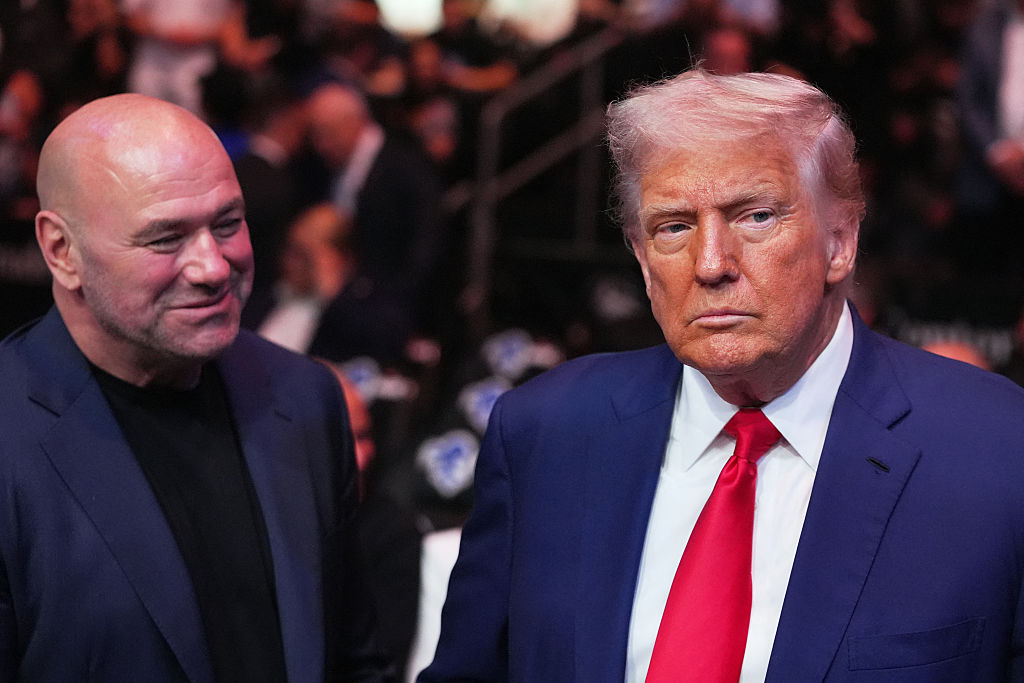
Donald Trump and Dana White attend a UFC event in 2025.

During the 2024 election, UFC President Dana White cemented his alliance with Donald Trump: pro-Trump messaging appeared at UFC events, and White stood alongside Trump on election night. Now he’s coming to the White House to cash in on their friendship. (Frank Franklin II / POOL / AFP via Getty Images)


On June 14, the White House will be hosting an Ultimate Fighting Championship (UFC) event called “Freedom 250.” The date of the event happens to coincide with Donald Trump’s eightieth birthday. Zac Brown will perform the national anthem for Freedom 250, which can boast generous sponsorship from the crypto industry.

The Freedom 250 extravaganza doesn’t come as a bolt from the blue. Over the past decade, the UFC and its president, Dana White, have moved steadily toward the Republican right in general and Trump in particular.

Donald and Dana

White’s relationship with Trump dates back to the early 2000s. Trump hosted UFC events at his Atlantic City properties at a time when the promotion was struggling for mainstream legitimacy, and White has repeatedly credited him with giving the UFC a platform when few others would.

That origin story, with its loyalty forged in marginality, has become a cornerstone of their public friendship. But what began as a business relationship has evolved into something far more explicitly political. White spoke at the 2016 Republican National Convention on Trump’s behalf, framing him as a fighter who, like a UFC athlete, perseveres against the odds.

By 2024, that alignment had deepened further as Trump became a regular presence at UFC events, entering arenas to roaring applause, often seated cageside in full view of the broadcast cameras. The UFC, in turn, leaned into the spectacle. Broadcasts lingered on Trump’s entrances, fighters greeted him, and the UFC production staff folded the crowd’s loud, emphatically positive reactions into the show itself.

During the 2024 election cycle, pro-Trump videos and messaging appeared at UFC events, blurring the line between sports entertainment and political rally. The Octagon, already a site of symbolic combat, became an arena where political identity was performed as much as athletic prowess.

On election night, Dana White stood on stage alongside Trump and Joe Rogan. This was a convergence of sports, entertainment, and right-wing populist media that captured the cultural coalition coalescing around Trumpism.

On April 11, 2026, the broadcast of UFC 327 began with Trump entering the Miami arena with his adult children and Secretary of State “Little” Marco Rubio to the presidential tones of a Kid Rock song. As peace talks with Iran were collapsing in Islamabad, the American president spent the next three hours sitting among the likes of Andrew Tate, Guy Fieri, and Joe Rogan at the Octagon fence.

The UFC fan base, for its part, has increasingly reflected this alignment. While certainly not monolithic, the promotion’s audience has shown strong currents of support for MAGA. Arena chants, social media discourse, and the celebratory reception Trump receives at live events are overwhelming.

None of this means the UFC is formally a political organization. But it does mean that it operates within a distinctly politicized cultural ecosystem, one in which certain narratives resonate more than others, and where symbolic gestures can take on amplified ideological meaning.

Selective Mourning

The Octagon is a stage where regulated brutality is sold. But occasionally, the UFC asks us to look at violence differently. It asks us to mourn. In rare moments, the promotion pauses its relentless churn of pay-per-view spectacle to honor the dead or the wounded.

On such occasions, a name appears on the cage or a decal on the door. These gestures are meant to humanize the enterprise, suggesting that beneath the blood and branding there is a caring community. But who gets remembered, and how, is never neutral.

Unsurprisingly, the UFC has run a series of events for veterans, such as the Fight for the Troops trilogy in 2008, 2011, and 2013, which were held at Fort Bragg, Fort Hood, and Fort Campbell, respectively. These were hyperpatriotic, hypermasculine celebrations of militarism featuring fighters such as Tim Kennedy, the Green Beret turned Trump-adjacent darling of the manosphere who was recently exposed for stolen valor and a host of other lies.

The UFC’s recent decision to display the name of Maya Gebala, a twelve-year-old girl who survived a mass shooting in British Columbia, during events in Vancouver, Houston, and Miami, fits into a small but telling pattern. Alongside past honors for figures like Charles “Mask” Lewis Jr and Shalie Lipp, Gebala’s name was physically inscribed into the architecture of the sport, on some of the company’s most prized advertising real estate.

Placing the name of a child with no commercial attachment to the sport directly onto the cage itself was unprecedented. Dana White reportedly reached out to the family and offered to cover medical expenses. The gesture was widely praised, and, at first glance, it is difficult to object to acts of generosity toward victims of horrific violence.

However, gestures are also signals. In the UFC’s case, they reveal a politics that is far more selective, and far more ideological, than the promotion is willing to admit. White’s incredibly generous offer also raises questions as to why he singled out this particular tragedy. Transphobia may be the explanation.

Spectacle of Compassion

The UFC has no formal platform on gun violence. It does not lobby for legislation or issue policy statements. Instead, it responds episodically: donating $1 million after the 2017 Las Vegas shooting, offering financial support to individual victims, amplifying stories of resilience. (We should also note that the UFC itself is based in Sin City, and its most important bouts take place in Vegas mega-casinos.)

This is philanthropy as branding: reactive, personalized, and carefully contained. It allows the UFC to appear compassionate without ever confronting the structural conditions that produce the violence it mourns.

The tribute to Maya Gebala fits this pattern perfectly. It is an individualized response to tragedy, stripped of political context. There is no discussion of gun laws, no interrogation of systemic failures. It appears as just a name on a cage, a story of survival, and a promise of support.

In this sense, the UFC’s approach mirrors a broader trend in American corporate culture: the privatization of empathy. Social problems are reframed as opportunities for charitable intervention, rather than collective action, in a politics of sentiment rather than substance. But the story does not end there.

Naming and Framing

What makes the Gebala tribute politically significant is not just that it happened, but how it has been framed, and by whom. In the weeks following the shooting, right-wing media and social media networks seized on one particular detail: the identity of the perpetrator, described as a trans woman. The tragedy was quickly folded into a familiar narrative — one that casts transgender people as threats and aberrations.

Within hours of the horrific murders on February 10, transphobic reactions were spreading on social media. Two days later, British Columbia’s Human Rights Minister Kasari Govender issued a statement condemning “the anti-trans disinformation and the hateful narratives that are being spread.”

The UFC did not explicitly endorse this framing. Dana White did not publicly comment on the shooter’s identity, and the Octagon tribute made no mention of it. The UFC press officers did not reply to email inquiries for this story. But in a media ecosystem where that framing was already ubiquitous, silence can be as meaningful as speech.

By elevating Gebala’s story without contextualizing the broader discourse surrounding it, the UFC created a space in which that discourse could flourish unchecked. The tribute became a kind of blank canvas onto which others could project their own interpretations, some of them explicitly transphobic.

For viewers already inclined to see transgender people as dangerous, the combination of a mass shooting, a trans perpetrator, and a high-profile tribute to a victim can reinforce existing prejudices. The UFC does not need to say anything explicitly, as the narrative assembles itself.

Politics of Recognition

When the UFC chooses to honor someone in the Octagon, it is making a statement about who belongs within its symbolic universe. For example, Charles “Mask” Lewis Jr, a key figure in the sport’s early commercialization, is permanently memorialized on the cage.

Mask was a cofounder and comic-book style spokesperson for Tap Out, one of the pioneering brands of mixed martial arts (MMA) culture. He and his colleagues SkySkrape and Punkass got their start selling T-shirts out of the trunk of a car in the parking lot of MMA and Brazilian jujitsu events in 1997.

Just before his 2009 death while street racing his Ferrari, Mask projected company earnings of $225 million. Regardless of the aesthetic value of Tap Out graphic tees, his contributions to building MMA as a commercially viable spectator sport are undeniable.

Shalie Lipp, an aspiring fighter whose life was cut short in a car accident, received a tribute that connected her story to the dreams the UFC sells. It was also a way for the UFC to virtue signal its support for female fighters without doing anything substantial about it. Alison Dean’s Seconds Out: Women and Fighting is an excellent analysis of the sexist hurdles faced by female boxers and MMA fighters that details the UFC’s complicated history promoting women in the overwhelming homosocial environment.

Maya Gebala’s inclusion extends this logic. While she is not part of the sport, her story can be integrated into its narrative of overcoming adversity and fighting back. However, there are countless victims of gun violence whose names never appear on the Octagon. The question is not just why Gebala was chosen, but what her story allows the UFC to do.

It allows the promotion to present itself as compassionate without challenging the structures that produce violence. In the current political climate, it also intersects with a discourse that casts transgender people as dangerous outsiders.

Beyond the Cage

None of this is to suggest that the UFC should not honor victims, or that Dana White should not offer financial support to those in need. These are, in themselves, positive actions.

However, in a media landscape where symbols carry enormous weight, the UFC cannot pretend that its gestures exist in a vacuum. The names it places on the Octagon and the stories it chooses to amplify form part of a broader political field.

That field now includes a close, highly visible relationship between the UFC’s leadership and Donald Trump. The relationship shapes how audiences interpret everything from a fighter’s walkout to a victim’s name on the cage.

The Octagon is a controlled environment, and the violence within it is regulated and contained. Outside, things are far messier. The UFC is no longer just a sports promotion but a cultural node within a larger political project. Its signals echo far beyond the Octagon.