Americans: We’re Broke. Donald Trump: No, You’re Not.
Donald Trump and the Republicans are insisting the economy is great and unhappy Americans are deluded. Just like Democrats under Joe Biden, they’re lying to themselves and everyone else — and will eventually pay the price.
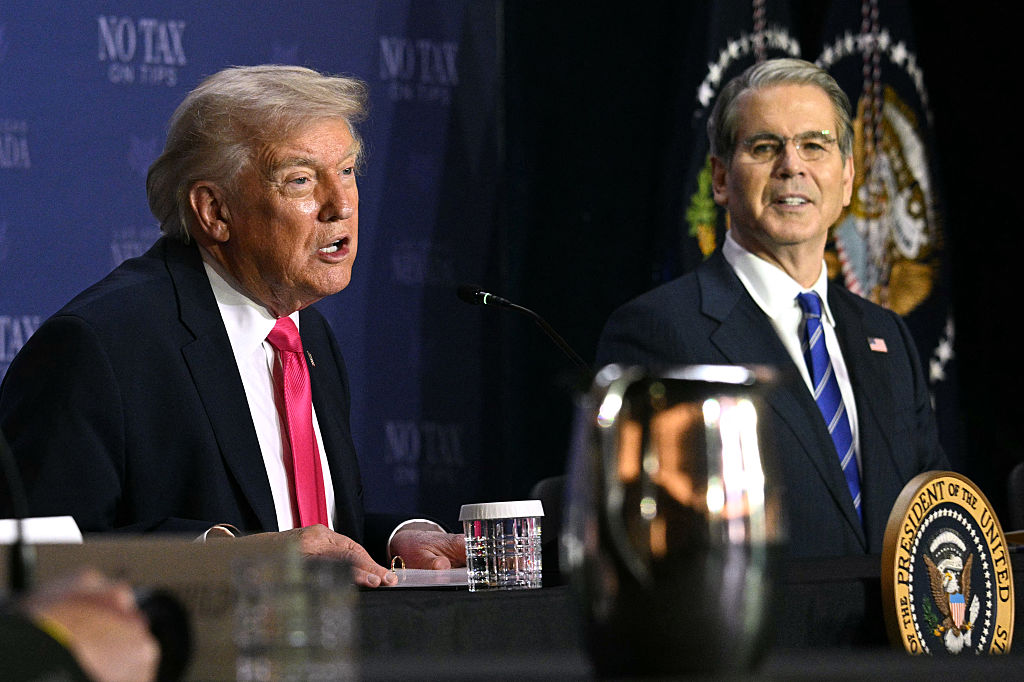
Donald Trump’s strategy of telling Americans that everything about their economic prospects is rosy while they repeatedly state that they’re suffering in an unaffordable economy is a tried-and-true recipe for failure. Just ask Joe Biden. (Jim Watson / AFP via Getty Images)
Not long ago, when Joe Biden was running the show, I pointed out again and again (and again) that countless metrics showed Americans were not having a good time economically, and that Democrats fixating on glowing macroeconomic stats and telling themselves the public was deluded would not change this — in fact, that it would eventually lead the party to political ruin. This was exactly what happened, as Donald Trump and the Republicans rode the wave of public discontent with the economy to the White House and control of Congress.
Now it’s Trump and the GOP who are repeating the exact same mistake that led Democrats to lose to them two years ago.
“Look in their heart of hearts, they feel good,” Treasury Secretary Scott Bessent recently said when asked about Americans’ dismal view of the US economy. “I’m not sure what they’re telling the survey people.”
At various times, Trump himself has asserted that “everything’s doing really well” and gave the US economy under him the grade of “A-plus-plus-plus-plus-plus,” claiming that “prices are coming down substantially.”
“I don’t think the people really feel as bad as the Democrats are talking about. The economy is doing well,” one of Trump’s loyal media boosters, Fox News host Maria Bartiromo, insisted.
“It’s phenomenal! That’s a big number!” another one, former Trump economic adviser Larry Kudlow, told Fox viewers about a recent GDP growth figure, in response to news about price rises. “And shows you how resilient the economy is. Business is strong. Profits are booming. That’s why the stock market is hitting all-time records.”
But as Bessent alluded to, what Americans are “telling the survey people” is a very different story compared to what Fox News hosts are telling Americans.
A record 55 percent now tell Gallup that their personal financial situation is getting worse, the fifth straight year that number has ticked up, and worse than any year of the Great Recession. More than 70 percent of Americans told a CBS News poll they’re struggling to afford food, housing, and other essentials. More than half told CNN the word “uncertainty” describes what they think about their financial futures. Young people are particularly pessimistic, with 81 percent of them rating the economy “bad” or “terrible.”
Nearly two-fifths of Americans still can’t afford to cover a $400 emergency, according to the Federal Reserve’s most recent “Economic Well-Being of U.S. Households” survey covering 2025 — the same exact proportion that said they couldn’t in the bad old days of 2024, and that said this all the way back in 2022, a year that saw the weakest self-reporting of Americans’ finances in years. This is roughly the same share that also told Morning Consult last year they either couldn’t cover that amount (18 percent) or would have to turn to a noncash equivalent to do so (25 percent), like a credit card, a loan, or selling something.
It’s not just price increases that are a worry. The share of Americans who told the Fed survey that “finding or keeping a job” was a concern ticked up five points from a year earlier, including a four-point uptick among those who found it a “major concern.”
Americans’ anxieties about health care costs are as high as ever, according to the most recent Kaiser Family Foundation polling, and in some respects have actually grown. The share of adults reporting that they had cut back on medication in various ways due to costs grew to 43 percent this year, a ten-point rise from 2025.
Okay, but if Americans really are as deluded as Trump and his people say, then maybe they’re just not answering these questions accurately. They might feel like they’re struggling with their finances, but that doesn’t mean they really are. It’s an insulting and elitist view cribbed directly from the previous Democratic administration, but let’s indulge it for a moment.
Unfortunately, there’s plenty of data that suggests that’s not the case.
Foreclosure filings spiked 26 percent from the same time last year in the first quarter of 2026, hitting a six-year high. In other words, the last time Americans filed more foreclosures was when the pandemic forced the economy to practically shut down. This is being driven by the spiking cost of home ownership, not just higher house prices and interest rates but soaring condo fees and insurance rates.
Foreclosures on home loans backed by the Federal Housing Administration (FHA), a New Deal–era agency created to boost home ownership, leaped 28 percent over the year to this past March, after Trump ended several pandemic-era Biden policies helping homeowners who were behind on their mortgage payments. Trump essentially repeated a fatal mistake Biden himself had made.
At the end of last year, FHA loans hit their highest delinquency rate since 2021, though delinquencies were up across the board for every type of home loan, according to the Mortgage Bankers Association’s National Delinquency Survey. According to the Federal Reserve Board’s most recent Financial Stability Report, the early payment delinquency rate among near-subprime and subprime borrowers — meaning, the share of mortgages that went delinquent within a year of being opened by borrowers with poor credit scores — is above its historical median.
Delinquency rates in 2026 for auto loans (40 percent), mortgages (21 percent), and especially credit cards (57 percent) are way up from where they were during and before the pandemic. After a major dip, thanks to pandemic-era programs that eased the burden on student loan borrowers, delinquencies on that front are nearing their pre-pandemic numbers, with roughly 3.6 million defaulting over the previous two quarters alone. Survey data shows that these defaulted borrowers are increasingly older, over fifty years old, and were not behind on their payments before the pandemic — suggesting that it’s Americans who were doing okay financially before who are now increasingly struggling to keep their heads above water.
This lines up with data from the National Foundation for Credit Counseling, a nonprofit network of credit counselors. Earlier this year, the organization reported that the level of US financial stress is the worst since it started tracking it in 2018, and that the profile of the typical American seeking credit counseling had drastically changed. Before the pandemic, it had been a person earning roughly $40,000 a year, with a debt worth a quarter of their income. Today it’s someone making around $70,000 a year whose debt is half that number.
According to the most recent data, farm bankruptcies skyrocketed 46 percent in 2025 with 315 filings, likely indicating much broader suffering, as only certain farms qualify for Chapter 12 bankruptcy. Since Trump’s war on Iran choked off the supply of vital commodities, 70 percent of farmers say they can’t afford the fertilizer they need. Bankruptcies more generally went up 11 percent over the calendar year 2025, the third straight year they’ve increased, with the biggest growth happening among nonbusiness bankruptcies.
All of this suggests that metrics dating to 2024, which in a number of cases are the most recent data we have, are far from limited to that year. Harvard’s Joint Center for Housing Studies’ 2026 biannual rental housing report found that cost-burdened renters — meaning anyone spending more than 30 percent of their income on rent and utilities — hit another all-time high in 2024. (The 2025 and 2026 data won’t be released until 2028). That report found that higher-income households were increasingly falling into this category, with the biggest growth of cost-burdened renters taking place among those making $45,000–$74,999 a year.
Alongside this was what the National Alliance to End Homelessness called “an unprecedented rise in homelessness” of 18 percent from 2023 to 2024, also the most recent data from the organization. At the same time, the number of utility shutoffs nationally, collected for the first time in 2024 and published last month, outstripped by millions what analysts had estimated would be the total. It’s backed by a data analysis by the Washington Post of utilities in eleven states, which found there had been a rise in disconnections in at least eight of them from 2024 to 2025.
Maybe most ominous is what has been recently reported by businesses traditionally favored by lower-income consumers. Executives at Dollar Tree, Walmart, and McDonald’s have all said not only that they are seeing larger shares of high-income earners shopping at their stores but also that the low- and medium-income households that have traditionally been their bread and butter are struggling.
Dollar Tree CEO Michael Creedon said on a fourth quarter earnings call that the company “grew households across all income cohorts” and at an “accelerated rate,” but that “in the middle to higher income households, we see accelerated trade down.” In other words, more affluent shoppers who normally wouldn’t be caught dead in one of their stores are increasingly turning to low-cost retailers to spend less.
“We had a lot of growth with customers who are income bracket of $100,000 or above, and that’s pretty consistent with the last few quarters,” Walmart CEO John R. Furner said this past February. “The lower income segment $50,000 and below, we did see, of course, as we mentioned, some stress. In many cases, we see people living paycheck-to-paycheck.”
“We’re seeing, you know, solid growth, good growth with higher income and also gaining share with higher income for us,” McDonald’s CEO Chris Kempczinski said on an earnings call for the first quarter of 2026. “That lower income, while the declines are not as pronounced as they were, maybe, you know, six or twelve months ago when we were talking about high single digit, the low income is absolutely still declining.”
In other words, lower-income Americans are cutting back their spending on even low-cost consumer goods, and higher-income households, even those making six figures, are turning to those budget options, which they have tended to shun. This does not paint a picture of an economy that’s working particularly well for anyone, and in fact, suggests that the “K-shaped economy” — where low-income households cut back spending but high-income households keep the economy propped up by spending even more — may be slowly turning into a “backslash economy,” where everything is trending down.
That both Democrats and Republicans and their respective loyalists have just wholesale swapped talking points about this speaks to more than just the polarization that shapes how many Americans look at their country. It speaks to a political and media elite that is, no matter their party or ideology, blissfully out of touch with the lives of the people they’re meant to be serving, and which, owing to its own exorbitant wealth, simply experiences an entirely different economic reality from most of the US public.