The Economy Is on the Brink
We’re heading into what could be a rough economic patch with the worst leadership imaginable.
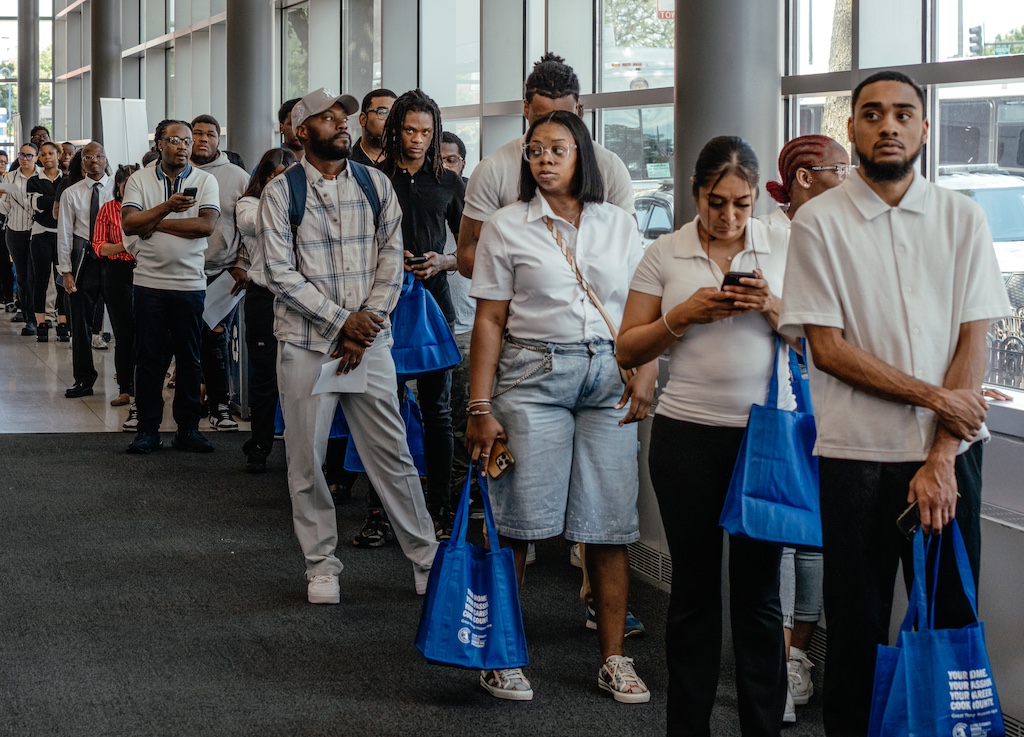
Job seekers wait in line to enter a job fair hosted by the Cook County government in Chicago to support federal workers who have been laid off. (Jamie Kelter Davis / Bloomberg via Getty Images)
It’s been a rough few months for economic data parsers. The federal government shutdown meant an interruption of the usual torrent of official statistics, and those of us who use those numbers to make sense of the economic and social world were wandering around in the dark. Yes, there were some private sector stats, but, lacking rigor, transparency, material disinterest, and long histories, they were weak substitutes for the real thing.
The torrent has returned, with lots of backlog to catch up on. On November 20, the monthly employment report for September from the Bureau of Labor Statistics (BLS) was published; it was originally scheduled for release on October 3. And on December 16, we got the reports for October and November together; October would normally have been released on November 7, and November on December 5. The monthly employment reports are probably the best single look at how “the economy” translates into people’s material lives. The latest trio do not make for inspiring reading: job growth was weak and unemployment continued its upward climb.
Before going into detail, a few technical notes. That monthly employment report draws on two surveys, one of 60,000 households, the other of 121,000 employers, known as the payroll or establishment survey. These are very large surveys; a typical opinion poll samples only around 1,000 people. The payroll survey is the source for news items like “employers added 64,000 jobs in November” (which they did); the household survey is the source for, most prominently, the unemployment rate, though it also provides plenty of demographic data on employment (age, education, race, sex, full- or part-time, etc.).
Because of the shutdown, the BLS was unable to conduct the household survey for October, the first miss since the monthly survey began in 1948. Because employers file their reports electronically, there was no gap in the establishment survey.
A few words about each survey. Total employment by the establishment measure fell by 105,000 in October and rose by just 64,000 in November. (For context, there were 159.6 million jobs in November.) The reason for October’s big loss was a decline of 162,000 in federal employees. Donald Trump’s cuts had been showing up gradually in the earlier months of this year, but this was a big hit. It fell another 6,000 in November. Since January, federal employment is down almost 300,000, from 3.0 million to 2.7 million, a 9 percent decline. As a share of total employment, 1.7 percent, it’s the lowest it’s been since monthly payroll numbers began in 1939. Somehow the idea that federal employment is bloated and out of control has taken root, but its share of the total has been falling with little interruption since peaking in 1952.
But private employment did little to offset the federal carnage. Over the two months together, private employers added 121,000 workers, a number that would have been a weak gain for a single month by recent standards. Several important sectors — finance, retail, manufacturing, transportation and warehousing, professional and business services, and leisure and hospitality — either barely gained or lost workers. Losses in individual sectors below a modest headline gain are not healthy signs. Nor was the gain for the year ending in November dazzling: just 0.6 percent, less than half its rate at the beginning of the year.
Sometimes the household and payroll surveys paint different pictures, leaving honest analysts confused and those with a line to sell promoting the appealing one as telling the “real” story. Not this time: both stank.
The household survey’s count of employment rose an average of 48,000 over the two months, less than a sixth the 2024 average. (On the household measure, there were 163.7 million people employed. The establishment survey counts jobs; the household, people with jobs.) Of those gains, 1.3 million were part-time — more than the total because full-time employment fell by 983,000. Of the part-timers, three-quarters were classed as “part-time for economic reasons,” meaning they wanted full-time work but could only find part-time. The unemployment rate crept up to 4.6 percent, up 0.4 over the year and the highest it’s been in over eight years (bracketing the crazy pandemic months). Black unemployment rose to 8.3 percent, up almost two points over the last year; teen unemployment to 16.3 percent, up over three points.
It wasn’t a disastrous report, but it did have a pre-recession feel. The slowdown in employment growth and the upward creep in the unemployment rate look a lot like things did in late 2007, just before the onset of the Great Recession. And it’s possible things are worse than they seem. Among other things, the deportations are a real challenge to the BLS statisticians, and Federal Reserve chair Jerome Powell, who is plugged into a formidable intelligence network of employers, bankers, and analysts, thinks employment growth is actually close to zero. But with inflation stubbornly high — though we’ll get two more reports on consumer prices before the central bank’s next policy meeting on January 28, so that outlook could change — he may not be in the mood to cut interest rates.
Recessions are bad, though they are a recurrent and apparently inevitable feature of life under capitalism — we’ve had thirteen of them since the end of World War II, or one every six years. What’s striking about the current conjuncture, as the theoryheads say, is that the structural problems of the American economy are more important than where we are in the boom-and-bust cycle. Spending on artificial intelligence (AI) data centers by a handful of tech firms in increasingly large and increasingly borrowed sums has been pretty much the driving force of economic growth over the last year or so, even though there’s little evidence of an economic payoff from that frenzy. (It recently emerged, for example, that almost no one is using Microsoft’s Copilot, which is happy news for Office users.)
Aside from the AI frenzy, there’s not much dynamism around. Trump is doing his best to destroy what could be dynamic sectors of the future, like clean energy and transportation, but in his atavistic love of fossil fuels and gas guzzlers, he’s ceded leadership in those fields to China. Same with his war on science. And deporting immigrant workers, whom J. D. Vance and friends blame for all our problems, is more likely to reduce native employment than expand it.
We’re heading into what could be a rough economic patch with the worst leadership imaginable.