Pay Close Attention to Trump’s Affordability Rhetoric

Donald Trump’s State of the Union was mostly lies and grievances. But his aggressive play for economic populism — borrowing progressive ideas and branding them as his own — should be a warning for Democrats to get serious about affordability.
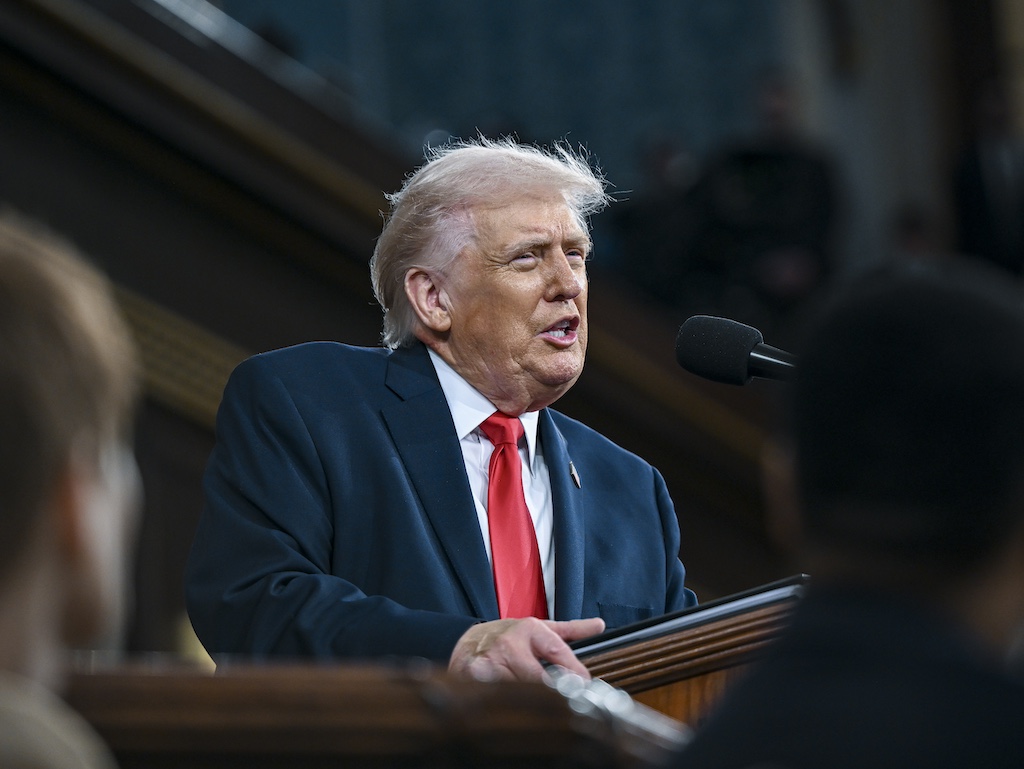
Donald Trump went beyond rhetorical flourishes in his State of the Union address, seeming to take the speech as an opportunity to aggressively occupy the populist lane. (Kenny Holston / the New York Times via Getty Images)

In last night’s State of the Union address, Donald Trump described an America beyond recognition, one where prices are way down, wages are way up, jobs are plentiful, housing is affordable, war is over, prescription drugs are basically free, and violent crime is nearly nonexistent except when perpetrated by undocumented immigrants. During this extended fantasy of an alternate United States, rid of every pressing problem other than those pinned solely on Democrats, almost everything out of Trump’s mouth was shameless spin or a bald-faced lie.

But while the nation’s fact-checkers work overtime, it’s worth taking a step back and admiring the speech’s focus on affordability. Not admiring Trump himself, whose litany of grandiose claims insults the intelligence of Americans who know exactly what they’re making and spending, but observing with some astonishment his eagerness to play the economic populist.

Trump is no stranger to mimicking economic populist rhetoric. Just months after announcing his first presidential campaign in 2015, he admitted to CNN that he had watched Bernie Sanders talk about trade and decided to crib lines for his own speeches. He did much the same last night, at one point postulating that a worthy government “answers to the people and not the powerful” — strange stuff coming from a billionaire who flagrantly operates a patronage network of other superelites keen to exchange money for influence.

But Trump went beyond rhetorical flourishes in last night’s address, seeming to take the speech as an opportunity to aggressively occupy the populist lane. For one extended section, he even presented a series of preexisting progressive economic ideas as his own.

First, he touted his Trump Accounts idea, which is just a personally branded version of the “baby bonds” policy championed by Cory Booker and Ayanna Pressley and backed by Bernie Sanders, Alexandria Ocasio-Cortez, and Elizabeth Warren.

Then he upped the ante by plugging his administration’s effort to stop large institutional investors from buying single-family homes to add to their expanding rental portfolios, thus jacking up housing prices for profit. A closer look at the Trump administration’s actual offerings on this front reveals a smattering of half-measures, but the spirit is remarkably consistent with left-wing economic principles. Trump said that he wanted “homes for people, not for corporations.”

The cherry on top: the president said that the nation “must also ensure that members of Congress cannot corruptly profit from using insider info in the stock market.”

Stock trading among members of Congress has been a cause célèbre of the progressive wing of the Democratic Party for over a decade. This has put them in conflict with more conservative Democrats, many of whom are wealthy stock owners and traders themselves — including party leader Nancy Pelosi, who was involved in a yearslong swirl of outrage over her husband’s uncanny stock‑picking and her own reluctance to back a real ban on congressional trading.

Trump cannily exploited this intra-party division. When several Democrats applauded his line, Trump mocked them, saying, “They stood up for that, I can’t believe it. Did Nancy Pelosi stand up, if she’s here? I doubt it.” Trump then took ownership of the issue legislatively, saying, “Pass the Stop Insider Trading Act without delay.” The act in question is a Republican-led effort that is a far less restrictive, loophole-ridden version of a Democrat-sponsored bill. Nasty work, but to the average viewer, it was no doubt highly effective.

An Affordability Arms Race?

Later in his address, Trump devoted time to his second administration’s more traditional fare: red-meat culture-war issues that fan the flames of neighborly hatred.

He took his obsession with violent crime committed by undocumented immigrants to such extremes that he even falsely claimed an undocumented immigrant had murdered twenty-three-year-old Iryna Zarutska. In reality, the victim herself was an immigrant refugee, while her killer was American-born.

But the specifics hardly mattered by that point in the speech, which had become a kaleidoscope of libidinally charged signifiers. Worked up by a string of evocative vignettes capturing their most cherished grievances, Republicans gave a several-minute-long applause interlude. What began as approval for Trump dragged on and morphed into a gesture of aggression targeted at the seated and silent Democrats. A prolonged, antagonistic standing ovation is something I personally had never seen before.

By the time Trump’s State of the Union address was complete, the viewer, having been treated to winking election denialism and claims of Charlie Kirk’s martyrdom, is likely to have forgotten the overtures to economic populism in the middle of Trump’s address. But those overtures are the most worth trying to understand.

Trump used the word “affordability” many times last night. He even lapsed into a meta-commentary on the sudden ubiquity of the word, which held a revealing clue as to his own emphasis on the subject. After alleging that Democratic Party policies were responsible for rising prices, Trump somewhat incoherently riffed that “the same people in this chamber who voted for those disasters suddenly used the word affordability — a word, they just used it, somebody gave it to them.”

He’s right, someone did give it to them. That someone is Zohran Mamdani, the democratic socialist mayor of New York, who ran for office on a relentless message of affordability. Since Mamdani’s victory, many Democrats have begun to concede that they need to emulate him. Party leaders strongly resisted the progressive wing’s push to spotlight economic populism throughout the prior decade, even as Sanders and younger democratic socialists like Ocasio-Cortez energized a large portion of their base. Whether humbled by their second loss to Trump or starstruck by Mamdani’s charisma or both, Democrats have started singing a different song.

It remains to be seen whether Democrats are capable of bucking their donors and abandoning their neoliberal dogmas enough to match their words with action. But Donald Trump’s State of the Union speech should make one thing clear: they aren’t the only ones who clocked Mamdani’s success. If the Democrats were paying attention to Trump’s State of the Union, they will understand that Trump’s robust overtures to affordability and economic populism are actually a gauntlet thrown.

To be sure, Trump’s economic populism is profoundly disingenuous. His party’s and administration’s commitment to privatization, deregulation, and austerity are fundamentally incompatible with affordability. Not to mention that the redistributive and regulatory action required to achieve real affordability for the majority of Americans would undermine his own financial interests, and he has no intention of doing that. Trump gave a nod to these contradictions last night when the Republicans in the room, who sycophantically leapt to their feet after nearly every line of his speech, stood and clapped for his stolen progressive agenda items — to which Trump candidly responded that he was surprised Republicans were applauding that.

But given the vacuum created by the Democratic Party’s own decades-long disinterest in the working class, Trump and the GOP don’t need to deliver on economic populism to benefit from it in the 2026 midterms and beyond. They just need to establish convincing ownership over the issue in people’s minds. Trump recognizes that economic populism is a valuable lane, and that the Democrats have left it wide open.

Affordability is the defining political issue of the moment, and whoever owns it wins. The Democratic Party continues to neglect working-class economic issues at its peril. The silver lining of Trump’s lying bluster is that it stands at least some chance of convincing a few influential Democrats to ratchet up their own commitment to economic populism. It would not be the worst thing in the world if the two parties entered an arms race to prove who was serious about raising wages, creating good union jobs, and bringing down the costs of housing, health care, and everyday life. The Republicans would expose themselves as frauds in short order, and the Democrats might accidentally find themselves back in the good graces of the working class.