Liberal Poptimists Tried to Kill Rock. They Failed.
Faced with declining market share and poptimist contempt, rock music once seemed bound for the dustbin of history. But an industry crisis and a moribund liberal political establishment are driving a rediscovery of rock’s potential.
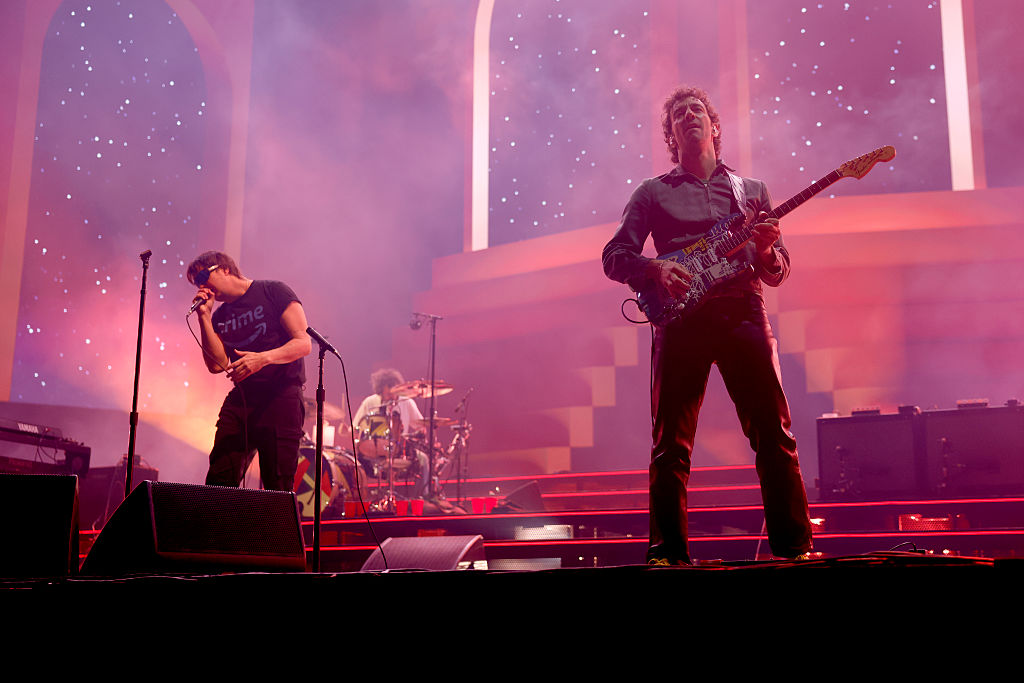
Poptimism has been atrophying, crashing down with the broader form of liberal politics that once empowered it. Meanwhile, rock music is blasting back to life. (Kayla Bartkowski / Los Angeles Times via Getty Images)
The Strokes broke through in the early 2000s with crisp-toned vintage guitars and an unapologetic croon from their lead singer. It was to be a decade marked by a return of sounds from the past.
Despite the vastly different genres, the Strokes, Amy Winehouse, Yeah Yeah Yeahs, Interpol, TV on the Radio, the White Stripes, Franz Ferdinand, and Bloc Party were all part of this wave of “retromania.” Far from hiding it, each of them reveled in it — not only the sounds but the aesthetics, from Winehouse’s beehive hairdo to Interpol’s skinny ties. For the Strokes, their music blended early Tom Petty with arty downtown bands of the late 1960s and ’70s like the Velvet Underground and Television. For Franz Ferdinand, it was 1970s iconoclasts Roxy Music and Gang of Four. For the White Stripes, it went back further to early Delta blues, peppered with a little bit of 1960s garage rock like the MC5.
This isn’t to say it was bad music just because it drew from older styles. Much of it was good, even excellent. Retro-ness had a darker side, though, what cultural critic Mark Fisher identified as a melancholic component, as if certain artists were not just remembering the glory days but finding themselves “haunted” by a “future just out of reach.” For Fisher, this backward turn was a testament to the “slow cancellation of the future,” the death of a meaningful alternative to capitalism.
Today we’re haunted not so much by melancholy as by doomerism — the idea that music is now in decline and will not get any better. In a 2024 poll, Americans ranked the 2020s as the worst decade of music since the 1930s, matched by a significant decline in consumption of current releases. People are especially troubled by AI music — not to mention ghost artists, platform marketing, quasi-payola schemes, and the dominance of streaming. (Oh, good news: you can gamble on music now too.)
Retromania is definitely back, as new artists produce atmospheric, churning hardcore and other sounds of a bygone musical age. A survey of contemporary rock music shows artists aren’t just searching for old-school musical inspiration, let alone mourning history’s lost relics. Instead, they are producing music that is vital and relevant to life in the 2020s.
This latter point is the most remarkable. For over a decade, rock faced predictions of its death and denunciations of its supposedly reactionary fandom — rock, according to its critics, is just too white and too male. Things looked especially dismal given the dominance of poptimism, a critical tendency that ditched rock for easy web traffic and centrist liberalism. For this crowd, all things pop and hip-hop were to be celebrated as the political vanguard. Rock, in the indie form, was the music of the dreaded Infinite Jest–reading white aesthete. In its classic form, it was the music of the right-coded redneck. Both of these figures, and their preferred music, would need to step aside for the future. For progress.
Fast-forward to the present. Rock was one of the fastest growing genres last year, surging not only in the United States and UK but Thailand, Indonesia, and the Philippines. And many great musicians never stopped making records — all the 2000s artists named above (save Winehouse, RIP) have evolved over time and continue to make music.
People are excitedly rediscovering classic rock again, and kids are joking online about the triumphant return of what they’re calling “white boy garage music.” Even butt rock and nu metal are apparently cool again.
Meanwhile, poptimism has been atrophying, crashing down at the same time as the broader liberal cultural approach that once empowered it.
In the exact moment a genuine left is driving history’s rebirth, rock’s fortunes are on the rise. Perhaps it might serve as wellspring for a new alternative.
Pop Ascendant
Rock was a key casualty of the shift to streaming. In 2014, R&B/hip-hop became the most dominant streaming genre, and in 2017, it was recognized as the most consumed genre overall. For years, alarmists zeroed in on symptoms of rock’s coming death, from shrinking electric guitar sales to the fact that in 2021, not a single rock or metal album made Billboard’s year-end 200 albums list.
Rock didn’t go anywhere, but there was a pervasive sense it was in a dire place. Negative sentiment was fueled by artists like Imagine Dragons — who led Billboard’s top rock artists chart in 2017 and 2018 — as well as the popularity of easily hateable über-nostalgic acts like Greta Van Fleet and Mumford & Sons.
While some commentators saw an opportunity for rock to rejoin the underground, others held that rock got what it deserved. As one critic explained, the ascendance of pop, hip-hop, and other genres represented a market correction based on rock’s “lack of cultural innovation, aesthetic appeal, and musical experimentation.”
This sentiment is a paradigmatic example of poptimism, a critical tendency to celebrate pop across the board while downplaying the greatness of rock. The term “poptimism” entered the discourse at least as early as 1987, but it was a 2004 New York Times article by music critic Kelefa Sanneh that turned the concept into a critical touchstone.
Sanneh’s piece didn’t actually use the word at all, instead critiquing its opposite, “rockism.” For Sanneh, rockism meant “idolizing the authentic old legend (or underground hero) while mocking the latest pop star; lionizing punk while barely tolerating disco; loving the live show and hating the music video; extolling the growling performer while hating the lip-syncher.”
His article inspired several years of critical discussion about the virtues of pop music and the duty of critics to repent their rockist sins. Put down that copy of Yankee Hotel Foxtrot and learn to love the Swifties.
In many respects, poptimists were just acknowledging where the market was going. Rock did dominate the early history of popular music journalism and academic scholarship. But a paradigm shift was well underway by the mid-2000s. The poptimists were simply pushing on an open door. Rolling Stone put Madonna on the cover in 1984 and Run-DMC there in 1986. Spanish-language music and hip-hop had earned a place on MTV. Even the once impenetrable gates of the ivory tower had broken down, driven by academic books like Andrew Goodwin’s 1992 MTV study Dancing in the Distraction Factory and Tricia Rose’s 1994 hip-hop monograph Black Noise.
By 1999, Source magazine was the number-one music publication in the United States. That year, the Billboard chart was dominated by pop artists, save an occasional peppering of acts like the Goo Goo Dolls and Sugar Ray — far from the canonic grandmasters preferred by the moustache-twirling rockists.
Ultimately, it was pragmatism, not a poptimist-induced awakening, that saw rockists hang up their spurs. In exactly the moment rock’s market share was dropping and web traffic started paying the bills, editors quickly understood that trumpeting fading legacy artists and hunting countercultural cache was a fool’s errand.
Representative is Pitchfork, which was called out more than once over the years for its rockist tendencies. They spent most of the 2010s apologizing by doling out top scores to Drake, Kanye West, and Beyoncé. In 2015, they even denounced themselves for propagating indie’s whiteness. They were very sorry; they were doing the work.
Today, as they report on North West’s music and the Focker-in-Law trailer, it’s clear what drove the shift.
Poptimism’s Weird Liberal Moralizing
Vague moralism was a key component of poptimism from its birth. Early champions cast rockism as something deeply pernicious, while poptimism was portrayed as an embrace of the democratic culture of the masses.
This view was central to Carl Wilson’s 2007 book Let’s Talk About Love, a poptimist confessional about the author’s own dislike of Céline Dion. Wilson asked why people love (and love to hate) the queen of power ballads, leading him to the conclusion that “myriad pop pleasures meet the heterodox needs of diverse publics.” He further characterized pop fans as the oppressed millions, the “people who, aboard the Titanic, would have perished in steerage.”
In many senses, poptimism was a chess move: out-hipster the hipsters by saying Dion is actually cooler than Elliott Smith. But while revisiting the book in 2014, Wilson doubled down on the democracy claim. He analogized rockists and “men’s rights’ activists,” writing, “If you’re straight, white, relatively well-off, cis-male, Anglo-American or any combination thereof, that can be particularly disorienting, coming from a culture that used to pretend reality did revolve around you.”
There was something telling about commentary like this from the often white men who seemed most anxious about their white maleness. As Wilson explained it elsewhere:
Rock is kind of associated with a bonehead white male kind of thing. I’m not too upset that we’re in that space. But at the same time, I think if I were a teenage boy right now and wanted something to throw down to, right now would be a weird cultural space to occupy.
Poptimism’s vibes are very much those of “White Dudes for Harris.” It’s perhaps no surprise that poptimism became part of the Democratic Party’s cultural front, especially as the party elite went to war against Bernie Sanders in 2016 and 2020. Representative of the poptimism-to-centrism pipeline is the writing of Noah Berlatsky, who penned a New Republic article asking “Why ‘Indie’ Music Is So Unbearably White” before later chastising “Bernie Sanders’s Misguided Attacks on the ‘Liberal Elite.’”
While concocting the “Bernie bro” myth for the anti-Sanders smear campaign, Robinson Meyer made the link clearer. His 2015 Atlantic piece “Here Comes the Berniebro” targeted the white, “very male” fans of the “jangly bearded bands” who clung to delusions about Bernie.
“Indie Bernie” himself was likened to the cooler-than-thou “punk rocker” who “doesn’t see why you’d want to buy designer jeans when thrift store Levis fit just fine and are less than $10.” And despite the fact that he attracted significant support from pop and hip-hop artists — Cardi B, Killer Mike, Halsey — his supporters were characterized as “a who’s who of young indie darlings.”
Nobody cared that Hillary Clinton was backed by Arcade Fire’s Win Butler and Grizzly Bear’s Ed Droste — both of whom were explicitly linked to indie’s whiteness problem a decade before — or that Justin Vernon (Bon Iver) endorsed Harris. They were especially silent in 2024 when Killer Mike warned, “Black voters aren’t stupid. The policy behind the pigment is what’s going to matter.”
Instead, Katy Perry was praised as the “Hillary Clinton of pop” after she laundered Clinton’s ill-fated campaign; she then performed at Joe Biden’s inauguration before running the strategy back for Kamala Harris. Lance Bass joined Harris on TikTok, asking “What are we going to say to Donald Trump in November?” as they lip-synched to NSYNC’s iconic “Bye Bye Bye.” (Maybe they thought it would inspire people to “Pokémon Go to the polls.”)
When Taylor Swift endorsed the vice president, people were ready to call the election then and there. After all, they secured her army, as Team Kamala rushed out to sell Swiftie-style friendship bracelets. Look how that turned out.
The Poptimist Establishment in Decline
The Democratic Party has been in a state of crisis for years, dropping two layup elections against Trump. Lately, they’ve failed to mount even half-hearted opposition, and despite Trump’s sheer unpopularity, the party continues to hemorrhage support from working-class voters — not just white men but every non-college-educated racial group. The media is also losing credibility. Last summer, Sanneh and Wilson revisited poptimism. Sanneh’s piece observed that critics were getting too nice, driving up Metacritic scores with positive reviews and even running a negative review of Swift’s The Tortured Poets Department without a byline.
Wilson (rightly) countered this had less to do with niceness and more to do with how music journalism is getting decimated by layoffs and cutbacks. Even so, he reaffirmed the progressive nature of poptimism, calling it “a first step in the direction of radical pluralism.” Today poptimism lingers as an ideological standpoint and a business strategy, found wherever editors are analyzing calendars to make sure they contain enough symbolic diversity without compromising the search-engine-friendly names.
Representative is a recent New York Times listicle of the greatest living American songwriters. The rankings included SEO-friendly artists like Bad Bunny and Young Thug — neither chosen by any of the acclaimed musicians surveyed by the Times — all while skipping over old-timers and producers who don’t deliver the same traffic: “There is a good answer to ‘Where’s Randy Newman,’ though, that is not nearly so frustrating. The answer is: He’s all over the lists sent in to the Times by his songwriting peers.”
Also conspicuously absent from the list were white male rock artists associated with indie or alternative rock, like Julian Casablancas, Will Oldham, Stephen Malkmus, David Byrne, Jack White, Michael Stipe, Jeff Mangum, Conor Oberst, James Murphy, or Jeff Tweedy. With the lone exception of Stephin Merritt, the list skipped over anyone associated with old Pitchfork or hipster cache, including indie’s women and artists of color — even alt-hip-hop, jazz, and experimental music. For a whole sphere of music, the math simply no longer maths.
Yet despite its enduring power among the establishment, poptimism’s star is fading. People were already rolling their eyes when Hillary and Chelsea Clinton sat down with Megan Thee Stallion to discuss a song about wet pussy. Poptimist cynicism has looked more and more absurd since Charli XCX issued the bewildering proclamation that “kamala IS brat” and platforms started churning out mind-numbing “How do you do, fellow kids?” headlines like “Hillary Clinton is being deemed ‘Mother’ after praising Taylor Swift for publicly endorsing Kamala Harris for president.”
By the time Katy Perry was launched into low-Earth orbit as part of some vague historic gesture, barely anyone was falling for it.
Just as the faux-populism of Democrats’ diversity rhetoric rings like a cynical defense of party capture, it’s obvious that identity-based musical moralism is disingenuous cover for the collapsing line between journalism and clickbait.
As top artists win accolades for their politics while staying silent on pressing social issues, readers issue a bored sigh at the hundredth article saying there’s something urgent about Beyoncé’s Grammy and Harry Styles’ relationships.
Long Live Rock
Faced with a decaying critical establishment and a carceral music industry, it’s no surprise people are turning backward. What is more unexpected is that we’re seeing potent revivals of punk, metal, shoegaze, and other rock genres, marked by a synthesis of old and new.
Veteran artists are flourishing alongside the young revivalists. My Bloody Valentine, a beloved rockist favorite and the band that helped define the shoegaze genre back in the 1980s, just played a massive show at the Royal Albert Hall in London. This might have something to do with the fact that, against all odds, “shoegaze” — a long obscure subgenre of rock from the more provincial regions of the British Isles — is now deeply and shockingly popular with Zoomers and Gen Alpha thanks to TikTok and Spotify.
Moreover, many artists are channeling the past to put forth a genuine political alternative. Groups like Fontaines D.C. and Mannequin Pussy are risking their careers to speak on controversial issues. And artists like Sam Fender, Lambrini Girls, and Maruja leverage the sounds of the past to address the challenges of the present. The genre poptimism declared culturally irrelevant turns out to have a purpose — just not the right party. To be clear, rock doesn’t have a monopoly on good music or good politics; Jesse Welles, billy woods, Kneecap, and plenty of others are part of this rebirth as well. But one of the most deleterious effects of rock’s fall was a narrowing of the political horizon for all genres — pop and hip-hop included.
Change won’t necessarily come just because kids are plugging into Fenders and strumming out power chords. But it certainly didn’t come from bringing Swift into prestige media or demanding voters sing along with anointed Democrat candidates.
Today we have a choice between treading water and championing what music in the 2020s could be. The answer was already out there, when Bernie Bros like Casablancas, White, and Vampire Weekend (and Lil Yachty, Chuck D, and Big Boi) were endorsing Sanders. But today, as legacy media crumbles, industry conditions worsen, and liberal centrism offers no answers, the decision is increasingly clear.
Two decades ago, Fisher challenged poptimism, warning against “being coerced by the pressure of the present into settling for less.”
This April, as the Strokes performed at Coachella, the group backstopped the track “Oblivius” from their 2016 Future Present Past EP with a powerful video montage of leaders who were brought down by US intervention, including Chile’s Salvador Allende, the Congo’s Patrice Lumumba, and most timely, Iran’s Mohammad Mosaddegh.
When it was first released back in 2016, Pitchfork characterized the EP as part of the band’s aging into classic rock and oldies stations, proof of their fading relevance from the world. In 2020, the Strokes followed it up with The New Abnormal. Pitchfork called that album “sluggish and slight, rendering their signature sound as background music.” They awarded it 5.7 out of 10. That same year, Taylor Swift released two albums — Pitchfork gave one a 7.9, the other an 8.0.
But last month at Coachella, as footage of a bombed-out Tehran played with the caption “over 30 universities destroyed in Iran” — all while Casablancas bellowed “What side are you standing on?” — the moment only underscored how they’ve thwarted all the critics’ expectations. The Strokes were supposed to die off and fade away; a relic from rock’s supposed last gasp at the turn of the century. Instead, they’ve rallied to the moment. In their Spotify Popular tracks, four in their top ten — including the first slot — are for songs from that 2020 record. They accomplished this even as the poptimists scolded them to get back in their rockist place.
Today the present coerces us in the other direction. Rock was once the musical vehicle for something more. Maybe it will be again.