The Ramones Spoke for Capitalism’s Leftovers
The Ramones’ legendary self-titled debut celebrates its 50th anniversary this month. More than the blueprint for later political punk, the record spoke for those the system had already forgotten.
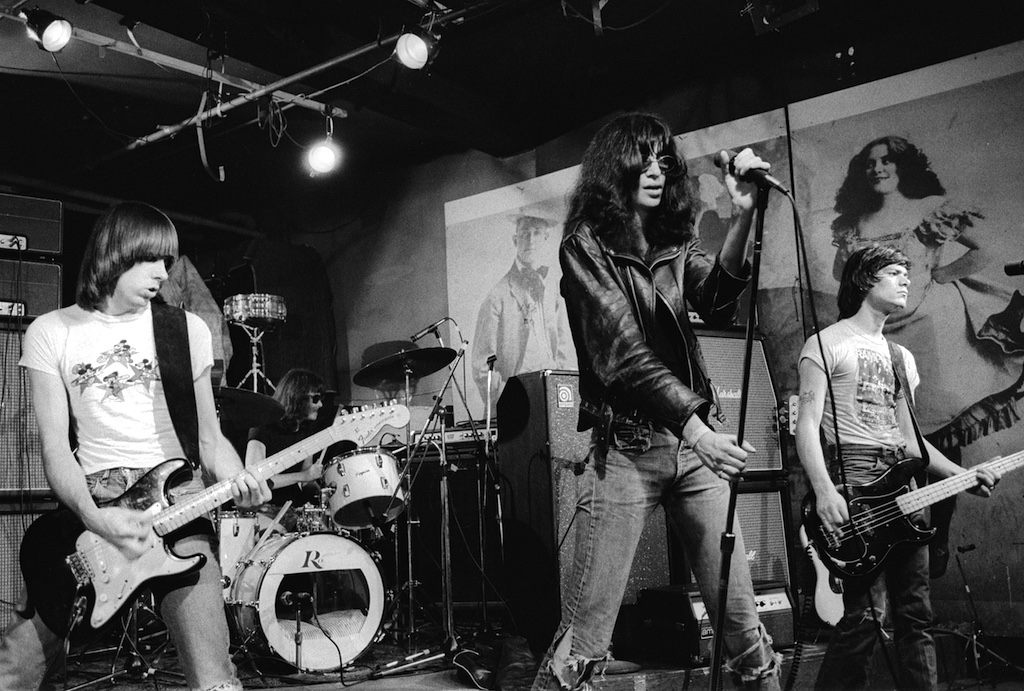
On the 50th anniversary of their debut, the Ramones’s lumpen rock remains a message in a bottle to those left behind. (Allan Tannenbaum / Getty Images)
The Ramones’ self-titled debut album, Ramones, was released fifty years ago this month. Recorded in a handful of days on a shoestring budget and clocking in under thirty minutes, the record has become the stuff of legend.
Long hailed as a key influence on generations of punk, metal, alternative rock, and other genres, the album was added to the National Recording Registry in 2012.
For many people, Ramones has become the quintessential origin point of American punk rock. In its delirious half-hour runtime, it represents the urtext of the short, fast, and loud sound that has reverberated across the decades.
Making sense of the band’s political force is more complicated, and not only because guitarist Johnny Ramone was a conservative who supported Ronald Reagan and George W. Bush. The Ramones lack the open proletarian sensibilities of contemporaries like the Clash, let alone the out-and-out radicalism of Crass, Nausea, and later left-wing acts.
But Ramones represents more than the musical substructure that later political artists built on. The band’s music spoke forcefully for capitalism’s leftovers. They constructed a musical framework from rock and roll’s trash — the unpretentious, raw sounds of the previous decade — all while Peter Frampton, Wings, and Chicago ruled the charts of 1976.
They synthesized this sound with the culture of those left behind: cheap horror movies, boredom, addiction, even hustling — the unglamorous refuse of a society that no longer pretended to care. In this way, Ramones remains an enduring lesson about speaking for all corners of society, not just the already-converted.
Lumpen Rock for Lumpenoids
Unlike the political punk that was nursed in England’s dole queues or New York’s downtown squats, the members of the Ramones grew up in Forest Hills, Queens, a comfortable, middle-class area sheltered from the blight of downtown New York. Drummer and producer Tommy Ramone recalled that, all in all, it was a pleasant place to grow up.
Even so, the young members of the band found themselves drifting away from the American dream and the sense of purpose that effused baby boomer culture. Done in by the boredom and purposelessness that plagued so many, they turned on, tuned in, and dropped out but had nothing to show for it.
The Ramones began experimenting with drugs and alcohol; Dee Dee started selling drugs when he was fifteen and was arrested for armed robbery while hitchhiking to California. Joey, who had begun bouncing through dead-end jobs, was kicked out of his home by his mother.
The boys drifted through subcultures. For a time, Johnny wore his hair down to his waist, held down by a tie-dyed headband. Joey also spent time as a hippie but got into glam, singing for the band Sniper.
But it was classic rock music and underground rockers like the Stooges who really connected the members of the band. By all accounts, the Ramones’ early moments together were a musical disaster. Beginning to play live in 1974, the group fumbled through tracks, collapsed mid-tune, and broke into arguments on stage. In spite of — or because of this — they won a place on the downtown New York underground rock scene, centered on clubs like Max’s Kansas City and CBGB.
The Ramones were helped along by several visionary people. The band found early champions in Rock Scene cofounder and journalist Lisa Robinson, as well as Craig Leon, who went on to produce the Ramones, Blondie, and Suicide. They also received support from Danny Fields, a Harvard Law dropout who hung with the Andy Warhol set and had worked with the Doors, the Stooges, and MC5; he joined with Linda Stein to comanage the band. And after a lengthy negotiation, visionary Sire Records cofounder Seymour Stein agreed to sign the band.
Ramones was recorded in a single week inside Radio City Music Hall, produced by Leon and Tommy Ramone. The album cost $6,400 to record, a fraction of the price that top rock acts were spending in the era. (Fleetwood Mac’s 1979 album, Tusk, cost well over $1 million.) The iconic cover of the record was shot by Roberta Bayley, a photographer who worked for the scene magazine Punk.
Despite excitement about the project, especially from music critics, the album was a flop. As the band’s publicist, Janis Schacht, explained, “The first album only sold 7,000 copies even though I had a two-level horizontal file cabinet: one for the Ramones’ press, and one for all the other Sire acts.”
Critics clearly found something in the record they had been searching for. The great Robert Christgau said of the record: “It blows everything else off the radio.” Writing in Rolling Stone, Paul Nelson observed, “Their first album, Ramones, is constructed almost entirely out of rhythm tracks of an exhilarating intensity rock & roll has not experienced since its early days.”
Central to the album’s praise was how the Ramones delivered a militantly back-to-basics sound that returned rock to its roots.
Nelson also captured this aspect of the band’s sound, observing, “The Ramones are authentic primitives whose work has to be heard to be understood.” Lisa Persky similarly underscored their primitivism, writing, “The Ramones are to rock and roll what the Microwave oven is to cooking.”
The thought was put succinctly the following year by Greil Marcus, who contended that the Ramones made “lumpen rock for lumpenoids.”
“Chain Saw”
The Ramones’ lumpen character is on display right from the rip. The album’s blistering opener, “Blitzkrieg Bop,” has come to embody the band’s no-frill construction. Speaking of revved up kids losing their mind, the track was driven by the inane shout-chorus that has become more iconic than the Bay City Rollers’ 1974 hit “Saturday Night” that inspired the chant.
Even so, the band showcased their profound pop sensibilities throughout the record. That sensibility undergirds the album’s lone cover, “Let’s Dance,” a 1962 dance hit made famous by the Latin rock artist Chris Montez.
“Let’s Dance” was a perfect choice for the Ramones. In many ways, the band turned back to a period before rock received its glow-up via psychedelia, prog, and other genres. The band took inspiration from a simpler moment in rock, drawing influence from acts like Hermans Hermits, the early Beatles, the Dave Clark Five, Elvis Presley, Little Richard, Ricky Nelson, and Dion.
That same sensibility infused many of the band’s original tracks over the years. “I Wanna Be Your Boyfriend” already displayed the band’s ability to extract deep musicality from minimal materials. The track hearkened back to the great teenage love songs of the 1960s, demonstrating how the Ramones remained true believers even as they pushed rock into more aggressive territory.
Despite the clear nostalgia on display on Ramones, the band also tapped into the darker underside of American culture. The role of comic books and horror movies in early punk is sometimes neglected, but horror tropes infused the Cramps’ “Human Fly” and “I Was a Teenage Werewolf,” as well as the first record by the Misfits (who grew up just outside the city and performed there in the ’70s).
The Ramones’ instance of this, “Chain Saw,” referred to The Texas Chainsaw Massacre (1974), a film that explicitly leaned into the trashy and disgusting corners of our world. By tapping into this aesthetic, the Ramones became one of the paradigmatic musical examples of what the great film critic Pauline Kael called trash.
That trash aesthetic had a specific contour in New York, the city that had been symbolically told to drop dead by Gerald Ford the year before. “Now I Wanna Sniff Some Glue” spoke to the drug-induced stupor that fed off apathy and boredom. (A heroin overdose would claim Dee Dee’s life many years later.)
The track “53rd and 3rd," which drew on Dee Dee’s own experiences working as a hustler, captured another hidden corner of city. This was the queer underworld captured in John Rechy’s great 1963 novel, City of Night, which had received a trashier, more outrageous update through LGBTQ punk artists like Jayne County and Mumps.
We’re Outta Here
The Ramones remained strikingly true to the sound they developed and the values they inhabited, touring relentlessly for twenty straight years — barely ever registering on the charts even as they developed a legion of fans and followers.
Fifty years later, New York has changed, as has the world at large. Even so, Ramones remains powerful and potent. It holds force as a model for artists — the stripped down, revved up engine of dozens of punk’s subgenres and offshoots in the decades since.
That sound has gained power as a vessel for political contestation, conveying rage at injustice and allowing artists to speak forcefully and truthfully.
But on a deeper level, their lumpen rock remains a message in a bottle to those left behind, and those who want to speak for the whole working class. It’s a message not just for the already-converted, but everyone left behind by capitalism.