Kim Gordon’s Capitalist Realism

Kim Gordon’s songwriting with Sonic Youth sought to create a space of subversion between art and politics. Her solo LPs move away from such a project: not out of resignation, but because of the difficulty in creating such a space in today’s hyperpolitics. 
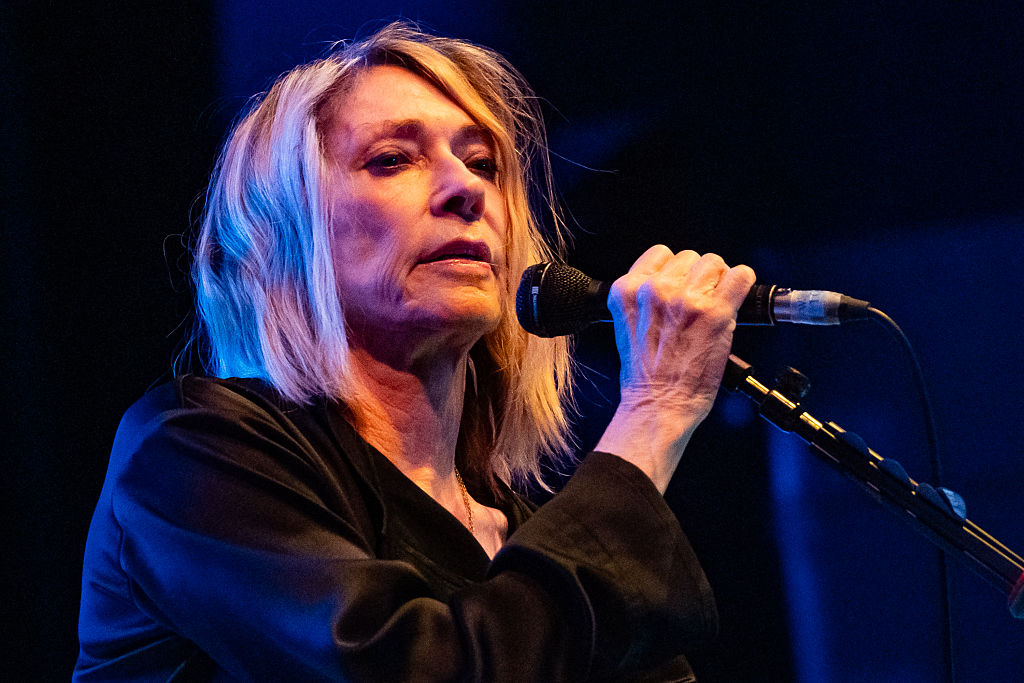
Kim Gordon performs at O2 Shepherd's Bush Empire on April 14, 2026 in London, England.

Kim Gordon’s latest album Play Me asks what political songwriting might look like today. Yet she’s also aware of the exhaustion of attempts to seem transgressive that end up as empty exercises in style. (Lorne Thomson / Redferns via Getty Images)


There is an early moment in Girl in a Band (2015), Kim Gordon’s acclaimed (and recently republished) memoir, where she describes her first performance onstage with a short-lived band called Introjection. The trio included Christine Hahn and Miranda Stanton from The Static, and their one and only performance was at the Massachusetts College of Art and Design. A musical novice but with art-school smarts, Gordon describes her lyrics as “ad copy I’d torn from women’s magazines” with one song titled “Soft Polished Separates” and another “Cosmopolitan Girl.”

With some revision, this improvisational, found-object style that started her career as a musician can still be heard on Gordon’s new album, Play Me (Matador). A lean and brisk LP with twelve tracks at twenty-nine minutes, it extends the hip-hop sound developed on her two previous solo releases, No Home Record (2019) and The Collective (2024), with the assistance of producer Justin Raisen, who has also worked with Charli XCX among many others. Like its music, the album’s lyrics are equally presentist, touching upon AI, Elon Musk, and the Trump administration: you know, the usual late-career subject matter for a canonical singer-songwriter.

Gordon is seventy-three years old — for context, Bruce Springsteen is seventy-six and Bob Dylan is eighty-four — though Play Me is far from being a work of reminiscence or nostalgia. It is, in Gordon’s characteristically experimental way, a political album. Unlike Springsteen, whose response to the fatal Immigration and Customs Enforcement shootings of Renée Good and Alex Pretti was the familiar-feeling “Streets of Minneapolis,” or Dylan, whose recent album Rough and Rowdy Ways (2020) had a seventeen-minute retelling of John F. Kennedy’s assassination (“Murder Most Foul”), Gordon is not inclined to rehash her earlier work or wax poetic on precedents for our current moment.

Play Me asks instead what political songwriting might look like today, in a context where Boomers are aging out and younger artists, whether Phoebe Bridgers, MJ Lenderman, or Cameron Winter, appear more concerned with claiming a genealogy with a previous sound and scene than confronting questions about the broader culture. Gordon recognizes the urgency of speaking to the political present while also bringing a sense of self-awareness about the hazards of doing this. The result is a bracing record that musically and lyrically meets the moment through elements of attention, subversion, and refusal: features that have long defined her artistic career.

I’ll Be Your Mirror

Though trained as a visual artist — for this reason, Gordon can be seen as a successor to women artist-musicians like Yoko Ono and Laurie Anderson — much of her creative ethos derives from her storied career as a founding member of Sonic Youth. Over the band’s three-decade lifespan, Gordon came into the foreground with songs that articulated a feminist view of not just the rock scene, but of American society more generally. Songs like “The Sprawl” from Daydream Nation (1988) and “Swimsuit Issue” from Dirty (1992) delineated the connections between sex and the marketplace and workplace, respectively, and the commodification of women’s lives more generally. The band’s one-off side project, Ciccone Youth, extended this critical approach by cheekily celebrating Madonna. A former denizen of the Lower East Side and its No Wave scene that birthed Sonic Youth, Madonna was a ripe symbol for deconstruction, with the band offering a metacritique of the commerce and cultural tastemaking she represented by the late 1980s.

With its awkward drum machines, tape loops, and sampling of Madonna’s music, Ciccone Youth’s only release, The Whitey Album (1989), also experimented with hip-hop techniques. Tracks like “Into the Groovey” ventured beyond Sonic Youth’s usual rock setup while still retaining their guitar-based sound. This nascent interest was elaborated on Goo (1990) with Chuck D. and Gordon passing the mic on the hit single “Kool Thing” — “Fear of a female planet?” she teases at one moment — which was the result of Sonic Youth and Public Enemy sharing studio time at Greene St Recording in SoHo. Gordon’s distinctive speaking vocal style, which resembles that of the Velvet Underground’s Nico, easily transferred to this uptown genre.

Rather than a radical conceptual turn, Gordon’s unapologetic swagger on Play Me and its predecessor, The Collective, therefore sounds like a late-career culmination. It feels more than right. Her first solo effort, No Home Record, set her in this direction, albeit tentatively. With its tonal contrasts between shattered, blown-out beats and quieter, piano-driven interludes, the opening track on that album, “Sketch Artist,” amounts to being a mission statement, the title itself implying a first draft. Yet the following track, “Air BnB,” reverts to a more rock-oriented sound, suggesting that she hadn’t completely dispensed with her Sonic Youth past. The remainder of the LP is largely defined by this provisional dialectic between her former band’s instincts and the pull toward a different artistic horizon.

The musical shift found on No Home Record further reflected a change in Gordon’s personal life. The breakup of Sonic Youth followed shortly after the dissolution of her nearly three-decade marriage to cofounder Thurston Moore, which Girl in a Band addresses with moments of excruciating detail. Their relationship had not only stabilized Sonic Youth, but it was emblematic of the possibility of having a groundbreaking artistic career without sacrificing a secure personal life.

No Home Record is, consequently, an expression of emotional dislocation and the task of starting over, of working through imposed circumstances beyond one’s control, and of finding renewal in uncertainty. By the bleak final track, “Get Yr Life Back,” Gordon scales up this individual ennui to a societal level. “The end of capitalism, winners and losers,” she whispers against a nightmarish backdrop of industrial reverb and factory percussion, questioning what relevance the personal can have in a time of political polarization and planetary crisis. “There are no truths anymore, and the rain keeps on.”

Gordon’s method since then has been to hold up a mirror to the present, continuing her departure from the conventions of lyrical storytelling. Like the ad copy of her earliest work, the lyrics on The Collective and Play Me come across as borrowed from elsewhere rather than purposefully written. They resemble offhand notes-to-self, snippets of overheard conversation, or keywords drawn from media and public discourse. Gordon decenters herself in favor of letting the social filter through her music. In the same way that hip-hop has often salvaged and reassembled the passages and phrasing of soul and R & B, Gordon has adopted the role of a verbal bricoleur.

To wit, the first single from The Collective, “Bye Bye,” has Gordon going through a to-do list before leaving on a trip, a mundane yet relatable tabulation that becomes a commentary on the banal necessities of contemporary life. This observational approach that informs The Collective extends to other realms of public discussion and preoccupation, including toxic masculinity (“I’m a Man”) or the encroachment of technology and the loss of the human factor (“The Candy House”).

The result is not so much an LP of topical eclecticism or an effort at indexing social ills, but a tacit argument about the connections between these scattered subjects that flourish malignantly when they are not perceived as part of a cultural whole. Gordon does not pretend to have any answers on The Collective. Still, her renewal of ambition post-marriage, post-band, and post-rock appears fixed to these broader questions.

Not Today 

“We’re post, right?” Gordon asks her listeners with a verbal wink on the track “Post Empire” from Play Me. Her new album is looser and more settled than its predecessor, but it is no less political. If The Collective drew inspiration from Jennifer Egan’s speculative fiction novel, The Candy House (2022), a multicharacter, polyphonic work that questioned the destabilizing effects of the technological on the personal, Play Me goes further to delineate the boundaries between these two aspects. The track “Black Out” conveys the grim claustrophobia of a world with AI and Donald Trump, while “Dirty Tech” delivers a more playful (and ironic) take on sex, technology, and the workplace (“I like it when you talk dirty tech to me”). On “Subcon,” Gordon rhetorically asks, in a veiled swipe at Musk, “You wanna go to Mars, and then what?”

Gordon has long held an interest in sci-fi — “The Sprawl” mentioned earlier revealed the influence of William Gibson — but her sense of futurism on The Collective and Play Me is more immediate. Her engagement with contemporary figures and the way the marketplace of late capitalism shapes everyday life demonstrates her nonconformist approach to political songwriting, one unaligned with a tradition involving figures like Pete Seeger or Joan Baez. As with her past work, Gordon is concerned with matters of agency and complicity. As a recording artist, she is conscious of her participation in sustaining the systemic conditions of the capitalist marketplace and the risks entailed, those of reinforcing gender norms or elevating profit over art.

While Gordon’s songwriting with Sonic Youth identified the edges between sex and intellect, art and politics, in the service of creating a critical space of resistance and subversion, her solo LPs suggest the abandonment of such a project — not out of resignation, but due to the impossibility of such a space under our current conditions of hyperpolitics and techno-capitalism. It is not enough to be “transgressive” anymore, whatever that might mean. The anxiety of selling out, which defined the independent music scene during the 1990s, has long been moribund. Even the songs on The Collective and Play Me, whether the soul music sample on “Play Me” or the pulsing, dread-filled melody of “Bye Bye,” convey the rudiments of hip-hop cliché, signaling not so much derivativeness but self-awareness about a larger cultural exhaustion. Artistic expression thrives on the past, even when work like Gordon’s attempts to break away from such habitual reflexes.

In Capitalist Realism (2009), Mark Fisher writes of how Kurt Cobain’s suicide marked the end of a certain utopianism in rock music, which was already being overtaken by hip-hop. In both instances, authenticity was integral to their creativity — a feature recognized and commodified by the corporate music industry. As Fisher argues, drawing on the observations of fellow music critic Simon Reynolds, the respective forms of “realism” that hip-hop artists or figures like Cobain drew upon, whether anti-black racism in urban America or white working-class aggrievement in the Pacific Northwest, were displaced by a “capitalist realism” that turned such experiences into merely style and product, emptied of the social relations that informed them.

Gordon’s solo music can be understood against this backdrop. Neither staking a position of authenticity nor consenting to the demands of the marketplace — against all archetypes, Gordon is, after all, a seventy-something white woman recording hip-hop albums — the politics of her past three LPs have centered on bringing social relations back into focus, along with the techno-infrastructure that is both sustaining and fragmenting them. With its contemporary stylishness and social commentary, there remains an ad-copy aspect to Gordon’s approach insofar as Play Me reflects the cultural and market landscape seemingly as it is, selectively embracing its features of musical taste while calling out its more exploitative political and economic measures.

If Springsteen’s songwriting tends to speak from a specific place, Gordon’s themes of dislocation, transience, and alienation articulate the non-places of global capitalism. As the anthropologist Marc Augé has written, these modern spaces produced by capital — airport terminals, hotel rooms, interstate highway systems — appear as if devoid of history or cultural precedent. Tracks like “Bye Bye” infuse a glimmering sense of humanism into such locations and conditions of depersonalization and abstraction.

Indeed, Gordon’s deadpan delivery on “Bye Bye” — she performs a more politically minded version on Play Me — sounds like an update to Dylan’s “Subterranean Homesick Blues,” but one defined by the prosaic items of late capitalism rather than the eccentric musings of an underground counterculture. There is no underground or counterculture any longer, Gordon implies. There is no outside to global capitalism.

If there is a continuity in Gordon’s work, it is her unmistakable voice. Amid the sampling, trap beats, and electric guitar that course through Play Me, there are competing tonal registers of political despair, sexual innuendo, gender pushback, and diagnostic critical detachment, all of which are expressions of Gordon’s intellectual and emotional life through her shape-shifting vocal delivery.

There is also pleasure. The marketplace can be fun. Though Play Me can be interpreted in different ways, the LP’s title is ultimately a flirtatious come-on. Amid our techno-futurist malaise, Kim Gordon hasn’t lost track of herself.