Phil Ochs Wrote the Soundtrack to the New Left

The 1960s saw a stampede of lefty folk musicians, but none as politically engaged as Phil Ochs. A true activist-musician who thought of himself as a “singing journalist,” Ochs was as comfortable playing at a demonstration as at a concert hall.
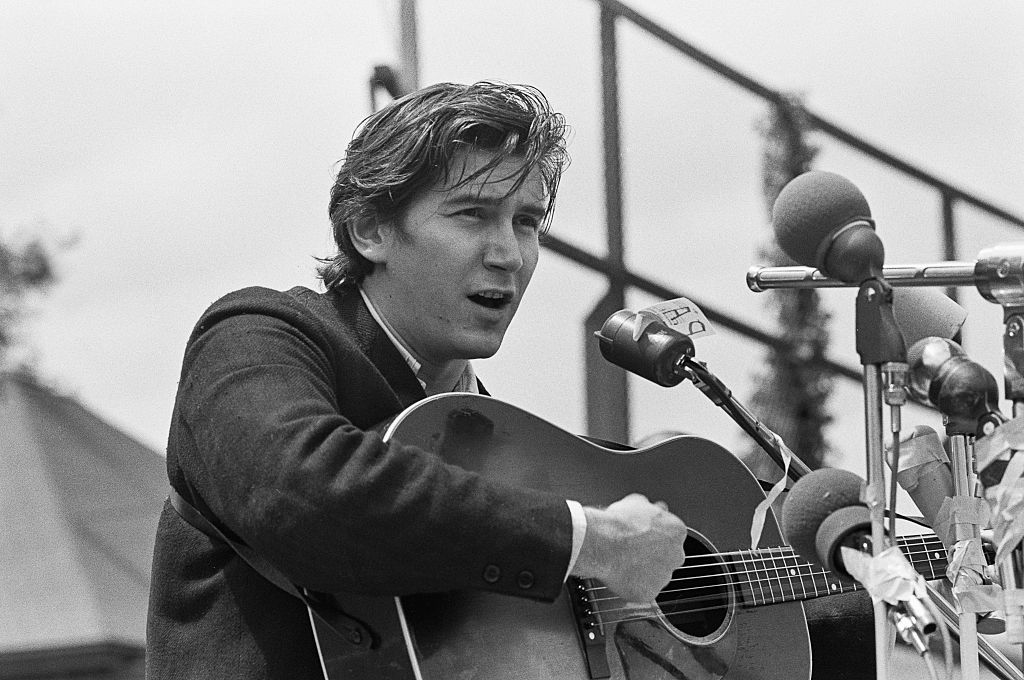
Phil Ochs died fifty years ago today. He never enjoyed the wide and lasting popularity of Bob Dylan or Joan Baez, but he was the most politically engaged among the folk singers who came of age in the 1960s. (Graphic House / Archive Photos / Getty Images)

The title of Phil Ochs’s 1965 song “I Ain’t Marching Anymore” can be misleading. Rather than encouraging Americans to stop marching in protest of the Vietnam War, Ochs was reflecting his generation’s anger at being asked — as many previous generations had been — to march as soldiers and sacrifice their lives for an immoral war. The song goes through the litany of American military history from the perspective of a weary soldier who has been present at every war since the War of 1812. “It’s always the old who lead us to the war, always the young to fall,” goes the chorus. To Ochs, Americans had paid too high a price for the country’s militarism. “Call it peace or call it treason. Call it love or call it reason, but I ain’t a-marching anymore.”

Ochs wrote in the album’s liner notes that the song “borders between pacifism and treason, combining the best qualities of both.” He observed that “the fact that you won’t be hearing this song on the radio is more than enough justification for the writing of it.” “I Ain’t Marching Anymore” quickly became an anthem of the antiwar movement.

Ochs never enjoyed the wide and lasting popularity of Bob Dylan or Joan Baez, but he was the most politically engaged among the folk singers who came of age in the 1960s. Like many of his generation, Ochs believed in the ideals he learned in school — equality, democracy, justice, and America’s role of promoting freedom around the world. But by his late teens, Ochs joined his peers in recognizing the harsher realities of American imperialism, deep-rooted racism, and class struggle. He devoted his short life to music and radical protest.

On April 9, 1976, Ochs succumbed to his long-standing depression, bipolar disorder, and alcoholism, and died by suicide. Today marks the fiftieth anniversary of his death. He wrote about two hundred songs and released eight albums, employing his sharp wit and moving lyrics that shimmered with optimism, patriotism, outrage, and despair.

Anthems of the New Left

Most of Ochs’s songs reflected the concerns of the 1960s left — racial violence (“Too Many Martyrs,” “Here’s to the State Of Mississippi,” “Talking Birmingham Jam”), the Harlem riots of 1964 (“In The Heat of the Summer”), the limits of liberalism (“Love Me, I’m a Liberal”), the Vietnam War (“White Boots Marching in a Yellow Land,” “We Seek No Wider War,” “Talking Vietnam Blues,” “Draft Dodger Rag”), migrant farm labor (“Bracero,” which channeled Woody Guthrie’s song “Deportees”), US militarism (“Santo Domingo,” “Cops of the World”), the politics of religion (“Canons Of Christianity“) and the social consequences of inequality (“There but for Fortune,” “Flower Lady”).

His songs ranged from hopeful (“What’s That I Hear?”) and patriotic (“Power and the Glory”) to angry and cynical (“Outside of a Small Circle of Friends”) to deeply personal (“When I’m Gone,” “Pleasures of the Harbor,” “Changes,” “Chords of Fame”). “Lou Marsh” told the story of a New York social worker who was killed trying to stop a gang fight. “Celia” describes a couple — she a Filipina, he a white American — who lived ten years as political prisoners in the Philippines. When they were released, the United States refused Celia entry, forcing them to live in England. In “The Crucifixion,” Ochs compared the deaths of Jesus Christ and President John F. Kennedy.

Even before his first album was released, Ochs had become a well-known figure in the overlapping worlds of folk music and leftist activism. Invited to perform at the prestigious Newport Folk Festival in 1963, he sang “Too Many Martyrs,” “Talking Birmingham Jam,” and “Power and the Glory,” bringing the crowd to its feet.

Throughout his career, Ochs performed at civil rights and antiwar rallies and demonstrations, as well as at concert halls, including several sold-out performances at New York’s Carnegie Hall. Many other singers lent their names or performed at rallies, but Ochs was an activist as well as a singer-songwriter, organizing events to publicize and raise money for progressive causes.

In late December of 1963, Ochs traveled to Kentucky with a group of New York–area college students to bring food and other supplies to unemployed coal miners. He performed a new song, “No Christmas in Kentucky,” for the workers and told the Associated Press, in a story that was widely syndicated, “Relief is not the answer. There is only one answer, and that’s jobs.”

The next year, he wrote “Here’s to the State of Mississippi” after he visited and sang for Mississippi Freedom Summer volunteers who were registering voters under dangerous conditions. The Ku Klux Klan had just murdered three volunteers. In the search for their bodies, the FBI found others who had been killed and buried by racist thugs. In the song, he criticized the state’s segregated schools, its politicians, its cops and judges, and its churches:

Here’s to the state of Mississippi

For underneath her borders the devil draws no line

If you drag her muddy river, nameless bodies you will find

Oh, the fat trees of the forest have hid a thousand crimes

The calendar is lyin’ when it reads the present time.

Whoa, here’s to the land you’ve torn out the heart of,

Mississippi, find yourself another country to be part of!

In another stanza, which would need only slight changes to apply to the current Immigration and Customs Enforcement (ICE) raids, Ochs wrote:

And here’s to the cops of Mississippi

They’re chewing their tobacco as they lock the prison door

Their bellies bounce inside them when they knock you to the floor

No, they don’t like taking prisoners in their private little war

Behind their broken badges there are murderers and more.

In the early 1960s, when few Americans had even heard about Vietnam, Ochs schooled himself in the country’s history, the struggles of colonial countries seeking self-determination, the travails of US military intervention around the world, and the influence of US corporations in exploiting workers and undermining democracy. His songs reflect his knowledge of America’s left and labor history, battles over the First Amendment, and the crusades for black freedom and better conditions for migrant farmworkers. He empathized with the victims of oppression but also found humor, and a source of his satire, in the excuses that the powerful used to justify their bullying and cruelty.

“Power and the Glory” combines his patriotism with a strong plea for justice:

Here is a land full of power and glory

Beauty that words cannot recall

Oh, her power shall rest on the strength of her freedom

Her glory shall rest on us all.

One of its stanzas updated Guthrie’s “This Land Is Your Land”:

Yet she’s only as rich as the poorest of her poor

Only as free as the padlocked prison door

Only as strong as our love for this land

Only as tall as we stand.

Ironically, the song later became part of the repertoire of the US Army band. Another 1966 song, “Cops of the World,” seems particularly appropriate in response to Donald Trump’s reckless gunboat diplomacy toward Venezuela, Iran, and elsewhere:

Come, get out of the way, boys

Quick, get out of the way

You’d better watch what you say, boys

Better watch what you say

We’ve rammed in your harbor and tied to your port

And our pistols are hungry and our tempers are short

So bring your daughters around to the fort

’Cause we’re the cops of the world, boys

We’re the cops of the world.

His 1966 song, “When I’m Gone,” imagined a world without him in it:

Won’t be asked to do my share when I’m gone

Can’t sing louder than the guns when I’m gone

Can’t add my name into the fight while I’m gone

So I guess I’ll have to do it while I’m here.

And I won’t be laughing at the lies when I’m gone

And I can’t question how or when or why when I’m gone

Can’t live proud enough to die when I’m gone

So I guess I’ll have to do it while I’m here.

Love Me, I’m a Liberal

In 1967, Ochs organized rallies in New York and Los Angeles, declaring that “The War Is Over,” the title of one of his most popular songs. He explained: “Is everybody sick of this stinking war? In that case, friends, do what I and thousands of other Americans have done — declare the war over.” If young men refuse to fight, he proclaimed, the war will end.

Ochs continued to perform at antiwar rallies, including the protests outside the 1968 Democratic National Convention in Chicago. He was one of many people arrested by out-of-control police who battled and bludgeoned the protesters. He supported antiwar candidate Eugene McCarthy, but the Democrats nominated Vice President Hubert Humphrey, a liberal who nevertheless supported Lyndon B. Johnson’s Vietnam policy. During his testimony at the trial of the Chicago Seven in December 1969, Ochs recited the lyrics to “I Ain’t Marching Anymore.”

Ochs left Chicago questioning whether the system could be repaired or reformed. His song “Love Me, I’m a Liberal,” reflected the disillusionment of many activists, who blamed liberal Democrats who espoused support for civil rights and opposition to the Vietnam War but who inevitably tacked center and co-opted radical movements — a cohort that the New Left called “corporate liberalism.” One verse explained:

I cheered when Humphrey was chosen

My faith in the system restored

I’m glad that the Commies were thrown out

Of the AFL-CIO board

And I love Puerto Ricans and Negroes

As long as they don’t move next door

So love me, love me, love me, I’m a liberal.

The failure of the protests to persuade the Democrats to nominate an antiwar candidate or to change many Americans’ opinions about the war eventually convinced Ochs that the average American wasn’t swayed by topical songs or protest tactics. He decided to return to the music of his youth — early rock ’n’ roll — and to become “part Elvis Presley and part Che Guevara.” At concerts promoting his Greatest Hits album (1970), which actually featured new songs, he wore a gold suit and performed political songs in a rock ’n’ roll style.

Ochs never reached the wider audience or fame he hoped for. On the back cover of his Greatest Hits album, he wrote that “50 fans can’t be wrong!”, a reference to an Elvis Presley album that boasted of Elvis having fifty million fans.

The Singing Journalist

Born in 1940 to Jewish parents, Ochs grew up in Far Rockaway in Queens, New York, and later in Columbus, Ohio. As a teen, Ochs was a talented clarinet player, rising to the position of principal soloist at the Capital University Conservatory of Music before he was sixteen. But he soon became interested in the rock and country music he heard on the radio, including Buddy Holly, Elvis Presley, Merle Haggard, Faron Young, Ernest Tubb, Hank Williams, and Johnny Cash.

From 1956 to 1958, his parents sent him to Staunton Military Academy in rural Virginia, which may partly explain his opposition to militarism. He majored in journalism at Ohio State University, where he became interested in politics and wrote radical political commentary for the student newspaper. His friend Jim Glover introduced him to the politically oriented folk music of Guthrie, Pete Seeger, and the Weavers. He learned to play the guitar, began writing topical songs, briefly formed a duet with Glover called the Singing Socialists (renamed the Sundowners), and began performing at Cleveland-area folk clubs. In 1962, he moved to New York City to join the burgeoning folk scene. He quickly became a regular contributor to Broadside, a new magazine that linked folk music and politics. The lyrics to seventy-two of his songs were first printed there.

He described himself as a “singing journalist” whose songs were inspired by real events he saw in newspapers and magazines. “Outside of a Small Circle of Friends” was inspired by the murder of Kitty Genovese, who in 1964 was stabbed to death outside of her New York City apartment. Newspapers at the time reported that dozens of neighbors ignored her cries for help. Some radio stations refused to play the song because the lyrics included the line “smoking marijuana is more fun than drinking beer.”

During the 1970s, his mental health declined, and his substance abuse escalated, but he continued to perform. Along with James Taylor and Joni Mitchell, he sang at the inaugural benefit for Greenpeace in Vancouver on October 16, 1970.

In August 1971, Ochs and his friend David Ifshin traveled to Chile, where socialist Salvador Allende had been elected president the previous year. While there, he befriended Victor Jara, Chile’s popular leftist folk singer.

In October, Ochs visited Argentina and then sang at a political rally in Uruguay, where he and Ifshin were arrested and detained overnight. When they returned to Argentina, the two Americans were arrested as they left the airplane. Briefly imprisoned in Argentina, they were sent to Bolivia on a commercial airline. The American captain of the plane permitted Ochs and Ifshin to stay on the aircraft and barred Bolivian authorities, who wanted to arrest the two American dissidents, from entering. The plane then flew to Peru, where they boarded another flight to the United States.

Even after those harrowing experiences, Ochs continued to perform and protest. John Lennon invited him, along with Stevie Wonder, Abbie Hoffman, and others, to sing at the University of Michigan at the December 1971 “John Sinclair Freedom Rally,” held on behalf of the activist poet who had been arrested on minor drug charges and given a severe sentence.

Despite his experiences at the 1968 Democratic convention, he campaigned in 1972 for antiwar candidates, including Democratic presidential candidate George McGovern.

In mid-1972, Ochs traveled to several African countries. In Tanzania, he was attacked and choked by robbers, which damaged his vocal cords, causing him to lose the top three notes in his vocal range. Already suffering from mental problems, the assault fed into his paranoia, leading Ochs to believe that the CIA may have orchestrated the attack.

The War Is Over

Whether or not the CIA targeted Ochs, the agency certainly played a key role in the coup d’état that overthrew the Allende government in September 1973. The new military regime rounded up dissidents, including Jara, who was tortured and murdered.

Ochs organized a benefit concert to draw attention to the Chilean crisis and to raise money for its victims. The sold-out concert at New York’s Felt Forum in May 1974, called “An Evening with Salvador Allende,” included films of Allende and performances by Bob Dylan, Pete Seeger, Dave Van Ronk, and Arlo Guthrie, and a brief talk by former US Attorney General Ramsey Clark.

In 1973, Ochs rewrote his song about Mississippi into “Here’s to the State of Richard Nixon.” In January 1974, Ochs performed it at the Impeachment Ball, organized by Rep. Bella Abzug and other antiwar activists. Eight months later, Nixon resigned his presidency.

After US troops left Vietnam in April 1975, Ochs organized a final “The War Is Over” rally, held in New York’s Central Park the following month. Over one hundred thousand people showed up to listen to Seeger, Joan Baez, Paul Simon, Odetta, Harry Belafonte, and Ochs, who closed the event with “The War Is Over.”

Unable to overcome his mounting mental health struggles, Ochs died the following year.

Political Troubadour

Phil Ochs never had a top hit on his own, but others spread the word by covering his songs. Joan Baez’s version of his “There but for Fortune” peaked at number fifty on the Billboard charts and was nominated for a Grammy award.

Many other artists have covered his songs, including Nanci Griffith, Billy Bragg, Arlo Guthrie, Magpie, Tom Paxton, Peter Yarrow, Cher, Judy Collins, John Denver, Ani DiFranco, Gordon Lightfoot, Morrissey, Melanie, Christy Moore, and They Might Be Giants. Others have incorporated tributes to Ochs in their own work, including Pearl Jam, the Clash, David Bowie, Todd Snider, Richard Thompson, Jefferson Starship, Dar Williams, Harry Chapin, Jello Biafra, and Schooner Fare.

In a 1969 interview, Neil Young said, “I really think Phil Ochs is a genius. . . . He’s written fantastic, incredible songs — he’s on the same level with Dylan in my eyes.” In 2013, Young performed “Changes” at Farm Aid and included a recording of the song on one of his albums.

A few weeks after his death in 1976, Bella Abzug placed a eulogy about Ochs in the Congressional Record. She said: 

Phil Ochs’s poetic pronouncements were part of a larger effort to galvanize his generation into taking action to prevent war, racism, and poverty. He left us a legacy of important songs that continue to be relevant in 1976 — even though ‘the war is over.’

In 1982, Ochs’s friends used the Freedom of Information Act to obtain Ochs’s FBI file. They had started surveilling him as early as 1963. It went on for four hundred pages.

Others have taken up Ochs’s work, which itself was part of a long lineage of political troubadours. Joan Baez and Bruce Springsteen have maintained the tradition of activist-artists. Along with Maggie Rogers and Tom Morello, both performed at the two-hundred-thousand-strong No Kings rally in Minneapolis, with Springsteen singing “Streets of Minneapolis,” written for the movement. Dozens of artists have canceled performances at the John F. Kennedy Center for the Performing Arts in Washington, DC, since Trump changed its board and its mission last year.

In the current political climate, left-wing protest music is experiencing a resurgence, exemplified by newcomers like Jesse Welles. But despite this revival, Ochs is relatively unknown today — even among activists protesting Trump’s many wars, the ICE attacks on immigrants and protesters, and the administration’s efforts to undermine democracy.

In 2014, Ochs’s daughter donated his archives to the Woody Guthrie Center in Tulsa. It was a fitting tribute, as Ochs provides the missing link from Guthrie to the surviving tradition of protest music. He deserves to be better known, not only because of his pivotal place in American music and political history, but because his own songs still resonate with the struggle to make America live up to its loftiest ideals of democracy and equality.