Zohran Mamdani’s Budget Is a Step in the Right Direction
Up against a governor who vowed not to tax the rich, Zohran Mamdani delivered a New York City budget that isn’t transformative but protects public goods and makes progress on his affordability agenda.
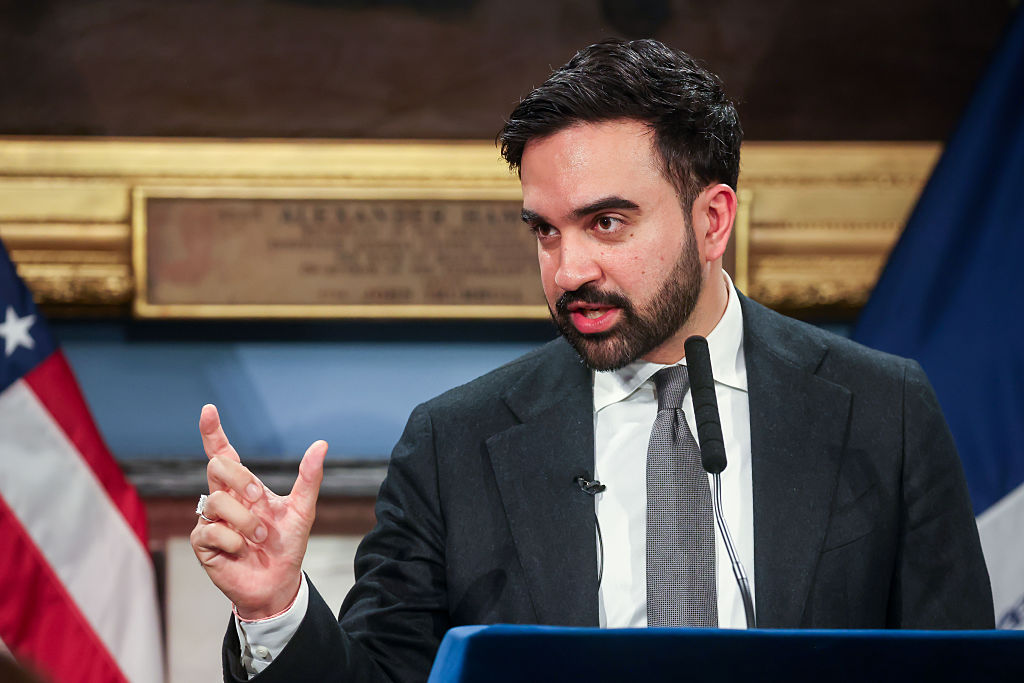
Mayor Zohran Mamdani presents the city’s 2027 executive budget in New York on Tuesday. (Michael Nagle / Bloomberg)
When New York Governor Kathy Hochul announced on Monday, the same day the New York City budget was unveiled, that she was providing $4 billion from the state to help close the city’s budget gap, the media was quick to frame it as if Mamdani and the city were spending irresponsibly. “Hochul forks over another $4B to bail out Mamdani’s NYC budget woes,” the New York Post complained. The right-wing Center Square agreed, also calling it a “bailout,” a word that also seems to have become a talking point of Hochul’s Republican opponent, the far-right Bruce Blakeman of Long Island.
This characterization of increased state funding as a bailout, with its implications that the city is being fiscally reckless, is wrong. The funding is a product of steady leadership from Mayor Zohran Mamdani, made possible by the organizing of and pressure from New Yorkers. The mayor walked a delicate tightrope throughout negotiations at the city and state level around this budget, being the tribune for a movement that angrily campaigned to get the governor to do more for the city by taxing the rich, while also working in partnership with the governor to fund major campaign promises around universal childcare policies that were not possible to achieve without the her cooperation.
The state funding that Mamdani and Hochul just announced will help fund the city’s needs and close the budget gap that was exacerbated by the mismanagement of previous mayor Eric Adams and by the cruel cuts of President Donald Trump. The budget that the city ended up with is far from perfect or transformative. But overall, it moves the city in the right direction, especially given the immense structural difficulties that Mamdani was up against.
Hochul, who once said she would never increase taxes on the rich, ended up imposing a pied-à-terre tax on second homes worth over $5 million, which will provide half a billion. This is hardly the extent of taxation on the wealthy that Mamdani and his supporters have called for, but given the governor’s previous intransigence on this issue, it is an important victory in a longer fight.
Mayor Mamdani and Speaker Julie Menin also announced that they are working with the city council on a plan to reduce the unincorporated business tax (UBT) credit, which allows certain business owners to deduct part of the UBT from their personal income tax, a perk that mainly benefits millionaires. That reform will give the city another $68 million in revenue.
The Mamdani administration also found savings. Each agency was asked to trim waste and inefficiencies — cutting down on bloat from outside contracts, giving up unused space, cutting unused programs, and improving financial management — a process the city says resulted in savings of $1.77 billion. Socialists often hear this kind of proposal and assume it is austerity by another name, but in this case the money is being directed to other vital needs, and these are not service cuts.
At least one source of savings is a dubious policy decision: delaying a mandate to decrease public school class sizes. Small class sizes are expensive, but they create a more intellectually enriching and safer learning environment for schoolchildren. As well, creating more union jobs is good economic development. A shortage of teachers and resources makes this law difficult for the city and the state to implement right now, which is why the mayor is delaying its implementation. But Mamdani has said he is committed to doing so by the end of his term.
Another source of savings is reasonable but likely to be misunderstood: restructuring unfunded pension fund liability. As Andrew Perry of the Fiscal Policy Institute explains, after the Great Recession, city pension fund payments were amortized in a way that put some payments off, then caused them to balloon recently, and drop to zero in 2032. Mamdani’s plan “smooths it out,” Perry says. “That amortization schedule never really made sense anyway, and this seems like a logical solution.”
Hochul’s failure to tax the rich further still matters: more revenue would have not only funded the smaller class sizes and other critical policies that Mamdani has proposed but also put New Yorkers in a better position to survive the Trump administration. The state budget is almost final, and it seems unfortunately likely that both city and state budgets will fall short of providing New Yorkers with a safety net that makes up for the cuts to food stamps and Medicaid. This is particularly galling since the federal cuts to those programs came from a tax cut that Trump gave to the rich, so taxing them to balance that out would hardly have resulted in a radical lifestyle change for the state’s richest.
But the budget avoids playing into the passive acceptance of austerity. It leaves crucial services intact, including cash assistance and shelter for the homeless; goes beyond what the mayor originally promised on libraries and parks; and designates $1.2 billion for universal childcare and, equally important‚ billions in capital funding for affordable housing, including the biggest city-level capital increase for public housing in recent history.
It does all this while avoiding raising property taxes, which would have made some fiscal sense but would also have been unpopular and difficult to message. New Yorkers who own property are not the majority of city residents, but they have social capital and would have screamed their heads off. It does appear, instead, that igniting a firestorm of outrage with a proposed property tax helped Mamdani to persuade the governor to fund the city — including by taxing the rich a little bit.
The budget also avoided tapping into budget reserves or the rainy day fund, which would have left the mayor vulnerable to charges of fiscal irresponsibility.
Considering the massive toll that Trumpism and years of neoliberalism have taken on the city, the scale of the affordability crisis, and the unique appetite in the city for using government programs to make everyone’s lives much better, it would have been better to tax the rich more as well as corporations, and to invest even more in New Yorkers. The Trump-induced safety net gaps on food security and health care are serious and worrisome.
But considering that Mamdani and the Left appeared to be set up for failure by the Adams administration and the federal government, as well as by a governor reluctant to even slightly inconvenience her plutocratic base, this budget is a political victory — a first step in building a new political culture in which working people matter and have power.