Zohran Mamdani Is Right to Condemn West Bank Land Sales
After a rowdy protest outside a real estate event at Park East Synagogue, Mayor Zohran Mamdani was widely criticized for egging on the unrest by condemning the sale of West Bank properties. But the criticisms don’t stand up to scrutiny.
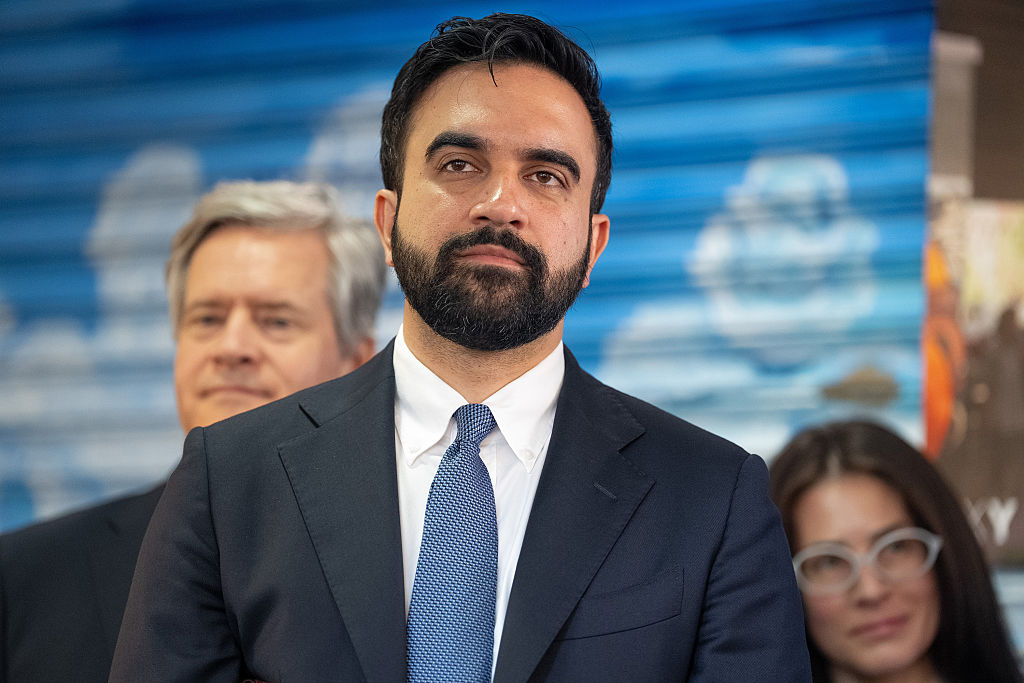
Zohran Mamdani was widely condemned for criticizing a real estate event promoting sales in illegal West Bank settlements. (Barry Williams / New York Daily News via Getty Images)
Last week, the Wall Street Journal ran an editorial titled “Mamdani and the Antisemites.” The next day, an article published in the conservative National Review called the mayor’s behavior “shameful.” The day after that, Republican city council member Vickie Paladino accused Mayor Mamdani of creating a “very dangerous environment.”
You might wonder what dangerous, shameful, and antisemitic thing New York’s mayor stood accused of doing. Perhaps he personally committed a hate crime or stood on a street corner screaming antisemitic slurs at one of his constituents?
As it turns out, this chorus of condemnation was inspired by the mayor saying through a spokesman that he was “deeply opposed” to a real estate event at New York’s Park East Synagogue that promoted the sale of real estate in illegal Israeli settlements in the West Bank. That’s it.
The Great Israeli Real Estate Event
The “Great Israeli Real Estate Event” that set up shop at Park East is a traveling real estate showcase that encourages migration to Israel by promoting properties available there. The event’s website features a form you can fill out if you’re interested. The form asks which area of Israel you’re interested in relocating to, and one of the options is Gush Etzion, in the occupied West Bank.
Some defenders of the event have argued that Gush Etzion shouldn’t be thought of the same way as other West Bank settlements because, when Israel and the Palestine Liberation Organization (PLO) were close to a two-state deal in the 1990s and 2000s, various proposals that floated around would have annexed this settlement bloc into Israel as part of a land swap with the new State of Palestine. But it’s unclear what possible moral or legal relevance that could have for the promotion of real estate there in 2026, when no such swap has been made and indeed when the Israeli government routinely insists that there will never be a future two-state deal.
Noah Hurowitz, a reporter for the Intercept, attended the event at Park East and described it in an interview. While most of the real estate being advertised was within Israel’s internationally recognized borders, he saw (and posted pictures of) several brochures for properties in West Bank settlements, including several outside of the Gush Etzion bloc. At the table where he got them, he asked about the security situation and was told that he’d be safer there than within Israel proper. In places like Tel Aviv and Jerusalem, the real estate promoter told him, “They [i.e., Arabs] can walk around freely.”
That chilling appeal to apartheid as a security feature cuts to the moral heart of the issue. When you hear that Israel moving its citizens into territory that it occupied in 1967 “violates international law,” it’s easy to think of this less like an ongoing human rights abuse than an abstract matter of where the border is supposed to be. But this isn’t like an ordinary territorial dispute between two countries, where whichever one has seized control of a disputed territory treats it like a normal part of the country and all of the people who live there have the same rights as people who live in the non-disputed parts of the country’s territory.
Israel is filling out the West Bank with heavily militarized Jewish-only settlements and using their presence as an excuse to clear out Palestinians who live too close to the settlements (and thus pose a potential “security threat”), all while denying basic human and democratic rights to the Palestinians who live only miles away.
If you live in the Palestinian village of Jab’a, surrounded on all sides by those Gush Etzion settlements promoted by the Great Israeli Real Estate event, you live under Israeli rule, but you can’t vote in Israeli elections like the settlers in Gush Etzion. If one of those settlers is accused of committing a crime, they’ll be tried in a real court. If the occupiers accuse you of committing a crime, you’ll be tried in a military court. And, of course, you won’t be allowed to “walk around freely” in the ethnically purified enclaves next door.
Mamdani’s Stand
The National Review’s Mark Goldfeder argued that the existence of an angry protest outside the synagogue hosting this real estate event made the mayor’s condemnation of the event itself inappropriate.
When a crowd targets a house of worship, the mayor’s job is not to explain why the crowd has a point. It is to protect the people inside. That duty does not depend on whether the mayor approves of the sermon, the speaker, or the politics of the people attending.
But Mamdani did provide police protection for the event (as he’s legally required to do). Even if we accept for the sake of argument that people inside the synagogue were under physical threat from which they required protection, that protection was provided. Goldfeder’s claim seems to be that the mayor’s duty is to provide protection and also shut up about the rights and wrongs of the underlying issue.
If so, though, one wonders why he didn’t condemn the many New York politicians who harshly objected to the crowd protesting the sale of illegally occupied land and accused the protesters of being antisemites and supporters of terrorism. By Goldfeder’s logic, wasn’t their job to make sure the protesters’ free speech rights were protected, not to explain why the protesters were wrong?
Goldfeder and others are opportunistically using the synagogue setting to portray the protesters as an antisemitic mob. But what was being protested wasn’t a worship service. It was a sale of real estate in settlements that violate international law and basic human rights norms, and it would have been protested whether it was held inside a synagogue, out on the grass in a public park, or anywhere else.
Surely the venue at which an event is held shouldn’t make protest illegal, regardless of the venue. If a mosque hosted a lecture entitled “Why the October 7th Attacks Were Justified” and pro-Israel protesters gathered outside, would Goldfeder say that Mamdani should only offer police protection and not also offer an opinion on the event? If some members of the crowd used offensive chants or slogans (as some surely would), then would he have a duty to desist from criticizing the lecture?
Unfortunately, the promotion of real estate in an internationally illegal settlement probably doesn’t violate any domestic American laws. If so, that should be changed. Until it is, though, the presence of police to keep order at a protest is inevitable. The use of “buffer zones” whereby police set up barricades to keep protesters off parts of a public street, on the other hand, raises serious First Amendment concerns. (In this case, it also provided misleading footage of protesters pushing against barricades. Out of context, that conveys the impression that they were trying to storm the synagogue rather than simply protest on parts of the public sidewalk designated as a de facto First Amendment-free zone.)
The mayor’s hands are tied in this regard, because the law mandating such buffer zones for protests outside houses of worship was passed by the city council with a veto-proof majority, meaning that it lapsed into effect even though Mamdani refused to sign it.
In light of the protest, and the mayor’s statement that he was “deeply opposed” to the real estate event, the Wall Street Journal’s editorial board declared that the “line” that anti-Zionism and antisemitism aren’t the same “is becoming impossible to believe.” But this is an insult to the intelligence of the Journal’s readers.
Mamdani couldn’t have made it clearer that his opposition to Israel’s oppression of the Palestinians is rooted in universalist principles about human rights that all humans deserve. Over and over during last year’s election, he was asked (even as he tried to focus on municipal issues) whether he believed that Israel “had a right to exist.” Over and over, his answer was crystal clear. He said that it did but not as a “Jewish state” with an ethnic hierarchy. It should instead exist as a “state of equal rights” — just as, Mamdani pointed out in one debate, he thinks Saudi Arabia has a right to exist as “a state of equal rights” instead of a gender-segregated theocracy.
It doesn’t get much clearer than that. And he’s absolutely right.