Kathy Hochul’s New Budget Fails to Meet the Moment
After a long delay, New York Gov. Kathy Hochul has passed a state budget — a budget that does almost nothing to protect the hundreds of thousands of New Yorkers about to lose health care and food stamps due to Donald Trump’s federal budget cuts.
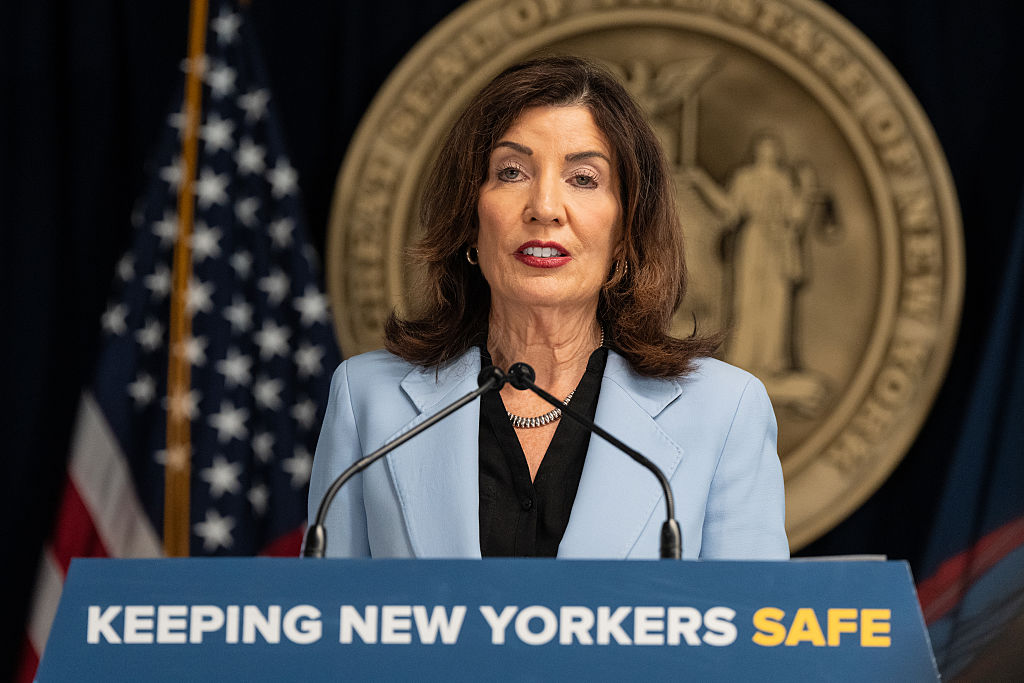
Examining Gov. Kathy Hochul’s new budget, you’d have little idea that hundreds of thousands of New Yorkers will soon lose food assistance and health care thanks to Donald Trump’s cuts. That’s because Hochul has done almost nothing to counteract those cuts. (Lev Radin / Pacific Press / LightRocket via Getty Images)
The New York State budget negotiations drew to an anti-climactic close this week. This was not only the longest budget negotiation in the last sixteen years but also one of the most nonsensical. The enacted budget does almost nothing to protect the lives of hundreds of thousands of New Yorkers about to lose access to health care and food stamps in the wake of Donald Trump’s One Big Beautiful Bill Act (OBBBA). Neither do they harness the energy and enthusiasm to build a more affordable state, embodied by New York City Mayor Zohran Mamdani.
Looking at the state budget legislation, you could easily miss that this year’s budget fight came at such a historic moment: unprecedented federal cuts to the social safety net alongside the most energetic and animated campaign for new revenue and expansions to publicly funded programs in modern history. Rather than respond in kind, lawmakers in Albany punted. The result will be at least 450,000 New Yorkers losing access to health insurance this July and possibly well over one million losing access over the next year, bringing the state’s rate of uninsurance back to its pre–Affordable Care Act level.
Further, federal funding cuts to the Supplemental Nutrition Assistance Program (SNAP) are showing up in New York state’s program data, where we see disenrollment of about 100,000 SNAP participants already. We should expect to see this number increase over the next twelve months as funding gets tighter and new work requirements kick in fully.
SNAP enrollment compared to July 2025 (OBBBA enactment)

One year ago, as Republicans in Washington debated their landmark legislation to cut $2 trillion in spending over the next decade, New York State lawmakers began making the nefarious claim that they “cannot make up for the federal funding cuts.” But this has never been true. New York’s tax base is clearly strong enough to make significant progress toward filling the federal funding cuts.
This year alone, one policy proposal offered low-cost insurance to the 450,000 New Yorkers who will lose their insurance this July for less than $1 billion per year, a relatively modest price in the context of a $268.5 billion annual budget. Instead, Governor Hochul is sending $100 “energy rebate” checks to households around the state, a move that will cost the state $1 billion and will do nothing to make lasting, structural changes to improve affordability.
Policies long fought for by labor unions in New York, and now widely popularized by Zohran Mamdani, could raise billions in new revenue and pay for state-funded programs to keep people insured and receiving nutrition assistance. As New York’s millionaire households receive a $12 billion tax cut from the federal government, the state should be recouping those funds to keep essential programs running. There are a number of options for how New York could raise revenue.
For example, extending the corporate tax to all pass-through businesses could raise $8 billion for the state. A 1 percentage point increase to the personal income tax rate for households earning over $300,000 per year would raise over $5 billion. And a modest surtax on capital gains income, not even fully making up for its preferential treatment at the federal level, would raise $4 billion.
Instead, the only major new tax policy implemented by the state budget was the pied-à-terre tax that will apply just to New York City and is expected to raise $300–$500 million for the city budget. Despite the clear mandate that sent Mayor Mamdani to office, Albany lawmakers failed to authorize New York City to raise any other taxes, putting severe constraints on what the mayor will be able to accomplish this year. (The state did restore some direct aid to the city, but not enough to achieve the ambitious policy agenda that brought the mayor into office).
One might wonder whether it makes political sense in the long run for the state of New York to make up for federal spending cuts. In fact, the liberal consensus has long been to build safety net programs at the federal level, allowing for redistribution between states and program expansion that is not constrained by balanced-budget amendments. But in an era of a constitutional crisis at the federal level, it is imperative that New York establish its own programs that offer refuge from the attacks on economic entitlements and civil liberties that now define national politics.
There were a couple silver linings to this year’s budget. In the first ten days of Mamdani’s mayoralty, he and the governor announced a major expansion to childcare programs in New York City and across the state. While this year’s expansion will not bring the state all the way to universal free public childcare, it increases the number of families with children under five receiving state-sponsored childcare from 40 percent to 58 percent. These expansions are paid for this year and next but will need new dedicated revenue in future years if they are to be fully implemented.
Additionally, public employees in the state won significant reforms to their retirement benefits. Teachers and teaching assistants across the state will see their retirement age lowered from sixty-three to fifty-eight after thirty years of service. Nonteacher civil servants will see their contribution rates lowered and benefit calculations improved. These are real material wins for New Yorkers. But their victory is bittersweet alongside the rest of the budget that so thoroughly failed to meet the moment.
Of course, there is always next year. And for those accustomed to the ways of Albany, it is well-understood that action is typically only taken once a crisis has occurred. We will be looking to next year to see if the crisis that New York is about to be thrust into will be enough to force the governor to take real action.