Zohran Mamdani and the Contradiction of Democratic Socialism
What happens when a DSA politician takes charge of the largest city in the United States? Zohran Mamdani’s early record is filled with successes, but also evidence of the contradictions between socialist politics and governing the capitalist state.
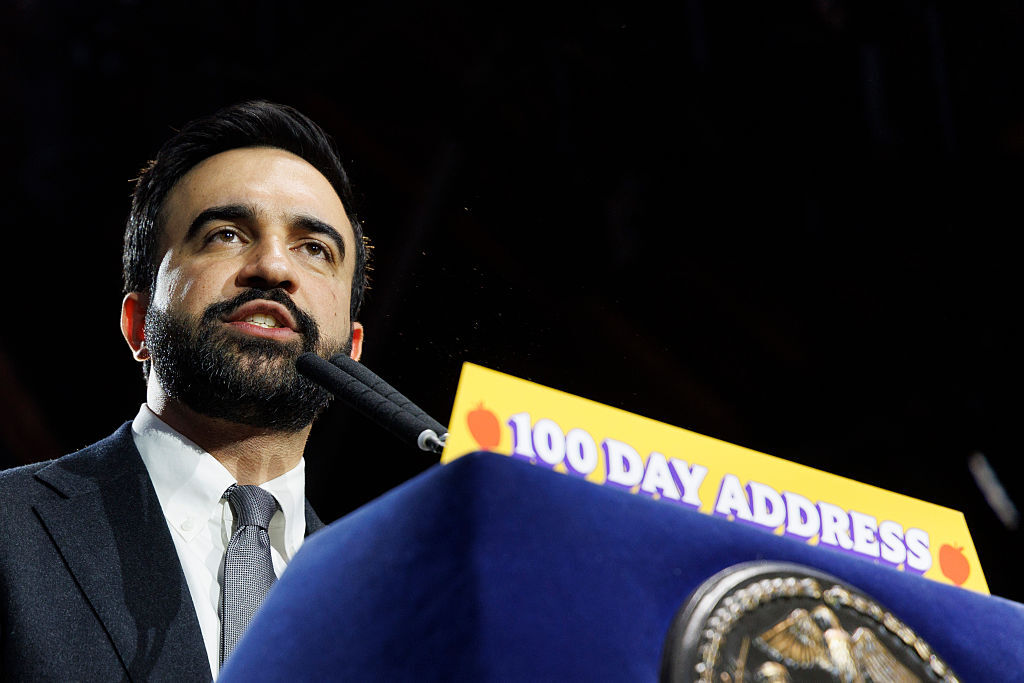
Mayor Zohran Mamdani finds himself caught between two projects: that of managing capitalism and that of overturning it. (Matthew Hoen / NurPhoto via Getty Images)
As Zohran Mamdani passes one hundred days as the mayor of New York City, we are being offered numerous retrospectives of his early returns. Some will seek to grade his policy work and evaluate his success in enacting his agenda. Others will assess the state of his political alliances within government and without. The more ideological balance sheets will seek to match up his actions to his own rhetoric and that of the socialist movement that put him in office.
Another way to view all these aspects is from the vantage point of the contradiction that Mayor Mamdani represents. That is, a contradiction in the properly dialectical Marxist sense: an antagonism that cannot be resolved without overcoming the larger system that gives rise to it, such as that between capital and labor. In this case, the contradiction is between Mamdani as a product of the Democratic Socialists of America (DSA), an organization at least nominally aiming to overturn the capitalist mode of production, and Mamdani as a politician attempting to operate the machinery of the capitalist state apparatus.
Even before his victory, an intra-left battle line had been drawn between two different views on how to relate to a Mamdani administration. This division can be seen as a reflection of the contradiction just described. On one side are those who see the task of DSA as defending Mamdani’s policy agenda and building the base of popular support for it. On the other are those more concerned with calling out compromises or betrayals that separate the new mayor’s actions in power from the principles of a democratic socialist organization.
This tension appears wherever socialist parties manage to elect their members to bourgeois governments and has historically often led to conflict between the “parliamentary party” and the mass membership base. DSA itself has already wrestled with the contradiction with respect to its other officials in various councils and legislatures. But the magnitude of the disputes have heightened now that a socialist holds executive rather than just legislative office in the country’s largest city, tasked not merely with passing laws but with managing the bureaucracy of government itself.
Moreover, Mamdani, unlike some other prominent elected officials like Alexandria Ocasio-Cortez, is a true “DSA elected.” That is, he developed politically in substantial part through his organizing with DSA, was brought into the state assembly on a slate backed by its political leadership and volunteer power, and became mayor through a campaign that, while it eventually assembled a broad progressive coalition, was initiated and led by DSA.
Outsiders often fail to understand the raucous internal culture of DSA, which is quite unlike most other major political institutions in American life. It is intensely democratic, with leadership, endorsements, and campaigns subject to the votes of and consultations with the full membership, which now numbers over one hundred thousand nationwide. And because the organization is funded almost entirely by its members’ dues, this democracy is truly meaningful and not subject to the veto of rich funders or a nonprofit board of directors. Moreover, DSA’s stated principles are so open-ended and broad that they can sustain an organization that attracts everyone from social democrats to communists and even anarchists.
Thus it is important, and indeed inevitable, that DSA’s membership will debate the right balance between criticizing the mayor and acting as his foot soldiers. The resulting dispute, however, often has a rigid, sterile quality, with each side caricaturing the other and reducing themselves to caricature in turn.
From one side you get the argument that criticizing our own elected officials is simply a disorganizing sectarianism. As the New York City DSA leader Álvaro López puts it, “we need to get away from a ‘holding them accountable’ framework toward a ‘building power’ framework.” Seemingly, in this conception, “building power” is conceived as creating a base of organizers who can win elections for left candidates and then continue organizing in the service of the electeds’ policy agenda.
Opposed to López’s perspective are those who are suspicious of the corruptions of power and of the ease with which individual politicians can be co-opted. Within DSA, this tendency has manifested in periodic campaigns to censure or even expel figures like Jamaal Bowman and Alexandria Ocasio-Cortez for public acts that directly contradict the stated positions of the organization.
We need to break through this repetitive debate by treating it as a true contradiction and work through the ways that this contradiction has played out in the mayor’s early term. Doing so will allow us to develop ideas about how DSA and the Mamdani administration can maintain a contradictory unity, operating independently while avoiding direct opposition.
Contradiction and Revolutionary Honesty
My approach to the Zohran-DSA contradiction is to view it through the lens of revolutionary honesty. It is Karl Marx and Friedrich Engels in the Communist Manifesto who proclaim that “the Communists disdain to conceal their views and aims. They openly declare that their ends can be attained only by the forcible overthrow of all existing social conditions.” To obfuscate or soften our positions for immediate advantage would be, in this view, a betrayal of the revolution.
In a similar vein, socialists love to quote the Guinean socialist leader Amílcar Cabral, who told his party members in 1965: “Tell no lies. Expose lies whenever they are told. Mask no difficulties, mistakes, failures. Claim no easy victories.” It’s a compelling call to revolutionary honesty, to trusting the masses rather than thinking the difficult realities of revolution need to be hidden or sugarcoated.
Naturally, on some level there will always be competing views on what the truth of any political situation actually is, which is why serious political debate is necessary. But in politics, there is a particular pressure to say things that we know aren’t quite true or do things that we know contradict our stated vision and objective. This is the kind of political falsehood I refer to.
In that sense, truth-telling is an appealing dictum, particularly in contrast to the disingenuous character of so much politics. And so we might apply it directly to the situation we face now. Can DSA be honest? Can Zohran Mamdani? What are the conditions in which this becomes possible?
It might be tempting to deploy the above quotes in a “holding accountable” manner, taking every opportunity to call out DSA electeds for soft-pedaling the true aims of the revolution. The problem with this, however, is that Amílcar Cabral was confronting a rather different situation than Zohran Mamdani, one that faced very different contradictions.
As the leader of a revolutionary army and government, he could view the totality of his politics through a lens of revolutionary honesty. Zohran, if he wants to succeed as mayor, will at times find it necessary to tell lies and claim easy victories. The question is whether we, as socialists who ultimately want him to succeed, can defend our own ability to be politically principled and clear-eyed about strategic realities.
By stepping into bourgeois elected office, and into responsibility for managing the largest city in the United States, Mamdani finds himself caught between two projects: that of managing capitalism and that of overturning it. That contradiction is structural, and it is not a property of either his policy agenda or his personal beliefs. The question is whether the movement that elected him will manage the contradiction or be torn apart by it.
The Mayor and the Blue Power
The Mamdani project (and DSA’s electoral project more generally) is predicated on the idea that it is possible for an elected socialist not merely to serve as a tribune of the Left but to govern effectively and deliver tangible improvements to the life of the city’s working class. This entails working with various political and economic actors on their own conventionally capitalist terms. That means balancing the budget, navigating the bond market, and facing down an antagonistic federal government, a centrist governor, and a council speaker hostile to much of the mayor’s agenda, among other things.
But another, perhaps even greater obstacle emanates from within the city government itself. New York, like virtually all major US cities, has in essence two governments: the civilian bureaucracy overseen by the mayor, and the New York Police Department. As Stuart Schrader explains in his recently released Blue Power, police, through their unions, have “built a political movement that made cops untouchable,” able to “strong-arm local leaders and nullify attempts at public oversight.” And these police departments are reliable allies of the forces of urban capital, especially finance and real estate, which prefer them to the more democratically accountable parts of the state. It is to this particular struggle that we now turn.
Mamdani’s relationship with the New York Police Department was always bound to be a central obstacle to the objectives of his administration. His choice to retain Jessica Tisch, daughter of a billionaire family, as police commissioner was perceived by many as an attempt to reassure ruling-class forces in NYC, and it provoked criticism from much of his base. But it can also be seen as his attempt to deal strategically with something of an impossible situation.
While the cops nominally answer to the mayor, the reality is quite a bit more complicated. As in many big cities, the NYPD — with its 33,000 officers and $6.4 billion budget — represents an independent base of power, one that is in some ways more powerful than the mayor’s office itself. The bloated nature of urban police departments, alongside the neoliberal hollowing out of the civilian state, means that armed agents of the state are woven into the operation of society in all kinds of ways — not only in high-profile situations like mental health crises, where Mamdani has argued for replacing them with unarmed specialists, but even in mundane things like assisting stranded motorists, administering parades, and filling out paperwork after a burglary.
That this is no way to run a healthy society doesn’t mean you can just rip the cops out of these processes all at once without creating disorder, and as a result they have the ability to undermine the livability of the city and therefore the legitimacy of the mayor. This is what happened during the mayoralty of Bill de Blasio, who provoked open revolt from the police — to the point that they even publicly threatened his daughter — even while failing to meaningfully reform them, and this should stand as a cautionary example. It is what makes their power so difficult to challenge, as calls to defund the police are easy to spin as a deepening of austerity rather than a redirection of government toward human needs.
In light of all this, the identity of the police commissioner becomes a fraught matter. You could appoint Angela Davis to the position, and all that would result is a complete loss of whatever control you might have over the department; the best scenario at the outset of Mamdani’s regime was probably someone who could command the loyalty of the department without doing too much to actively undermine the mayor.
There may have been better options than Tisch — journalist Spencer Ackerman, for example, suggested reaching into the ranks of South Asian officers, one section of cops who do broadly support Mamdani. But breaking the structural power of the NYPD is a long-term project that can’t be resolved by picking the right figurehead.
Mamdani is surely aware of this dynamic, and his proposal for a Department of Community Safety can be understood as another road to defunding, as it would reassign tasks such as mental health crisis response to unarmed civilian employees. But “defund the police” didn’t fail just because it chose the wrong slogan. Even if police will sometimes claim to be eager to shed some of their non-core duties, as Mamdani regularly cites for rhetorical effect, left unsaid is that the cops don’t intend this to accompany a commensurate reduction in their budget and head count.
Progress on the Department of Community Safety has been slow in the early going. Rather than the original proposal for a department with a billion-dollar budget, which would require city council legislation, he has opted for a smaller Office of Community Safety operating within the mayor’s office. This did not come about until March, even after the January police shooting of a young man having a mental health emergency, the very situation Mamdani had pledged to prevent.
While it’s impossible to know what has happened behind the scenes, the scale and timing of the office’s rollout suggests the delicate balance of power not just with the city council but with Tisch and the NYPD leadership. Tisch did not attend the launch press conference and has been evasive about her support for the larger department proposal.
She has also stalled another Mamdani promise: the disbanding of the NYPD’s Strategic Response Group, notorious for its violent responses to political protest. It was only on April 9, as his first one hundred days in office ended, that the mayor first broached the possibility of overruling the commissioner if the two could not come to an agreement on the issue. This again suggests a complex power struggle unfolding behind the scenes.
Under such conditions, what does revolutionary honesty demand of us? In the simplest terms, we can simply continue to demand Mamdani’s original platform. But we can also go beyond it, to a more capacious form of abolitionism that envisions the sort of broad dismantling of carceral institutions that briefly came to prominence after the George Floyd rebellion of 2020. This shouldn’t take the form of simply demanding a maximalist program from Mamdani, since he is structurally unable to achieve it even if he wants to. But neither should we make a virtue of necessity and pretend that the compromises that must be struck with the Blue Power are anything but that.
The Mayor, the Governor, and the Millionaires
A second theme of the Mamdani mayoralty is its relationship to other politicians and branches of government. Many feared that the far-right Trump administration would extend its string of attacks on big cities to New York, whether by denying federal funds or by sending in an invasion of immigration enforcement raids in the manner of Los Angeles, Chicago, and Minneapolis. This has mostly been forestalled for now, whether because of Mamdani’s apparent ability to personally charm the president, the defeat of the regime on the streets of Minneapolis, or the distraction of the numerous crises into which the White House has recklessly plunged the country.
Attention has thus focused on Mamdani’s dealings with politicians on the city and state levels. Most significant is his, and DSA’s, relationship to Governor Kathy Hochul. Hochul is a pro-corporate centrist and has habitually blocked the Left’s agenda in the state. In particular, she has opposed one of the mayor’s central proposals: raising taxes on the wealthy to close a budget gap and preserve public services. And yet after barely a month in office, and despite having a primary opponent to her left (he would later drop out), Mamdani endorsed Hochul for reelection.
Strategically, the move is understandable; Hochul is very likely to win, and Mamdani needs her cooperation to raise taxes on the rich and fund his agenda. In an article in the Nation, he defended his move by speaking of Hochul as “someone willing to engage in an honest dialogue that leads to results” and the Democratic Party as a “big tent” that “channels conflict toward progress.” He called Hochul, a creature of the Democratic establishment that blocked progressive change for years, someone who “believe[s] in transformation.” To whatever extent these phrases have any content, they certainly seem jarring. Revolutionary honesty, it is not.
There are also strategic critiques, of course, though these are difficult to adjudicate from the outside. Was the endorsement necessary? What, concretely, did Mamdani get from it? Can this move be credited for the governor’s tentative recent move toward taxing the rich, in the form of a limited tax on high-value second homes? There was also the peculiarity of his timing — many months before the primary election and in the midst of a nurses’ strike that Mamdani ostensibly supported and Hochul was attempting to break. But all of this is secondary to the basic incompatibility between the principles of a socialist politics and the substance of what Mamdani decided he was compelled to say.
Mamdani’s move immediately posed a challenge for his socialist base, both in the form of his fellow elected officials and the rank-and-file base of the Democratic Socialists of America. And indeed, the response they showed is encouraging, as an example of the possibility of remaining honest even when one component of your political project feels structurally compelled to dishonesty.
In the immediate aftermath of the endorsement, socialist State Senator Jabari Brisport made a statement that, while not naming Mamdani, was unmistakable in its target: Hochul, he said, was “by billionaires, for billionaires,” and “no politician will ever wield enough leverage to change that.” To underscore his point, he went on to declare “our movement is bigger than any one decision by any individual” and endorsed Hochul’s primary opponent, Antonio Delgado.
NYC-DSA, for its part, was a bit more circumspect, but demonstrated independence in its own way. Its statement, presented as a direct response to Mamdani’s endorsement, does not criticize Mamdani directly, to the chagrin of some members. But it does say that the organization “does not believe that Governor Kathy Hochul has risen to meet this moment” and goes on to underscore that “Mayor Mamdani has been clear that the Governor must tax the rich” and that DSA “will work to make sure she meets that demand.” Even if a bit evasive about the meaning of the endorsement itself, this rhetoric at least establishes that the organization has priorities that are separable from and not dependent on the mayor.
This positions DSA as a force that will fight for the substantive platform Mamdani ran on, and not as an army that the mayor can call into whatever battle he chooses. This is important, and indeed the relationship it discloses may be the key to the success of the entire socialist electoral project. It recalls the moment when Hochul, having belatedly endorsed Mamdani before the election, faced a rally crowd chanting “Tax the rich” during her speech.
The chanting was a fleeting, cathartic thing, but it stands in for something more profound, something that Mamdani and all socialist politicians should welcome. It represents the autonomous reality of masses in motion, existing prior to and apart from elected leaders. That autonomy is ultimately the source of strength of the politicians themselves. It allows Mamdani to say to Hochul, “You see, this is what brought me here, and not only can you not control it, but I can’t control it either.” Genuine mass politics tells the truth and demands what its wants, and it is not subject to the strategic considerations of a politician within the bourgeois state.
Between the Inside and the Outside
Alongside all these bigger struggles, there has of course been the steady stream of news coverage and social media chatter, reacting to various statements made or positions taken by Mamdani and those around him. This is where the question of honesty comes up in the most obvious way. Sometimes it’s the tabloid press trying to tie Mamdani to DSA positions that they expect to be unpopular. Other times it’s DSA members and other leftists expressing alarm at Mamdani for what they perceive to be excessive concessions to those right-wing critics, whether it’s his disavowal of the phrase “Globalize the intifada” or his occasional posts in praise of the NYPD.
This is also an area where the contradiction between the needs of the movement and the exigencies of governing can play out in the most straightforward way. Maybe Mamdani won’t say “Globalize the intifada” (which he says he never did anyway), but we can. He may not be able to call the cops racist or call for a radical restructuring of the NYPD, even if he might agree on some level. But we can, and we must. Leave the cheerleading to the mayor’s office; we can continue to tell the truth.
Nevertheless, DSA organizers will inevitably pore over Mamdani’s public statements, scrutinizing them to determine whether they reflect a political compromise or an actual shift in political objectives. In this instance, managing the contradiction requires some way of communicating across the divide, some semi-reliable signal of what the mayor is really up to. And so here it is worthwhile to look more closely at the internal relations between Zohran and DSA, rather than simply contrasting them.
Thus far, I have mostly portrayed DSA and the Zohran apparatus (e.g., the mayor’s office and Our Time) as disconnected entities operating at arm’s length from one another. But this is obviously not the case. In addition to the plethora of DSA members employed by the mayor’s office, there are also formal mechanisms for coordination with the organization as a whole, in the form of regular meetings with the NYC chapter’s elected cochairs. This mirrors the system of Socialists in Office committees, which are intended to be mechanisms for cogovernance between representatives of DSA’s membership and its elected state and local legislators.
Here is where the “inside” and “outside” of the fabled inside-outside strategy meet. And it is also here that the principle of revolutionary honesty meets the exigencies of operating within the state. Invariably, the delicate business of legislating or governing means that elected officials cannot be fully open about all the behind-the-scenes realities of politics, even with DSA members themselves — the organization, after all, is a remarkably permeable one, that anyone can join simply by putting their credit card details into a website. Thus, the best elected officials can do at times is to convene, for a frank discussion, a smaller group of trusted leaders, who must then exercise their own judgment about enlightening the broader membership.
For those who fear that socialist electeds will inevitably pull DSA in the direction of liberal co-optation, it is here, in the metaphorical and literal meeting of the politicians and the masses, that the greatest danger lies. And it is not a concern we should ignore but one we should attend to closely. At the same time, if we are indeed going to attempt the experiment of twenty-first-century American electoral socialism at all, it is inevitable and necessary for some such mechanisms to exist.
Revolutionary Truth and Consequences
Earlier this month, NYC-DSA convened a forum with Alexandria Ocasio-Cortez as the chapter debated whether to re-endorse her for election to the House of Representatives. AOC had been a flash point in the organization for years, and one particularly sore point was her vote to fund Israel’s Iron Dome missile defense system. In the last cycle, though the chapter endorsed her, DSA’s national leadership split, leading to no national endorsement.
This year, it seemed, might be a breaking point. As public opinion continues to turn against Israel, how is it tenable to have an elected official taking votes like these, particularly as it becomes clear that there is no real political calculation that justifies shying away from the correct position? Whatever one thinks of the compromises the relationship with AOC entails, DSA has continued to tell an obvious truth: the distinction between “defensive” and “offensive” weapons is meaningless in a situation where Israel is the aggressor against occupied Palestinians and its neighboring countries, and defensive missile shields enable it to wage endless war while being shielded from the consequences.
At the forum, to the surprise of many, AOC announced that she now opposed any military aid to Israel, of any kind. While for some this was too little, too late, most factions across the DSA spectrum rushed to take credit and declare victory, and in some sense they all deserved to. By whatever combination of backroom pressure and public outrage, socialists had continued to tell the truth, and eventually Representative Ocasio-Cortez decided she could too. She was held accountable. Or we built power. Or both. Or perhaps, as AOC’s ambitions continue to evolve, and the broader liberal position shifts against Israel, neither is true.
From Telling the Truth to Asking the Real Questions
This is not meant as a call for all factions of DSA, or of the Left more broadly, to simply get along. It’s not even really a call to abandon debates over building power or holding electeds accountable. After all, if the Zohran mayoralty represents an objective contradiction that we cannot currently transcend, then that contradiction will inevitably be represented within DSA itself. That is one way of looking at the importance and function of our big tent, multitendency nature.
A plea for revolutionary honesty is a call for us to be honest about the things we agree on, among ourselves and with the public. But there are important disagreements and unknowns that should be debated, and some deeper, more substantive kinds of analysis that should get more emphasis. I’ll suggest just one that bears directly on Mamdani and the rest of DSA’s elected officials.
Ultimately, the fate of DSA’s audacious, precarious project of electoral socialism depends on the truth of its basic premise: that it is possible, in the current phase of capitalism, to build up a new kind of institutionalized social democracy to replace the broken Fordist one that sustained the twentieth century’s heavily unionized welfare states. For no matter the stated range of ideologies within DSA’s big tent, even the most revolutionary and least gradualist tendencies wouldn’t really have a reason to be there if they didn’t believe, on some level, that the project of twenty-first-century social democracy was viable for at least a little while.
If it is, it’s not a regime that would look just like the high tide of the postwar welfare states. And likely not one that would last indefinitely, or transition smoothly into postcapitalism. At some point, there will either be a revolutionary rupture that takes power from the capitalist class for good, or the new social democracy will suffer the same fate as the old, beaten back by ruling-class counterrevolution.
We need serious analysis of that question, an understanding of the ways the project can be stymied and redirected by the forces of capital. Perhaps we need to start building new kinds of institutions that can point beyond the popular state, such as the popular assemblies proposed by Bhaskar Sunkara and Gabriel Hetland. But in the meantime, we can still organize, tell the truth, and try to use whatever levers of state power we get our hands on to keep our promises to the working class.