Amazon Is Bleeding the Post Office Dry

The US Postal Service promises to deliver mail to rural areas where private carriers won’t extend service because it isn’t profitable. Now Amazon is taking advantage of that publicly built infrastructure for its own gain — at rural mail carriers’ expense.
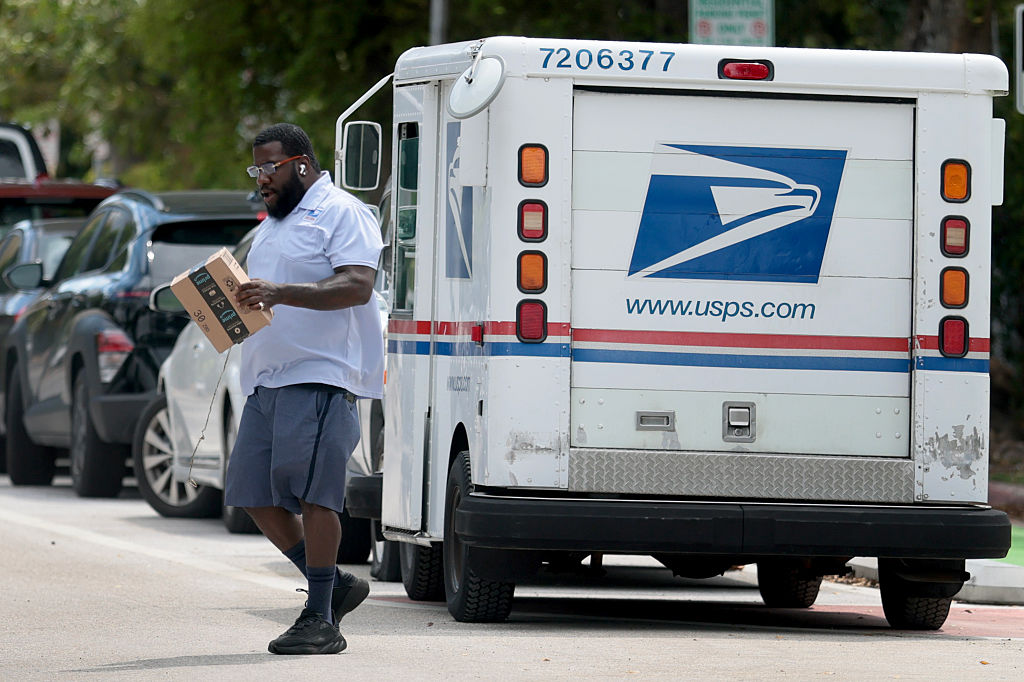
A USPS mail carrier holds an Amazon package while walking away from a parked USPS mail truck.

Amazon markets itself as USPS’s savior, but the real arrangement is exploitative. (Joe Raedle / Getty Images)


Finn Green works for the US Post Office as a rural carrier associate in and around Ojai, California. On a typical Monday, Green and other rural postal carriers deliver Amazon packages for hours without overtime pay. When mail volume is higher, such as days following legal holiday weekends and holiday seasons, carriers are ordered to prioritize Amazon parcels over Express and Registered mail, the US Postal Service’s (USPS) most expensive products. Only after completing the Amazon deliveries may carriers return to their regular route to deliver USPS mail.

Amazon’s recent statement about its relationship with the USPS presents a carefully constructed narrative. Since 2013, USPS has delivered Amazon packages through a program colloquially known as “Amazon Sundays.” The contract was up for renegotiation this year, and the stakes were high. Amazon brings in $6 billion in annual revenue to the federal agency, which is on the brink of bankruptcy. The 2026 negotiated contract resulted in the USPS delivering 80 percent of Amazon packages it had previously handled, an outcome USPS had no real power to refuse. Amazon, for its part, calls this a “long-standing partnership.” The relationship is not as mutual as Amazon suggests.

Amazon’s relationship with USPS is that of an independent, dominant tech corporation leveraging a financially strained public institution whose survival depends on the multibillion-dollar contract. Green explicitly pushes back on the idea that Amazon is “saving the day” and instead suggests that Amazon is also dependent on USPS for rural and last-mile delivery, where private logistics are too costly to replicate. Although Amazon presents itself as a high-tech delivery giant, its ability to promise cheap, fast, and near-universal shipping is absolutely reliant on USPS’s public infrastructure and labor.

USPS provides the tools necessary for Amazon’s success through long-established delivery routes, legally mandated universal service obligations, and a national workforce capable of reaching rural regions. Amazon’s role is not that of a benefactor but of a dominant customer whose logistical operations are actively reorganizing a public institution through the slow process of death by a thousand cuts. In Green’s words: “Amazon has us by the balls, basically . . . the system is rigged, where it’s like Amazon sets the metrics of what we have to hit, and if we don’t hit it, they can withhold that money.” These pressures flow downward through USPS operations and dictate how carriers prioritize their workload.

Workers are further exploited through the rural route evaluation system. Under this system, rural carriers are assigned a fixed number of paid hours for a given route, based on standardized assessments of expected workload. Actual working time often far exceeds the hours assigned to an evaluated route, particularly during periods of high mail or Amazon package volume.

Rural carriers work many additional hours beyond their evaluated time and do not receive corresponding pay or lunch breaks. Carriers are not allowed to return to the post office with any undelivered mail, meaning they must complete their full route no matter how long it takes. Delivering mail late is a federal violation, and a carrier who fails to complete an assigned route risks being fired.

USPS maintains records of both evaluated hours and actual hours reported by carriers. While carriers are required to complete full delivery routes under penalty of discipline, compensation is only addressed at specific thresholds rather than based on actual working hours. This means that although labor law requires hourly workers to be paid for every hour worked, the reality of combining the rural route evaluation system with delivery enforcement normalizes unpaid labor.

Workers like Green allege that union leadership delays addressing any structural problems. When Green raised concerns with the National Rural Letter Carriers’ Association (NRLCA), representatives acknowledged that the rural route evaluation system can result in carriers working unpaid hours without breaks. While NRLCA representatives admit the system is unfair, it is nevertheless authorized by the union contract and tied to the rural carrier’s pay structure.

Some carriers are disillusioned with the union’s perceived complicity in these exploitative practices. Additionally, say rural carriers like Green, their working conditions and hours make participating in union activities or holding management accountable practically impossible. The immediate labor crisis is a bureaucratic nightmare and feeds into a growing sense among workers that privatization is inevitable. “Here is a workforce that is unionized, but the unions aren’t strong enough,” explains Green — and Amazon knows it.

In 1970, postal service workers won protections after initiating a strike without leadership approval, but striking against the federal government remains illegal for USPS workers to this day. Alongside the 1970 workers’ strike, the postal system was restructured to operate more like a self-funded business, largely cutting off taxpayer support and relying instead on revenue from postage and services. USPS kept its public mandate to deliver mail to every address in the country, including rural and remote areas, six days a week. This created a contradictory system: USPS must remain financially independent while still delivering to addresses that private carriers won’t touch because they aren’t profitable.

Rather than being dismantled outright, USPS is repeatedly pressured through funding cuts, declining mail volumes, and a unique congressional requirement to pre-fund retiree health benefits. The breakdown of USPS isn’t by accident. Recent reports of USPS suspending pension contributions and projecting bankruptcy are presented as evidence of institutional failure, even though these crises are engineered by policy choices. Today Donald Trump claims there is no money to properly fund USPS while allocating billions of taxpayer dollars to the war in Iran and overall military spending.

Trump has repeatedly signaled support for privatizing the USPS. If this happens, Trump could use federal pressure on private postal operators to influence mail-in ballots. According to a recent report, nearly one in three Americans voted by mail in 2024. If mail-in ballot responsibilities became dispersed within the corporation, Amazon could use the opportunity to control and influence elections.

This is not outside the realm of possibility. In 2021, at an Amazon facility in Alabama, security guards were seen unlocking a USPS mailbox where employees were casting union election ballots. The Retail, Wholesale and Department Store Union accused Amazon of controlling the “mechanics of the election,” including pressuring workers to use the company-requested USPS mailbox to submit their ballots.

If the USPS were to shut down, millions of people across the country would lose a universal public communication system that delivers mail, ballots, stimulus payments, and essential goods to every address at a flat rate. Without the USPS, private carriers will lose money delivering to remote rural areas and won’t have any incentive to do so. This will disproportionately affect rural communities and people living below the poverty line. One rural population that will suffer in particular is Native American communities and Tribal Nations, which have already faced centuries of dispossession and neglect.

Amazon’s integration into USPS operations is not a good-faith partnership. The agency is expected to function as both a universal public service and a vehicle to prioritize efficiency and optimization standards set by Amazon, at the expense of workers. “People can see it coming,” warns Green. “They can see that if Amazon takes priority, it turns a federal workforce into a private workforce for a for-profit, multibillion-dollar company.”