We Can Use Predistribution to Fight Income Inequality
Mainstream economics argues that the tax system is the best tool for reducing economic inequality. In fact, “predistributive” measures like minimum wages and collective bargaining can be equally or more effective.
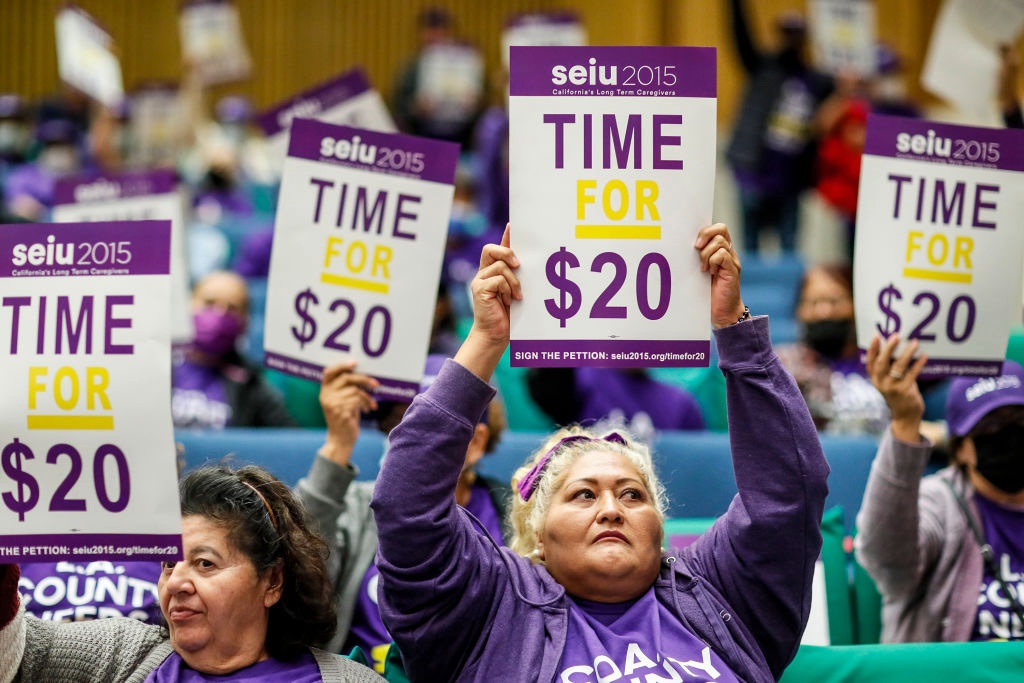
A minimum wage may increase employers’ wage costs, but these costs may be counterbalanced or even outweighed by savings from greater productivity, lower turnover, or reduced supervision. (Robert Gauthier / Los Angeles Times via Getty Images)
It is a commonplace that “neoliberal” thought and practice has an anti-redistributive bent. But dig a little deeper, and neoliberalism — or, at least, the mainstream economic thinking that has underwritten much policy in the neoliberal era — is shockingly pro-redistributive. The issue, instead, is how and when redistribution takes place. In this thinking, there is a clear preference for redistributing income exclusively through the tax system, while avoiding supposedly less efficient tools for reducing inequality, such as the minimum wage, collective bargaining, or housing regulation. In other words, there is a preference for redistribution rather than what has been termed predistribution.
This preference for tax redistribution has had palpable political and economic consequences. Recent research shows that, since the 1970s, working-class voters moved away from the Democratic Party as it abandoned its traditional support for predistribution through pro-union policies and public employment and embraced redistributive policies instead. Other research concludes that greater predistribution, not redistribution, explains why Europe is less unequal than the United States.
One of the most refined arguments for using redistribution rather than predistribution to address income inequality is the “double-distortion” argument, which says that predistribution is always more economically costly than redistribution. This argument, however, fails because it assumes that labor supply responses to either approach will be identical or that the costs of predistribution are “additive.” Neither assumption need always be true. I explore these issues at length in my new book, Ending Income Inequality: A Critical Approach to the Law and Economics of Redistribution, where I contend that the scope for predistribution is much larger than neoliberal thought and modern economic theory allow. Looking beyond the book, predistribution should be only the starting point for rethinking capitalism’s institutions.