Building Municipal Socialism in New York With DSA
Socialists’ path to supporting Mayor Zohran Mamdani will build on the strategy that socialists there have developed over the past decade, writes NYC Democratic Socialists of America cochair Grace Mausser.
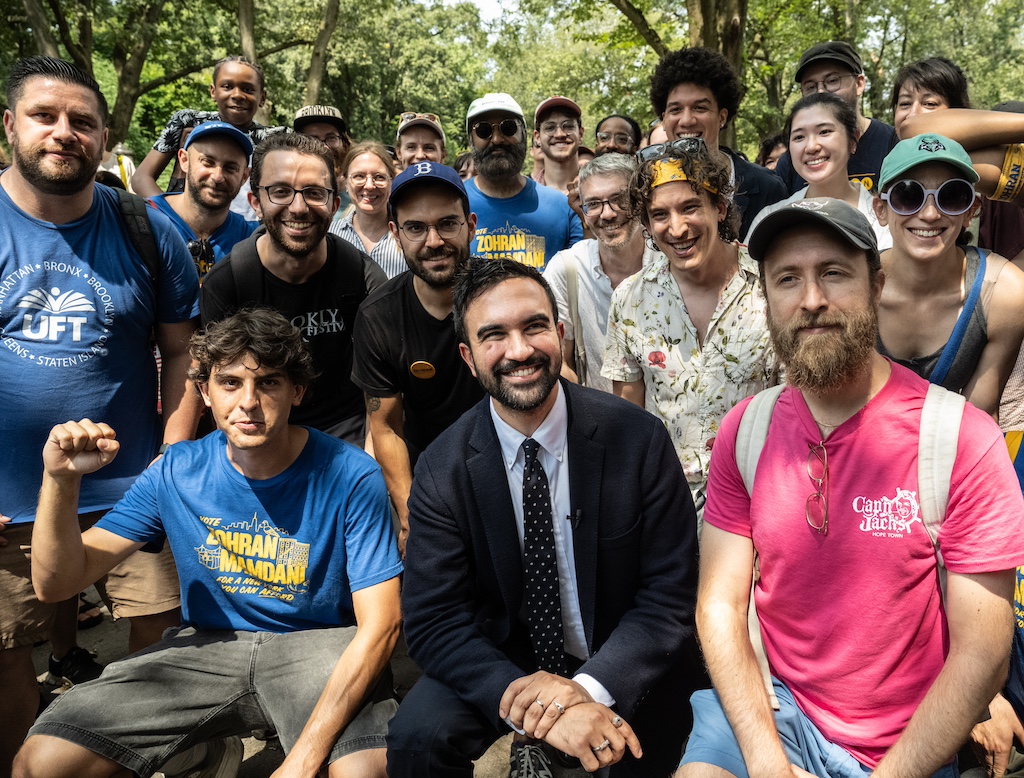
Zohran Mamdani calls NYC-DSA his political home, and the organization worked hand in hand to develop the campaign strategy, culture, and day-to-day execution to make him New York City's next mayor. (Stephanie Keith / Getty Images)
On September 6, Bernie Sanders and Zohran Mamdani packed a public school auditorium in Brooklyn. When asked what to do to make their vision of politics successful, Zohran answered, “Join DSA.” As those paying attention to New York City and State politics know, Mamdani’s victory in the New York City mayoral primary did not emerge solely from a savvy media strategy and a likable candidate. Zohran proudly calls New York City Democratic Socialists of America (NYC-DSA) his political home, and we worked hand in hand to develop the campaign strategy, culture, and day-to-day execution to make him the mayor of the largest city in the United States.
Now New York City’s left finds itself in thrilling but unchartered waters. As Ralph Miliband reminds us, “electoral victory only gives one the right to rule, not the power to rule.” Our path forward, to governing in New York City, must build upon the electoral and co-governance strategy that NYC-DSA has been developing and refining for nearly nine years. We have a model for winning mass campaigns; we have a model for true co-governance with legislators; now we will bring our experience to city hall.
Mamdani became an active member of the NYC-DSA chapter in 2017, during a period of tremendous growth for our project. Inspired by the surprise success of Sanders’s socialist message in the 2016 Democratic primaries and hardened by Donald Trump’s harrowing victory, socialists and leftists across the country felt inspired and compelled to become a more effective force.
In New York City, NYC-DSA tested our theory that socialism could win by experimenting in two city council races in Brooklyn: Khader el-Yateem and Jabari Brisport. In both races, NYC-DSA organizers, including a young Mamdani, built independent field operations that recruited hundreds of unpaid, highly motivated volunteers. Though we lost both races, we learned that our model, which demands that volunteers be trusted with campaign leadership and strategy decisions, is highly scalable, and if the conditions are right, we can win.
That ethos has guided every NYC-DSA race, including Zohran’s initial race for state assembly in 2020. All eleven of our elected socialist officials (“socialists in office,” or “SIOs”) have won their seats thanks to the commitment to distributed leadership and invitation into strategic decision-making that our campaigns prioritize. As observers look to Zohran’s race to see the future of the Democratic Party, we know the reason he won and it is simple: trust the volunteers.
Unlike traditional, establishment campaigns, we intentionally identify, train, and elevate people who have the capacity, interest, and potential to lead canvasses themselves. These highly skilled field leads ensure canvassers are trained, manage canvass materials, and handle any on-the-ground issues or questions. Some field leads are brought into even higher-level strategy. Known as field coordinators, these volunteers manage other field leads and have input into key decisions about where, when, and how a campaign canvasses.
It would have been impossible for staff to personally manage the amount of canvassing that was happening. There were dozens of events every weekend; staff couldn’t physically be in all those places. So you have to train people.
And then you have to trust them.
There will be some mistakes. But traditional political campaigns do not have this trust. They don’t believe that regular people who are excited by a political movement can handle this level of responsibility, and as a result, they tell themselves: “field doesn’t scale in a citywide or statewide race.” That is true — if you don’t trust your volunteers.
Though canvassing is at the heart of every NYC-DSA campaign, this commitment to the political development and strategic acumen of our core volunteers expands beyond the field into other tactical areas, like communications, fundraising, and policy. Establishment campaigns and the professional political class want us to believe they have inimitable skills. NYC-DSA believes that everyday New Yorkers have the ability and power to run our own political operation, and Zohran’s campaign put that belief into action.
The breadth and excitement of the campaign also brought more organizations into this campaigning style. Organizations that have invested years into the political development and leadership of their members — like CAAAV: Organizing Asian Communities; DRUM – Desis Rising Up and Moving; Jews For Racial & Economic Justice (JFREJ); and United Auto Workers Region 9A — were able to seize this mentality and deeply activate their members on not only canvassing but campaign strategy.
A truly powerful political operation, however, goes beyond simply winning elections. We are not interested in simply electing politicians who self-identify as socialists and relying on their individual principles to guide them to the right choices. Individuals falter — a stronger force is necessary to grapple with the complications of governing as socialists. So, in 2020, after five socialists won New York State legislative offices and joined State Senator Julia Salazar in Albany, we formed the Socialists in Office Committee (SIO); it would soon be joined by the City Socialists in Office Committee (CSIO) the following year.
These committees were designed to enable NYC-DSA to strategize alongside our elected officials. The elected officials and their staff meet with NYC-DSA leadership every week to share information, collectively choose priorities, and cohere on key votes. The primary purpose of this co-governance model is to enable an inside/outside strategy, where elected officials and staff with inside information and access can inform organizers on the outside about how they can best apply pressure to achieve our collective goals.
This strategy has been used to implement some of the most transformative state policy in the last decade, including tax increases on the wealthy in 2021 and the Build Public Renewables Act in 2023. Both efforts paired inside organizing and information-sharing with a robust outside pressure model, including canvassing in key legislators’ districts and holding citizen lobbying meetings.
The principle that guides our campaigns — that anyone can and should be empowered to control their political reality — is present in our SIO project. The NYC-DSA representation on the SIO committee is made up of elected, unpaid NYC-DSA members. DSA representatives on the committees are determined through internal elections, and any member could run for those spots. We do not treat working with elected officials as a sacred job, available only to political elites; it is a job for any serious organizer who wants to put the time and energy into our co-governance work.
Because of this, NYC-DSA’s SIO project is perhaps the most successful leftist governing project in the country. Though only a few years old and far from perfect, it has kept socialist elected officials connected to an organized base of activists and has helped insulate them from legislative leadership’s pressure tactics. A lone progressive may have all the right ideas, but when the speaker of the assembly threatens to cut money from their district and staff? Without an organized group to strategize with and rely on for support, it becomes all too appealing to make questionable compromises. This pattern helped solidify the Left’s long disillusionment with electoral politics, an orientation we are just beginning to move away from.
Through the later part of the twentieth century into the 2010s, the Left embraced a protest model. We were outsiders only, and our job was to apply pressure on the decision-makers. This model can result in some success but rarely has it resulted in sustained power. In some ways, being an outsider is more comfortable — you can focus solely on the demand and leave the messiness of implementation to those with power. But we all know remaining outsiders to policymaking power is insufficient to achieving any socialist goal within our lifetimes. The SIO projects make significant headway toward breaking the Left’s outsider orientation. NYC-DSA takes collective responsibility for both the success and failures of our socialist elected officials.
Developing a Cogovernance Structure
SIO should be the model we build on to develop a co-governance structure with the Mamdani mayoral administration. NYC-DSA has demonstrated that we can scale a radically open campaign model from a state assembly race to a mayoral campaign; and we have shown that it is possible to hold a bloc of leftist elected officials together and connected to a mass base. Now we must combine and evolve the two ideas. Doing so will require three things: bringing more organizations into the structure, developing beyond an inside/outside strategy, and ensuring everyday New Yorkers have ways to engage in all levels of the work.
1) Bringing more organizations into the structure
First, we must include more groups in co-governance with the Mamdani administration. NYC-DSA is the only organization in the SIO projects. While this has worked so far, the geographic scale and unilateral power of the mayor demands a wider base. Zohran has already united community organizations and unions across the city with his campaign. Importantly, many of those groups also have organized, active bases that were excited and engaged in the campaigns. Now is the time to form a left-labor coalition; an opportunity to collectively enact a populist agenda is a great incentive for these groups to put their differences aside and strategize together.
2) Beyond an inside/outside strategy
Second, we must evolve our inside/outside strategy. The inside/outside strategy is primarily about extracting as many victories as possible from an ostensibly resistant leadership and administration. But we will soon have a mayor from within our movement. There will certainly still be enemies to pressure both at the city and state levels (Governor Kathy Hochul is certainly not excited to implement the Mamdani agenda), but mobilizing and preparing lower levels of government to support and enact policy goals from the top is different than pressuring high-level decision-makers. We cannot fall into the Left’s comfort zone of protesting power.
This dynamic was part of hindering Bill de Blasio’s administration. Most advocates chose an oppositional approach to the de Blasio administration (mainly looking to maximize their leverage on single-issue campaigns), and this orientation ushered in a collapse of that coalition. The young idealists who had entered the de Blasio administration on the inside took different tacks — some left the administration disillusioned with the mayor, others felt he had gotten a raw deal and became disillusioned with the Left. None had the power to use their relationships to change the underlying dynamics facing the Left or the administration.
The inside portion of the inside/outside strategy under de Blasio had little to show for itself after eight years, and the outside portion was not in a stronger position either. This time, we must utilize the Mamdani coalition’s membership and the massive volunteer base to create mass mobilization to enact Mamdani’s agenda, contesting opponents within and without the government itself.
Call it mass governance.
3) Ensuring everyday New Yorkers have ways to engage
This is why the third piece is key.
Just like in every NYC-DSA campaign, we must ensure that regular supporters have clear ways to engage on all levels of this work. This will mean creating active policy campaigns that will enable the 50,000 canvassers and 500 field leads from Zohran’s campaign to put their door-knocking and field strategy skills to use. Additionally, we must ensure groups engaged in co-governing leadership are also mobilizing their members to knock doors and lobby for the changes necessary to enact Zohran’s agenda.
Further, we must plug Zohran organizers and supporters into lower-level city institutions en masse. New York City has hundreds of small semigovernmental bodies that are typically ceded to less progressive forces, such as community boards, and parent-teacher associations and community education councils. The city also has hundreds of opportunities for people to volunteer, including at libraries and parks. Both the Mamdani administration and groups organizing with it should work to encourage supporters to engage in these spaces. We have the opportunity to create a sense of mass ownership over the city and build support for Zohran’s agenda from the bottom of city government to the top.
Winning this election was shocking, but NYC-DSA has shocked before. Winning is hard, but we know from experience that governing is harder. The same forces that fight leftists in elections fight us in office, and we must continually organize and mobilize to beat back those powers, even when press and public attention is turned elsewhere. We must use this victory and the strength of the mayor’s office to build the power needed to reshape the city — into a city by and for the working class.