Hungary’s Narrow Path Out of Orbánism
Elections on Sunday could finally remove Viktor Orbán from power. Opposition forces have rallied behind rival candidate Péter Magyar, less out of belief in his program than from desperation at the country’s authoritarian turn.
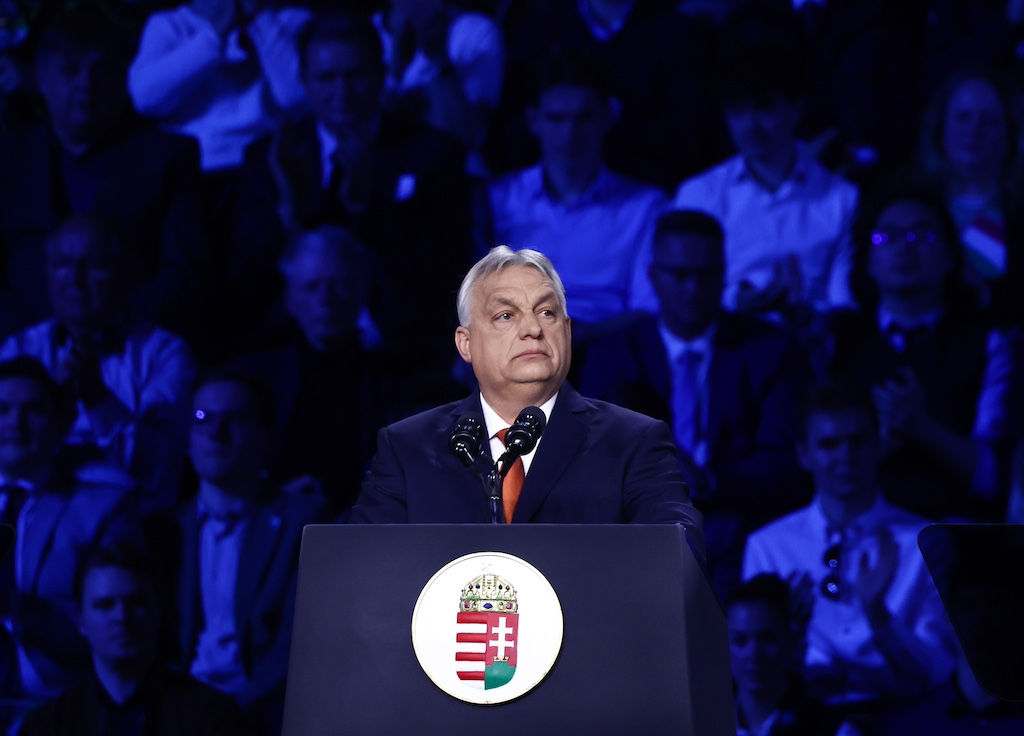
Despite the favorable constellation of an opposition in the lead and a mobilized civil society, Hungary’s path toward democratization remains narrow and treacherous. (Jakub Porzycki / NurPhoto via Getty Images)
Ever since Viktor Orbán’s far-right Fidesz party came to power with a sweeping supermajority in 2010, Hungary’s democratic institutions have faced constant pressure. Orbán called his victory a “revolution in the ballot box” and proceeded to systematically dismantle most institutional checks on his personal power. He adopted a new constitution, brought the Constitutional Court under party control, changed the electoral system, and redrew electoral districts to give his party a significant advantage.
There was more. Orbán used his political power to enrich friends and family members, consolidated most of the media market in the hands of loyalists, turned the public broadcaster into a propaganda outlet, and weaponized the state to bully NGOs, academics, labor unions, and the remnants of the independent press into silence.
While elections remained technically free, they were anything but fair. The systematic distortion of the playing field in favor of Fidesz produced three subsequent supermajorities in the 2014, 2018, and 2022 parliamentary elections.
The outlook for this Sunday’s vote, however, looks very different.
In previous “free but not fair” elections, the only realistic question was whether the incumbent ruling party would maintain its two-thirds supermajority. Today all independent polling institutes report a comfortable lead for the opposition, in percentage terms at least. A recent poll by independent pollster Medián showed a 20 percent lead for the center-right Tisza (Respect and Freedom) Party, though government-aligned counterparts continue to report that Orbán’s party remains ahead.
The main opposition runner, the center-right Péter Magyar, also appears to be the bookmakers’ favorite. It is likely no coincidence that Hungarian authorities banned Polymarket for “facilitating illegal gambling” just as the campaign began. Another clue to the genuine unpredictability of this election is that publicly traded shares of Orbán-affiliated companies consistently trended downward in the last weeks of the campaign.
To make matters worse for Orbán, a sequence of scandals shook Hungary ahead of the vote. In December, leaked video footage revealed severe cases of child abuse in state-run children’s homes. In February, the public learned how the government enabled Samsung to expose workers to toxic chemicals in a battery plant. Some workers were allegedly asked to take rotating shifts within the most contaminated zones, a practice reminiscent of repair works in the Chornobyl exclusion zone. In March, a detective from the National Bureau of Investigation revealed a plot by the country’s secret service to infiltrate and cripple Magyar’s Tisza Party using intimidation, blackmail, and bribes.
Despite his scandals and their own favorable polling, opponents of Orbán still face a challenging period ahead. Due to systematic gerrymandering, Fidesz could secure a parliamentary majority, even if most voters cast their ballots for the opposition. The incumbents can also rely on a neo-feudal network of local elites used to bribe or coerce some rural low-income communities to vote for Fidesz. While the outcome remains highly uncertain, that uncertainty itself makes this contest unprecedented in recent Hungarian history.
(Counter)-Populism
The meteoric rise of Magyar and his Tisza Party has transformed the Hungarian political landscape. In 2024, the public learned that President Katalin Novák had pardoned a man serving a prison sentence for covering up child sexual abuse. Magyar rose to prominence after releasing a taped recording of his wife, the justice minister, implicating other leading politicians in the scandal.
A few months later, the brand-new party of this previously little-known Fidesz member secured nearly 30 percent of the vote in the 2024 European elections and contributed to the near-total collapse of the fractured left-liberal opposition. Magyar positioned himself on the center right, adopted a more pro-EU and pro-NATO stance in foreign policy, and joined the European People’s Party, made up of parties like the German Christian Democrats, in the European Parliament.
Magyar’s Tisza Party is promising something to every electoral bloc, including tax cuts for low-income taxpayers, an increase in pensions, keeping Orbán’s popular tax incentives for families while supplementing them with higher cash transfers, and also maintaining fiscal discipline and avoiding large deficits. These policies would leave working-class Hungarians better off than the status quo, but since increasing the income tax of high earners is not on the agenda, they’d also leave Orbán’s famously regressive tax system largely unaltered.
Tisza’s election manifesto promises both tax cuts, increased transfers, and improved public services, while suggesting that anti-corruption measures, a wealth tax on the richest 0.2 percent of households, the confiscation of oligarchs’ illicit wealth, and access to EU funds currently frozen over rule-of-law violations will make these policies fiscally sustainable. Magyar claims to transcend traditional cleavages by populist slogans such as: “There is no left or right — only Hungarian.” If Hungarian Marxist G. M. Tamás were still with us, he would likely repeat his favorite quote from Alain: “Those who cannot decide if they are left-wing or right-wing are right-wing.”
Magyar’s rise coincided with — and contributed to — the fatal decline of various left-liberal formations. Many smaller parties, such as the Hungarian Socialist Party, the neoliberal Momentum Movement, the formerly far-right Jobbik, the Green Party, as well as Budapest mayor Gergely Karacsony’s Dialogue — the Greens’ Party, announced that they will not run in this year’s election to increase Tisza’s chances of ending Orbán’s long tenure. While most leftists and liberals have some reservations about Tisza, most mainstream liberal opinion formers tend to recognize that this is not a normal democratic election and that Magyar might be their only chance of halting further autocratization.
Magyar’s promise of restoring basic democratic standards appears to be enough to rally desperate liberals behind him, while his nationalist rhetoric allows him to gain support among socially conservative voters in Fidesz’s rural heartland. The two small parties left of Magyar that are still running are the Democratic Coalition established by former Prime Minister Ferenc Gyurcsány, whose unpopular austerity policies directly contributed to Orbán’s first supermajority, and the satirical Two-Tailed Dog Party.
Both are currently polling under the 5 percent threshold needed to enter parliament. If polls are to be trusted, the only party other than Fidesz and Tisza to surmount this hurdle is the Our Homeland Movement, on the lunatic fringe of the Right, bringing together an eclectic mix of anti-vaccine conspiracy theorists and unapologetic fascists.
In many respects, the secret of Magyar’s success lies in making Orbán “taste his own medicine” by championing a new style of populism suited to the TikTok age. A charismatic orator, he frequently evokes the heroic struggles of Hungary’s 1848 and 1956 revolutions, while pitting “ordinary Hungarians” against Orbán’s kleptocratic elite.
Initially, Magyar posted short videos of himself in everyday settings — in the kitchen, at the gym, or at the barber shop. As the election campaign approached, however, his content shifted toward a more statesmanlike image.
While Orbán cozies up to other illiberal leaders in the region, such as Slovakian Prime Minister Robert Fico, Magyar portrays this as a betrayal of Hungarian-speaking minorities in neighboring countries, presenting himself as a more credible nationalist than Orbán. On immigration, Tisza promises to maintain restrictive policies — including the razor wire fence along Hungary’s southern border — but criticizes the government for allowing multinational companies to hire non-EU guest workers on temporary visas.
Civil Society and Mass Mobilization
Hungary’s current chance to democratize does not stem exclusively from the shifts in party politics. It is also contingent on civil society’s ability to mobilize, both to prevent electoral manipulation, if needed, and to ensure that Magyar honors his word once in office. Mass mobilizations already played a significant role in creating a situation in which overturning Orbán is within reach. In March 2025, already trailing in the polls, Orbán announced a sweeping crackdown on the remnants of Hungary’s independent media and civil society. He also warned organizers of the Budapest Pride Parade that any money or effort spent on next year’s event would be wasted.
The effect of these announcements, however, was the opposite of what the government intended. Rather than terrifying civil society actors into submission, the specter of a drift toward open autocracy akin to a country like Belarus reenergized them. The mobilization that followed forced the government to reconsider its promised “spring cleanup.”
To make matters even more embarrassing for the government, the Budapest Pride Parade not only proceeded despite the official ban and threats but became one of the largest public gatherings in recent Hungarian history.
While the Pride ban was likely intended to pressure Magyar into taking a stance on a divisive issue, he stayed out of the controversy, allowing the Green party mayor, Karácsony, to take the lead in making Orbán’s Pride ban unenforceable.
The significance of this massive turnout extends far beyond a show of solidarity with Hungary’s LGBTQ community. Authoritarian leaders have powerful incentives to cling to office by any means available — especially in a kleptocracy like Hungary, where losing control of the justice system could expose corrupt elites to criminal prosecution. In this context, the parade also signaled that any attempt to subvert the election would be a risky gamble, which might not be worth taking, particularly for those with substantial funds in foreign bank accounts.
The Treacherous Path Ahead
Despite the favorable constellation of an opposition in the lead and a mobilized civil society, Hungary’s path toward democratization remains narrow and treacherous. Orban’s camp may opt for dirty tricks out of desperation.
Magyar recently warned the public that Russian-style kompromat may be used against him. He suspects that someone secretly filmed him in an intimate situation. In the current geopolitical climate, fear tactics about war escalation could also frighten voters into supporting the incumbent. Fidesz recently released an AI-generated video depicting the public execution of prisoners of war, implying that Hungary might join the war in Ukraine if voters bring a new government to power.
On Easter Sunday, a week before the vote, Serbian authorities allegedly uncovered a plot to blow up a gas pipeline critical for Hungary’s energy supply. Both Magyar and a former counterintelligence officer suggested that the conveniently timed security threat could be a false-flag operation designed to give Orbán a last-minute boost.
Although largely isolated within the EU, Orbán still has powerful allies abroad, from Moscow to Washington, DC. This year’s Conservative Political Action Conference (CPAC) in Hungary looked like the “who’s who” of the far-right internationale, with attendees including Javier Milei, Alice Weidel, Eduardo Bolsonaro, and Geert Wilders. Donald Trump assured Orbán of his “total and complete endorsement”; Benjamin Netanyahu thanked him for “standing up for Western civilization, against this tide of radical, fanatical Muslims.” J. D. Vance even visited Hungary just five days before the election to endorse Orbán while also warning of possible interference by “Brussels” — a narrative that could be used to undermine the legitimacy of the results in case Fidesz loses.
Perhaps more worryingly, reports by the Financial Times and the Washington Post suggest that Russian covert operations are currently underway in Hungary to help Vladimir Putin’s most important EU ally stay in power, including by allegedly proposing a plot to stage a fake assassination attempt.
Even in the event of a change in government, democratization remains far from guaranteed. Reversing most of the antidemocratic changes Orbán introduced would likely require a parliamentary supermajority. A new government would also have to govern alongside thousands of Fidesz loyalists deeply embedded in institutions at all levels of the administrative state.
Some polls suggest that a Tisza supermajority is not beyond the realm of possibility. Such a result would allow the new government to enact the institutional reforms needed to restore the rule of law, such as restoring the independence of higher courts, removing the political appointees from the justice system who currently guarantee impunity for corrupt actors, and joining the European prosecutor’s office. Yet it could also tempt Magyar to take control of the very machinery of power Orbán constructed and establish himself as Hungary’s next authoritarian strongman.
In this uncertain climate, civil society organizations that halted Hungary’s slide into “Belarusization” in 2026 must remain vigilant. They will have to prevent potential attempts at electoral manipulation but also pressure a Magyar government to implement the reforms voters mandated.
A Moment of Risk and Opportunity
The weeks ahead carry both significant risks and historic opportunities for Hungarian democrats. While in the worst-case scenario, the regime could cling to power through illegal means, signaling a drift toward open dictatorship, the recovery of Hungary’s diminished democracy is also within reach.
Orbán’s possible departure won’t be a victory for the Left. It would, nonetheless, be a serious blow to the global far right and could offer much-needed hope to citizens in embattled democracies worldwide.