Hungary After Orbán

Viktor Orbán was full of contradictions: a critic of neoliberalism who gave handouts to corporations and a moralist who ended up mired in scandal. But even after his election defeat, it’s unclear how much Hungary will really change.
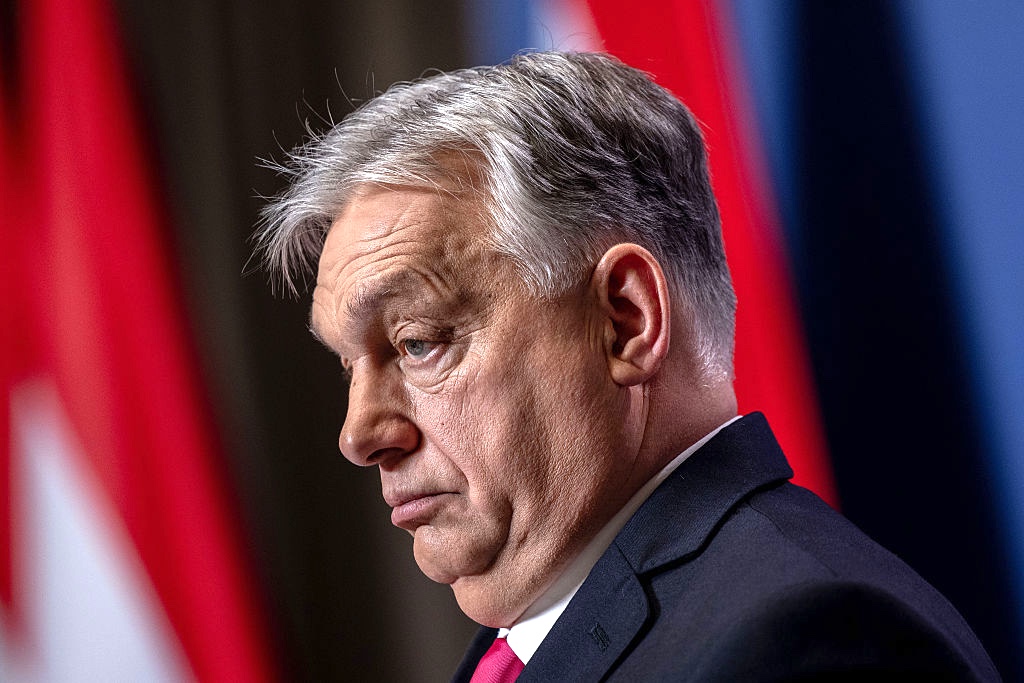
Despite Viktor Orbán’s outsize international profile, this was an election mostly rooted in local realities. (Janos Kummer / Getty Images)

Taunting his defeated opponents on the night of Hungary’s last elections four years ago, Viktor Orbán had boasted that his triumph could be seen from the moon, “or at least, from Brussels.” Four years later — despite the government’s investments in the domestic space program — his opponent Péter Magyar responded: the Hungarian people’s triumph “might not be visible from the moon” but it could be “seen from every Hungarian window.” Gathered along the Danube, his supporters erupted in cheers. A festival-like atmosphere filled Budapest’s streets and much of the country.

Results trickling in throughout the evening confirmed a reversal that had seemed only a distant possibility during much of Orbán’s sixteen-year rule. His Fidesz party was swept aside by the unbalanced electoral system it had devised, which allowed Magyar’s upstart Tisza Party to gain a potentially constitution-altering, absolute majority in parliament. Turnout, at almost 80 percent, was the highest in Hungary’s post-1989 history.

Despite Hungary’s small size and peripheral status, the end of Orbánism made headlines internationally. As right-wing leaders such as Marine Le Pen and Donald Trump eulogized Orbán’s legacy, most of the liberal response has focused on the country’s imminent “return to Europe” and the reestablishment of democratic norms. More tempered voices on the Left pointed out that the new parliament would be entirely right-wing; Magyar himself had been a member of Orbán’s Fidesz party until 2024 and sits with the conservative European People’s Party fraction in the European Parliament. Some claimed that nothing had — or could — change: this was simply Fidesz 2.0.

For many on the Hungarian left, it was a night of mixed feelings. On the one hand, there was relief at the demise of an unjust, cruel system of rule, which has become central — including as a direct source of funding— to global far-right networks. On the other, Magyar’s own belated break with Orbán hardly entails a break with the structures that have enabled his regime; the relief on Sunday night says much about the dire state of the Left worldwide.

Yet, after sixteen years of increasingly autocratic and self-serving Fidesz governments, to dismiss Magyar’s arrival as just more of the same would be to misrecognize the contingent opportunities, the structural shifts, and desire for change that led to this moment.

Orbán’s Many Moons

After spending most of the 2000s in opposition, Orbán returned as prime minister in 2010 promising to restore national sovereignty and break with the neoliberal, austerity-driven politics of the previous decades. Yet this was no real rupture but more a selective process of fiscal interventionism, pursuing job numbers by wage repression, a disciplinary public-works program, and increased integration into global production chains.

This was one of many tensions in this system. Orbán’s proclaimed “work-based society” was one that curtailed trade unions, allowed up to 400 hours unpaid annual overtime, and privatized public health and university systems by stealth. It has been a “pro-family” regime whose ruling members have been directly linked to systemic abuse in state-run foster homes, that has defunded childcare, and in which the country’s president had to resign after pardoning a pedophile’s enabler.

In response to free-falling levels of health and education, the government abolished these ministries and handed them over to the interior minister. Presenting himself as a dove in face of the “war camp” in Brussels, Orbán has gone to great lengths to shield Israel’s actions, been one of the German defense industry’s most loyal customers, and — reportedly spurred by a religious vision of his son — long mooted a military intervention in Chad. Since 2020, Hungary has been under a state of emergency, allowing the government to rule by decree; in recent years, army recruitment campaigns have dotted the country’s billboards, while lavishly produced and AI-generated propaganda videos have warned of imminent war.

As state and party effectively fused, independent media was curtailed, the rule of law weakened and digital surveillance expanded. Simultaneously, the government turned to culture wars in order to explain away the country’s ills: refugees, George Soros, Ukrainians, or “gender ideology.”

Even as Hungary’s social and economic metrics have slumped — it is today, with Bulgaria, one of the two poorest EU countries — Orbánism proved resilient until the last years: the economic upturn of the 2010s, subsidies for household energy consumption, coercive use of state power, the complicity of the EU, and an ineffective and dispersed opposition all allowed it to stabilize. So, how did it unravel so drastically?

Austerity Redux

Sunday’s outcome reminded us that despite Orbán’s outsize international profile, this was an election mostly rooted in local realities. Having reached power by standing against austerity, Orbán himself presided over what increasingly became even more drastic austerity. Keeping close to the EU’s fiscal orthodoxy, his administrations slashed town hall budgets, hardly invested in infrastructure, and enshrined a flat-tax system and the world’s highest VAT.

Hungary had one of Europe’s highest per capita death rates in Europe during the COVID pandemic and frequent disruptions to an underfunded state railway system became a flash point of popular anger in recent years. While it facilitated a construction boom, his “pro-family” policies largely consisted of tax breaks and loans for the middle and upper classes; as such, they amounted to an upward redistribution of wealth and failed to reverse falling birth rates. Neither J. D. Vance nor any of the right-wing personalities who would flock to Budapest talked to the ordinary Hungarians who had faced years of continuous economic stagnation — much of it with record-levels of inflation — crumbling infrastructure, and a tone-deaf government.

Orbán’s trajectory is, still, revealing of the far right’s trajectory worldwide. His shrewd criticism of neoliberalism after the 2008 financial crisis and selective use of state intervention in power sketched a new social contract with a national community conjured up — and disciplined — through his “workfare regime.” This project echoed and inspired that of parties like the True Finns or the Swedish Democrats in the 2010s; some of its elements were articulated by Le Pen and Trump; and it found its closest equivalent and allies in Poland’s Law and Justice party.

In the intervening decade, having seized or sufficiently shaped their respective states, these actors have all but abandoned their welfarist pretense, a shift in large part facilitated by the weakness of organized labor. These promises might have been hollow to begin with, but this process also points toward the radicalization of large sectors of capital worldwide. Having largely discarded the very notion of a social contract, they can offer little more than politics of resentment, graft, and militarization. Much of these tactics have proven dispiritingly effective globally — but as Orbán’s regime suffered electoral wipeout, jubilant crowds tore up his party’s electoral posters countrywide.

Orbán’s Losing Bets

Corruption and mismanagement doubtless played a role in Hungarian economic woes, but its shrinking economic leeway is inseparable from international processes. A small country with little in terms of natural resources or leverage, Hungary has long staked its economic prosperity on foreign investment. Since the 2000s, this has foremost consisted in the (predominantly German) car industry, whose presence Orbán facilitated through tax exemptions and the disciplining power of the state. While some point to the general downturn of German manufacturing to explain Hungary’s own decline, this is only part of the story.

As early as 2016, Orbán made a concerted effort to woo East Asian battery manufacturers to Hungary, with the goal of making Hungary a “battery hub” connecting Asian economies with European manufacturers. The investment was staggering: in 2023, Hungary received 43 percent of Chinese investment in the EU and factories sprouted up across its territory.

Yet — as researcher Dávid Karas writes, “Lacking the infrastructure, energy capacity, and labor necessary for hosting a battery ecosystem, the government assumed the costs of derisking an entire regime of production.” As energy prices spiraled upward in the wake of the Ukraine war and Germany cut EV subsidies, the whole project unraveled, significantly straining Hungary’s energy grid and macroeconomic stability.

Significantly, this was an industrial policy disembedded from social realities. As the environmental and social cost of these factories became apparent (they provide only few local jobs and have been shown to heavily pollute soil and water), dissatisfaction mounted even among the Fidesz faithful. In the final week of the election campaign, reports about a governmental cover-up of industrial accidents at the Samsung factory in Göd were leaked to the press, provoking outrage.

Hubris

EU funds had cushioned the Orbán regime’s first years and facilitated its consolidation; besides well-publicized spats with the European Commission, there were at the time few substantial differences. But as Orbán embarked on an increasingly diverging path in recent years — notably regarding Ukraine — EU funds were gradually frozen in response to a slew of rule-of-law breaches. Tightened finances reduced the government’s room for maneuver and, significantly, made it more difficult to maintain the clientelist networks that kept midsize entrepreneurs and local political figures within Fidesz’s orbit.

During its years in opposition in the 2000s, Fidesz had built an alliance with domestic entrepreneurs that felt left out of Hungary’s foreign direct investment (FDI)–oriented economy. By the end of Fidesz’s rule, however, an increasing section of Hungarian capital expressed public frustration with the concentration of wealth and power within a small oligarchic class. As the ruling elite engaged in ever-more ostentatious displays of wealth, from luxurious yachts and stadiums to zebras on Orbán’s family compound, a few entrepreneurs even went public with complaints that the “game was rigged.”

A similar process played out within Fidesz: long a vehicle for social and political mobility for the ambitious — usually young men from the provinces such as those that had formed Orbán’s own circle — the party had atrophied during its years in power. Emerging from this dissatisfaction, Magyar’s own stalled ascension within the party doubtless contributed to his break with it.

Orbán’s defeat is also, ultimately, a simple tale of hubris. Sixteen years in power have blinded the ruling clique to the realities faced by much of the country. If the regime’s reliance on propaganda could be seen as cunning, ruthless ploys in its early years, the Orbán elite appears to have increasingly believed its own, increasingly grandiose fantasies and the results of the ludicrous “national consultations” — state-funded propaganda exercises — it regularly organized. While Orbán successfully turned fear over war in neighboring Ukraine to his advantage in the lead-up to the 2022 elections, the specter of the existential threat posed by Kyiv had lost its edge after four years; it was also more difficult to paint Magyar as a Ukrainian asset given that he only slightly diverged from Orbán’s position on this issue.

This complacency was reflected in Fidesz’s lackluster campaign. Whereas previous elections had seen promises of cash transfers and the announcement of targeted economic policies in the run-up to the vote, the 2026 campaign was almost entirely built on fear-mongering and the notion that Fidesz represented the only stable choice.

Heckled by young protesters at a rally in Győr in the final days of the campaign, an irate Orbán yelled at them to be grateful instead. Regime strongman János Lázár made deeply damaging racist comments on the campaign trail about the country’s Roma population, a minority that had in fact largely voted for Fidesz in the past decade. A false-flag operation allegedly targeting energy infrastructure running through Serbia was so botched that even government-affiliated media soon enough stopped reporting on it. As for the past twenty years, Orbán refused to participate in any public debate.

The Rise of Magyarism

Magyar’s rise might have been as unforeseen as sudden — but it was the result of the slow dissolution of Fidesz’s economic project and the social contract that held it together. He was also fortunate to step into an anti-Orbán field that had been essentially leveled: a void due in equal parts to Orbán’s repression of potential counterpowers, the opposition’s dismal track record, and the same lack of socially anchored mass movements we see worldwide. A Fidesz insider, Magyar is the ex-husband of former Justice Minister Judit Varga, one of the chief culprits in the dismantling of Hungary’s judiciary (she has since accused him of domestic abuse).

Magyar broke into the Hungarian mainstream in February 2024 through an appearance on the YouTube channel Partizán, during which he criticized Fidesz’s handling of the then-unfolding “pedophile scandal” that had led to the resignation of both Varga and Katalin Novák, Hungary’s Fidesz-aligned president. A lawyer and Fidesz member since 2006, Magyar had held various high-ranking state positions. The “defection” of an Orbánite insider was rare enough to catch public attention at a moment of acute moral crisis for the government.

Soon enough, he announced his entry into the political arena at the head of the Respect and Freedom (Tisza) Party. At the 2024 European elections, he handily outperformed all existing opposition formations. In contrast to Orbán — who either appeared in heavily choreographed domestic settings or engaged in international meetings — he continued his campaign throughout the country throughout the next two years, often embarking on weeks-long trips to small towns and villages.

Magyar’s ascent built on outrage at the moral decay and corruption of the ruling elite; the fact that he had belonged to the same elite brought both interest and credibility to his story. If this outrage remained a key element of his messaging throughout the past years, he also campaigned on a promise to invest in the country’s decaying health system and infrastructure. He skillfully wove social considerations into what remains an essentially nationalist, pro-business technocratic program.

Rallying the overwhelmingly Fidesz-critical youth and provincial middle class to his cause, he could also count on the support of disgruntled entrepreneurs that felt Fidesz had “distorted competition”: his main economic adviser is the former global vice president of Shell. Elements of the state apparatus, fearful of a break with the EU and NATO, also joined Magyar, as shown by defections and denunciation of Orbán among high-ranking military and policemen.

Promising national renewal and a reestablishment of democratic and judicial norms, the Tisza program is a hodgepodge of various political inclinations: promising a 1 percent wealth tax on billionaires. and investment in social housing, it also vows not to touch Fidesz’s deeply unjust taxation system, “pro-family” tax breaks, or labor regime. Vowing to double down on Fidesz’s racist migration policies, Magyar has not engaged with demands from trade unions or feminist initiatives, and while his program alludes to the merits of crypto, climate policy is essentially absent.

Until 2024, Magyar’s political trajectory had been entirely shaped within Fidesz; he has often displayed the same kind of arrogance and hostility to questioning that has characterized the incumbents. In his first interventions after the elections, he promised to bring to justice those who had plundered Hungary, limit the premiership to two terms, and rejoin the International Criminal Court. He also invited Benjamin Netanyahu to Hungary and praised Italy’s far-right premier, Giorgia Meloni.

Challenges Ahead

Most of Magyar’s advisers and elected Tisza officials are either unknown or firmly on the right of the political spectrum — yet he himself acknowledged in his victory speech that many had voted for him less out of conviction than necessity. Having vacuumed up most opposition to Orbán, his own coalition is inherently unstable. Faced with daunting economic and political challenges, his base might rapidly fissure if tangible changes do not materialize.

Firmly defeated, Fidesz is nonetheless hardly dead: its 2.2 million voters — as Orbán underlined — amount to the same number that had assured it a two-thirds majority of seats in 2014. If Tisza could rely on a large number of volunteers, Fidesz remains the only institutionally organized party nationwide; its influence also extends throughout the economy, state apparatus, and social fabric.

Tisza does yield the same parliamentary majority that allowed Fidesz to change the constitution on a whim, but it must also contend with hostile courts, a Fidesz loyalist as president, and an economy dominated by transnational companies and Orbán-aligned oligarchs. Goodwill, and funds, from Brussels might alleviate the country’s predicament in the short run but can hardly overcome such structural challenges.

A View From the Left

The Hungarian Parliament elected on Sunday is the first since 1990 that contains not even a single member nominally on the Left. In addition to the Fidesz and Tisza fractions, the openly fascist Our Homeland Movement party has kept its representation. In reaction to popular pressure, unfavorable polls, and their own conviction, left-leaning MPs gradually dropped out of the race and endorsed Tisza; other voices on the extra-parliamentary left called for abstention.

The Democratic Coalition party (DK, long affiliated with disgraced former socialist PM Ferenc Gyurcsány) barely achieved 1 percent and is finally set to join the once all-powerful Socialist Party and Green Party splinters in the graveyard of what constituted the institutional face of Hungary’s left during the past decades. Once a promising force bridging grassroots organizing, party politics, and community work, the Szikra (Spark) movement has itself stalled in the face of daunting challenges and state clampdown. After decades of both overt and insidious repression, trade union density and organizing are at a historical low. Within the broader region of Eastern Europe, the wave of left-wing and green movements that emerged in the 2010s has survived rather than grown.

And yet, the overdue disappearance of what has often passed for the Left in Hungary opens space for new initiatives and forms of organizing. There also exists a diffuse, heterogeneous progressive scene that was hardly present a decade ago; a new generation of labor organizers has emerged and critical scholarship and platforms have endured. The reestablishment of a less repressive judiciary and state apparatus cannot address the root causes of Hungary’s predicament but would make political organizing and mobilization less daunting than it has been during Fidesz’s rule.

The aspiration for a “Péter Magyar of the Left” remains a fantasy amid existing socio-historical conditions; however, his rise was fueled by a genuine appetite for social change and political involvement that any left-wing initiative must take note of. And while there is little in Magyar’s program or trajectory that breaks with the market-driven politics that have turned Hungary into a deeply unequal country, he was only able to achieve such broad support by campaigning for the kind of state-led social policies that a majority of Hungarians yearn for. Failure to deliver might quickly lead to confrontation with a newly politicized population.

Magyar has yet to take office, but his promise of a return to normality can already be discarded as illusory: an international order buttressed by US-hegemony, seemingly frictionless globalization, and a relatively stable climate is not coming back. The Europe “Hungary has returned to” remains rudderless, morally tainted, and structurally dependent on the exploitation of the labor and resources of countries such as Hungary itself. But Magyar’s own rise epitomizes a political terrain made of rapid change and recomposition. Two years ago, Sunday’s outcome was near-unimaginable. The large-scale mobilization, hope, and politicization that led to this outcome can hopefully lead to a more open and plural political space.

This change might not be visible from the moon. But it can, let’s hope, allow the forging of new paths.