What Viktor Orbán’s Downfall Hasn’t Settled
In Hungary’s election, Péter Magyar rallied urban white-collar workers, business figures excluded from state patronage networks, intellectuals, and youth. It’s much less clear that his new government can satisfy all these groups’ expectations.
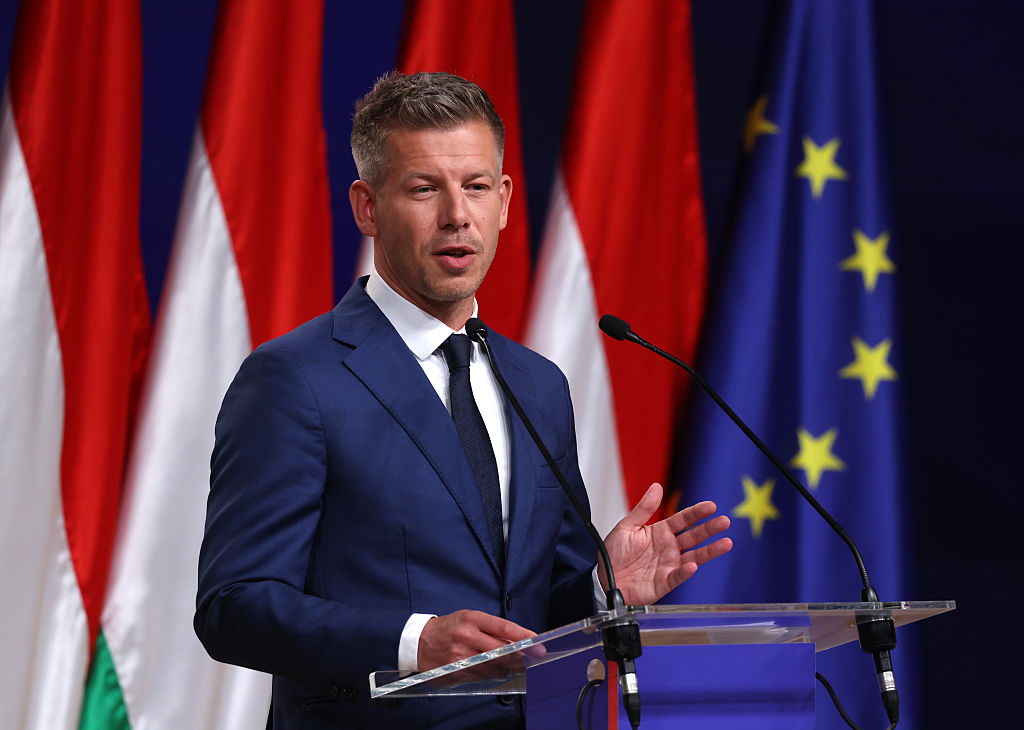
Now entering government, it’s unclear how Péter Magyar’s Tisza can revive the economy. The Left remains weak, and Viktor Orbán’s party may again posture as the voice of working-class frustration. (Sean Gallup / Getty Images)
Péter Magyar’s Tisza party has won a two-thirds supermajority in Hungary’s 199-seat parliament, built on nearly 80 percent turnout, the highest since the fall of state socialism. With some expatriate ballots still being counted, Tisza holds 140 seats to Fidesz’s 53, marking the end of Viktor Orbán’s self-styled “illiberal” rule.
Some analysts now suggest that Orbán’s government cannot have been truly authoritarian if it could be voted out this cleanly. That misses the point. What enabled change was not the mildness of his rule but a rare convergence of pressures: geopolitical isolation, economic malaise, moral crisis, and a disciplined challenger who mobilized previously passive citizens while sweeping aside other, discredited opposition forces.
But the deeper question is what exactly this result has broken. This was not the defeat of a government that had simply outstayed its welcome. It was the breakdown of a political settlement that had seemed, until recently, both electorally durable and socially entrenched. What broke on April 12 was Orbánism’s capacity to organize consent: across classes, across regions, and above all across generations.
Why Orbánism Had Lasted
There were clear signs of a struggle over what Antonio Gramsci called moral leadership. Former insiders, from the police, the military, and the state-adjacent expert world, stepped forward in the last weeks of the campaign to describe how public institutions were bent to party-political ends, how opponents were targeted, and how public service decayed under state capture. Magyar turned this into more than just a ”corruption” narrative. He cast the regime’s functionaries not only as self-serving, but as the custodians of a morally exhausted order.
That mattered because Fidesz did not rule by patronage and coercion alone, even though it relied on both increasingly. It also ruled by presenting itself as the guarantor of seriousness, order, family, work, and national protection. The discourse of the “work-based society” dignified the productive family and the disciplined worker while stigmatizing the undeserving poor, a category that disproportionately mapped onto Roma communities. Rural heartlands and their peasant traditions were celebrated as the beating heart of the nation. The antiwar framing cast Orbán as the protector of ordinary Hungarians against reckless foreign entanglements. And the language of child protection and Christian nationhood wrapped a hard class project in moral prestige. When the Novák pardon scandal, in which President Katalin Novák pardoned an accomplice in a child abuse case, shattered that moral self-image, economic grievances that had long been contained by ideological loyalty became harder to neutralize.
Those material grievances were severe. The regime’s popular foundations were stabilized throughout the 2010s by a global liquidity boom and generous EU funding, which fed both the clientelist machinery and the modest improvements that kept broad constituencies acquiescent. When those conditions changed (COVID, the energy shock following Russia’s invasion of Ukraine, and above all the freezing of roughly €20 billion in EU funds that had long lubricated both selective redistribution and local patronage), the economic base of the settlement cracked. Growth stalled and living standards deteriorated. Hungary recorded the EU’s lowest actual individual consumption per capita in 2024. Inflation, peaking above 20 percent, hit hardest those who could least afford it. The clientelist networks that had connected the state to local communities thinned as there was less to redistribute. And oligarchic enrichment, long tolerated when ordinary people felt their own position improving, became politically toxic once broad gains stopped.
The result was a broad popular repudiation, not a surgical, class-based defection. Tisza won 96 of 106 districts, sweeping cities and most midsize towns. Fidesz’s surviving support was concentrated above all in rural and small-town Hungary: in relatively better-off western hinterlands where its organizational infrastructure remained robust, and in poorer northeastern peripheries marked by aging, clientelist pressure, and fear of change.
The split was, however, above all generational. Older rural voters who had experienced the shocks of several transitions disproportionately stayed with the status quo, often expressing fear of war and suspicion of promises of change. Younger voters moved massively against Orbánism. They had experienced his rule as systematic blockage: a government that allowed rents to rise while offering no serious housing solution; one that hollowed out public education, harshly policed even minor drug use, and attacked LGBT people. It seemed culturally incapable of speaking to anyone under forty. Fidesz had become an old party in more than demographic terms. Magyar, whatever his ideological limits, came to embody youth, movement, and possibility.
What Tisza Is, and What It Isn’t
Magyar’s particular advantage was that he appeared at once as insider and rupture: someone recognizably shaped by the national-conservative world, yet newly credible as the instrument of its undoing. That dual positioning helped him detach conservative and apolitical voters who would never have crossed over to the old opposition. He built a genuine oppositional formation: an electoral vehicle capable of absorbing the entire opposition spectrum and a clever organizational model that combined hyper-centralized leadership with genuine grassroots organizing.
But Tisza’s strength lies in its breadth, and breadth has costs. Magyar assembled a coalition that temporarily aligned constituencies with divergent material interests: urban white-collar workers frustrated by decaying public services, small entrepreneurs excluded from the clientelist machinery, a significant liberal intelligentsia whose primary motivation was ending Orbán’s rule, and above all younger voters for whom illiberalism was a system that defined and constrained their adult lives. What held this together was anti-corruption framing, deliberate ideological ambiguity, and the promise of regime change. What it did not require was a clear vision of what kind of society should replace the old one besides a clear indication of unmooring the country from Russian influence and reanchoring it in Europe through anti-corruption, the curtailment of the state’s overreach, the reestablishment of meritocracy as a chief value, and the pledge to adopt the euro. This path is broadly conservative-liberal but also contains key nationalist-sovereignist elements.
This is visible in Tisza’s program. Magyar pledged to keep Fidesz’s pronatalist family subsidies, the border wall, and strict immigration controls, which constitute some of the landmark policies of the illiberal settlement. His offer to those excluded was real but modest: a lower tax rate for minimum-wage earners, a doubling of the universal family allowance (családi pótlék) — a modest monthly cash benefit paid per child regardless of income or employment — frozen since 2008, and value-added tax (VAT) relief on essential medicines. His manifesto pledged public housing and a state fund for housing renovation, a departure from Orbán’s private credit–only approach, but without concrete numbers it remains unclear how far this will go. Notably absent is any credible offer to blue-collar workers: there is no commitment to strengthening labor rights, no pledge to repeal the 2018 reform to overtime that once mobilized tens of thousands under the banner of protesting the “slave law,” and no strategy for the peripheral regions where economic opportunity remains scarce, and dependency on the state runs deep. Most fundamentally, there is no plan to restructure a dual economy in which an oversized and undertaxed foreign-dominated export sector relies on low wages and weak labor and environmental protections, while a domestic sector built on state-distributed subsidies has little incentive to innovate.
The fiscal bind is real. A government inheriting depleted coffers, a budget deficit near 5 percent of GDP, and gutted public services cannot simultaneously maintain everything Fidesz built for its base and deliver what its own core supporters expect, at least not without progressive taxation, which Magyar has ruled out. Something will have to give. The question is which constituency absorbs the disappointment.
The Supermajority: Opportunity and Temptation
The two-thirds majority changes the institutional picture dramatically. The constitutional architecture that Orbán erected is now formally surmountable. The constitution can be amended or even rewritten. Cardinal laws can be amended. State institutions can be restaffed. Magyar has already pledged a two-term limit for the prime minister’s job, a move that would both bind his own future power and make it impossible for Orbán to stage a return in 2030, possibly forcing the latter into the shadow role adopted by his friend, Jarosław Kaczyński, in Poland.
But will Tisza use this mandate to build a genuinely plural political order, or will the supermajority reproduce the temptation of centralization in a pro-European, technocratic register? One risk is the alienation of citizens from the very process of democratic regime change. Tisza, despite its mobilizational success, is a hyper-centralized party not designed to incorporate supporters into decision-making in any meaningful way. Meanwhile, the illiberal regime has spent years hollowing out the channels through which citizens might shape political transformation. Watchdog organizations have also been weakened, and it is doubtful they will have enough leverage to restrain a Tisza government should it begin to reproduce centralizing habits of its own. Magyar, moreover, has made no pledge to reform the profoundly unjust electoral system that amplifies the winner’s advantage — a system that has now backfired against Fidesz, but remains democratically corrosive all the same.
The danger, then, is not only institutional but social. Formal power to remake the state is not the same as a social project capable of addressing the distributional contradictions the old regime left behind. Hungary has seen this dynamic before, especially since the decomposition of the Socialist Party after 2008: broad discontent, no organized left capable of shaping the terms of transition, and disappointment repeatedly reabsorbed by the right. When the Socialists won in 1994 promising to defend the losers of the transition, they turned instead to the infamous Bokros austerity package, paving the way for Fidesz’s first victory in 1998. The pattern (popular mandate, deferred distributional choices, rightward remobilization) is not a distant memory.
The Political Field Ahead
The Polish comparison is instructive; not as an institutional template, since Magyar’s supermajority gives him formal powers like Poland’s center-right premier Donald Tusk never had, but as a warning about the political field that tends to emerge after an illiberal regime falls to a broad, ideologically thin, center-right coalition. In Poland, two years after Tusk returned to office, Kaczyński’s hard-right Law and Justice (PiS) camp has retained much of its social base, and its preferred candidate won last year’s presidential election. According to Ipsos exit poll data from the 2025 runoff, the PiS-backed Karol Nawrocki won 80.1 percent of farmers and 69.3 percent of workers. The liberal-conservative government, now cohabiting with President Nawrocki has not contested those constituencies; it has by and large governed without them. The Left has been subordinated within Tusk’s coalition with almost no programmatic gains.
Could Hungary follow a similar path? The institutional constraints are clearly lesser. But Fidesz still won over 2.3 million votes. While its base has eroded, it has not fractured. Its remaining support is concentrated in the rural and small-town constituencies where the stability brought by the regime after the turbulence of the Great Recession and a deep political crisis is most tangible. If Magyar’s government cannot deliver on its promises while preserving what those constituencies value, the nationalist right will retain a ready-made reentry path. And it will not only be Fidesz waiting in the wings. The neofascist Mi Hazánk (Our Homeland), which received nearly 6 percent, will also speak to disgruntled working-class and lower-middle-class men through a fusion of anti-Roma scapegoating, vigilante law-and-order politics, and selective anti-capitalist rhetoric that casts “hard-working Hungarians” as abandoned by the state and exploited by multinational capital. A similar pattern, in which the defeat of illiberal governance coexists with a nationalist right that retains its rural and popular base, is visible in Romania and Slovakia as well.
The paradox is that the collapse of Hungary’s old left, which had long occupied the political space without filling it, may open room for renewal. For the first time in sixteen years, grassroots organizing is possible without the illiberal state actively suppressing it. But the obstacles remain formidable: organizational weakness, ideological discredit, and a political field now dominated by Tisza on one side and nationalist reaction on the other. Whether a credible left emerges in time to contest the distributional choices Tisza will face, and to prevent the nationalist right from becoming the sole voice of working-class frustration, will be one of the key factors that shape whether this moment lasts.
What happened on April 12 deserves to be celebrated. But it is not a happy ending. It is the beginning of a different kind of struggle. It could still go wrong in ways Hungary has seen before. But for the first time in a long while, its future story is open.