Democracy After Orbánism?
Péter Magyar will be sworn in as Hungary’s new prime minister this week. His government has a strong technocratic thrust — a departure from Viktor Orbán’s cronyism but hardly a revitalization of democratic participation.
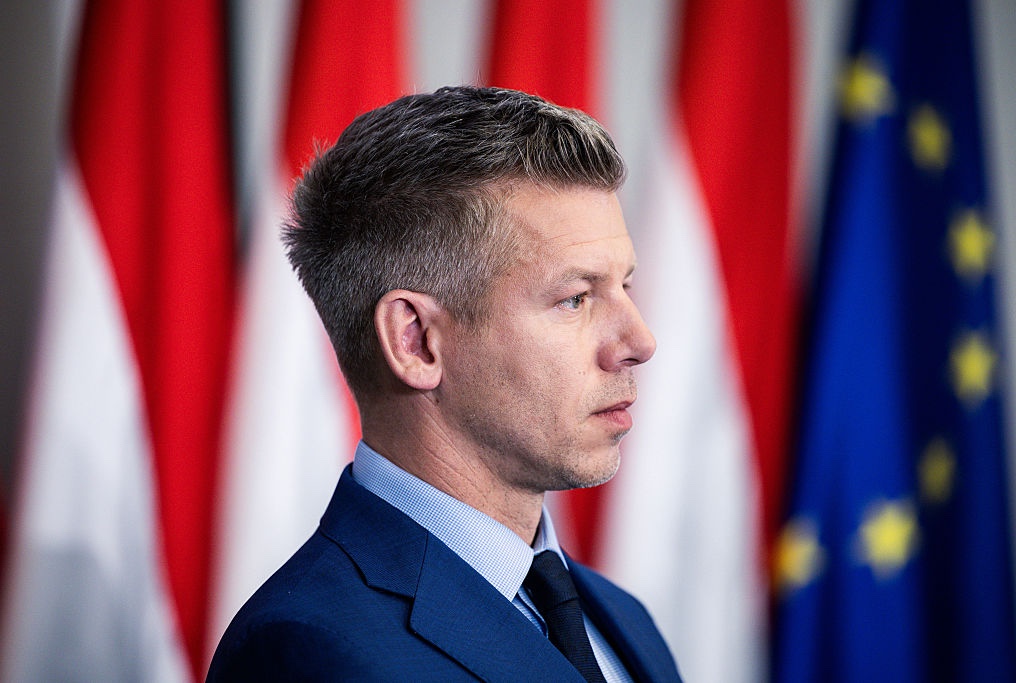
New Hungarian premier Péter Magyar offers Hungary a change in political leadership, but his immediate agenda looks technocratic and fiscally orthodox. (Akos Stiller / Bloomberg via Getty Images)
The opposition’s monumental victory in Hungary has swept away the petty despotism that strangled the country’s dreams for over a decade and upended the myth of the far right’s inevitable momentum. The government to be sworn in on May 9 faces a historic opportunity that carries a profound burden of responsibility: neither illiberalism nor the liberal end of history is preordained. And for the first time since World War I, the Left is not represented in parliament. The risk is that we will fail to lay the foundations for a sustainable democratic turn.
A Defeat, Not a Victory
The moment calls for celebration, but not of the victory of liberal democracy. Viktor Orbán did not fall because Hungarian shopkeepers, truckers, and nurses suddenly took to reading John Locke. He fell because the economy collapsed, while the crony class was busy transforming itself — and the taxpayers’ billions — into a new aristocracy. Cumulative inflation since 2020 reached 50 percent. The “Eastern Opening,” staked on East Asian battery factories, underperformed. The freezing of EU funds cut off Orbánism’s clientelist redistribution. Morally and economically, the system had run out of breath.
On the surface, Orbánism wasn’t always so shambolic. It rose as a political answer to the exhaustion of the pre-2010 liberal model dependent on foreign capital and cheap labor. It welded together three constituencies: it preserved the centrality of transnational manufacturing capital, emancipated the domestic bourgeoisie, and integrated workers through a mixture of statist-clientelist redistribution and nationalism.
The aim was to accelerate accumulation at the top while buying quiescence at the bottom. Through the 2010s, this social contract delivered well enough to endure. But accumulation chases quick profits; development requires long-horizon planning and upgrading against short-term interests. Without quality bureaucracy, accumulation degenerates into cronyism.
For all the talk of “national champions,” Orbán was never interested in high-quality institutions; his party-state fused loyalty and spectacle. Without a developmental state, the contradictions of dependency returned and corroded the authoritarian social contract at the heart of Orbánism. Thus, his regime collapsed.
When millions struggle to pay the bills, when bailiffs and debt enforcement are a real threat, when there is no public hospital that the average Hungarian can enter without dread — all the while elites flaunt their luxury in lakefront villas, Adriatic yachts, and Pannonian safari parks — the political cover-up of child abuse in state institutions becomes the perfect symbol of the entire system’s moral decay. Once the material promises had evaporated, the high-budget nationalist blockbuster stitched together from moral panics about minorities and external enemies lost its audience. Official propaganda devolved into fearmongering and idiocy, which one could only laugh at, assuming one wasn’t already crying.
The “old opposition” that came before Péter Magyar had its chances before, but it failed to rise to the challenge of Orbán’s competitive authoritarianism. Hungarian voters are split across several distinct ideological camps, which is better suited to a proportional, multiround electoral system than the majoritarian two-party system Orbán’s electoral machinery imposes. The answer would have been renewal coupled with a show of unity and strength, but the old opposition’s leaders lacked the skill, courage, and insight needed. Merely piecing together coalitions without meaningful political innovation was doomed to fail. Tepid attempts at innovation, including one that I myself took part in, never evolved into a genuine challenge to Orbán.
Magyar broke out of this trap. He unapologetically swept aside the discredited opposition, instead establishing himself as a unifier and potent challenger. He also possessed the pragmatism not to alienate voters with the obligatory rituals of liberal orthodoxy that characterized the old opposition. The defining voices of the old opposition wanted to defend democracy by lecturing about democracy and the rule of law, constantly talking about Orbán, laced with some euro-talk and free-speech rhetoric. That identity does not make democracy something masses of people can experience as their own and is too evocative of a pre-Orbán world voters are also fed up with.
Magyar was the right person in the right place at the right time: as a former insider, he had a view of high-profile cases against which he could speak credibly, from the archetype of the prodigal son returned. He, too, talked about Orbán, but he talked more about regime change, the dawn of a new era, public services, the dignity of labor, and security. He entered public life with a story and style slotted perfectly into the demands of personalized celebrity-and-spectacle politics, in which parties have lost their value. He carries a momentum capable of transforming disgust and disillusionment into hope, reaching far beyond the metropolitan professional-managerial class.
This victory has cleared the runway, but the work of democratic liftoff is only beginning. What we know of the new government provides grounds for both hope and skepticism. A government drawn largely from technocrats is a sharp contrast to the ever more clownish Orbán regime. However, anyone who remembers the 2008 crisis midwifed by Western techno-economic elites, the gilets jaunes uprisings against “expert-approved” carbon taxes, or the vain hopes for a techno-capitalist fix for the polycrisis will be less enthusiastic about technocracy, cheering for the government with that characteristically Hungarian hide-the-pain-Harold smile.
Yet in a post-Orbán Hungary, such a critical attitude appears to be a luxury. The new government’s identity rests on the trifecta of Westernization, expertise, and bourgeois-civic modernization (for which there is a single and powerful Hungarian verb, polgárosodás). It is hard to think of a less imaginative platform, but in Trump’s and Orbán’s shadows, this identity shines as revolutionary.
The Three Traps
Democrats must view the historical dead ends of liberal-centrist restorations following illiberal episodes as cautionary tales. In Britain, Keir Starmer won by a landslide after promising normalcy; less than two years later, the far-right Reform UK leads the polls. In Slovakia, the pro-European coalition that put an end to Vladimír Mečiar’s illiberal rule introduced a textbook stabilization package; in the wake of bread riots and rising inequality, Robert Fico hauled the country back into illiberalism within a decade and a half. In Tunisia, the democratic parties of the 2011 Arab Spring perpetuated the dependent development inherited from the authoritarian era, fattening the coastal export enclaves and leaving the interior regions and precarious youths behind; within a decade, autocracy returned.
The pattern is stubbornly consistent: where democratic restoration fails to address the economic, political, and cultural traps that breed frustration, illiberalism returns on the backs of a Polanyian double movement. Democratic forces around the world face this complex challenge, which Benedek Jávor and I, in our forthcoming book, call “triple devaluation.” This is also the puzzle facing post-Orbán Hungary on the journey to sustainable democracy.
The first trap is economic. Hungary’s economy remains a peripheral assembly platform for European capital, built on easy-to-exploit low-wage labor, plagued by permanent brain drain and a domestic corporate sector incapable of meaningful innovation. The new government can stimulate a short-term recovery by checking off a few anti-corruption and rule-of-law boxes, pivoting toward Brussels and efficiently distributing some €18 billion of unfrozen EU funds; the economy will likely hum along nicely for a while.
But only for a while. EU structural funds without a developmental-state framework are like a strong coffee for an exhausted driver: it gets you through the next bend but won’t get you all the way home. Without a new economic model, the frustrations that fed illiberalism before will resurface.
From automation to anxiety and burnout to climate change, the shocks are arriving, and they are arriving in a Europe that is losing ground globally, taking the back seat to China even in green industry and whose military-Keynesian answer today is to build tanks instead of cars. On top of that, the great global transformation has turned a portion of the economic elites themselves into pillars of illiberalism, from German investors in Hungary to the far-right pivot of alternative finance to Palantir’s techno-fascist manifesto.
Magyar’s heavyweight ministries (finance, economy, foreign affairs) signal a market-liberal, fiscally orthodox, technocratic reorientation. Outside economic policy, we can expect a welcome half-turn toward greater fairness: alongside the flat tax, a small income-tax cut at the bottom; a symbolic wealth tax at the top; progressive education policy; and increased financing for state health care, coupled with a lightweight social policy administration.
The rhetoric of economic modernization and fairness exists; a transformative developmental-state model does not.
The second trap is political. Orbán’s regime was built to outlast a simple change of government. Assets funneled into quasi-private foundations, loyal business networks, and partisan-aligned institutions function as the extragovernmental fortifications of illiberalism. The new constitutional supermajority may be capable of defusing these mines, and despite coming from Orbán’s circles, the new premier seems to harbor a deep disdain for his fallen predecessor’s crony networks, which is a good sign. Dismantling these fortifications would be no small feat, but it would still fall short of opening the democratic institutional landscape to citizens.
The lack of counterpower in society presents a greater challenge than Orbán’s institutional land mines. All other opposition parties have effectively dissolved themselves to clear the path for Magyar. Those that failed to do so have not only been crushed but humiliated. Trade unions are weak, civil society has been worn down by sixteen years of Orbánism, and Magyar’s Tisza Party is barely two years old with no organized membership.
Influencer-politician that he is, Magyar floats above society endowed with enormous symbolic capital, while his institutional roots remain thin. His centralized style points toward corrective centrism rather than deep deliberative, participatory, and economic democracy. Without new democratic institutions, the masses will sooner or later become alienated again, which was one of the reasons the pre-Orbán Third Hungarian Republic also failed.
Only power restrains power, and if society is disempowered, democracy is vulnerable.
The third trap is cultural. Magyar was right not to build his politics on a discourse about the constitution and symbolic identities; that same register was part of what alienated voters from the old opposition. But here, we also reach the limits of a center-right cultural half-turn.
That the center right competes with the far right by adopting anti-immigration politics under the guise of a suit-and-tie nationalism is no uniquely Hungarian phenomenon. Within this civilizationist frame, even a limited feminism and sexual rights are weaponized to prove the “superiority” of the “West” over the “barbarism” of the “Rest.” To anyone with even a passing acquaintance with world history or actual human connections beyond Europe, this Eurocentric grandstanding is cringe.
Nevertheless, in the East European psyche, “Europe” and “West” function as naive synonyms for law, decency, and merit — an illusion of liberal cosmopolitanism draped in Euronationalism that ultimately paved the way for Orbán’s reactionary backlash. This civilizationist narrative is especially dangerous because it herds the far right and the center right together with unwary liberals. And voters tend to choose the original over the copy: soft xenophobia merely lends credibility to far-right narratives.
Tisza makes clear gestures toward the educated middle class, and Magyar’s dynamic professionalism is attractive to aspirational youths. Yet there is no new framework of recognition on offer for the peripheries and the working class. What remains is the border fence, the rejection of the EU’s migration pact, and a defensive posture on the Ukraine question.
The political integration of low-income provincial classes remains trapped in the nationalist framework coded by Orbán’s Fidesz and the neofascist Our Homeland Movement. We cannot underestimate the political weight of this mass in a country where (based on my analysis of European Social Survey data) 60 percent of people are low-end service-sector or production workers.
It could be otherwise. Left-wing politics offers the chance for an inclusive national identity of a country where we are at home. In the spirit of Swedish social democracy’s classic folkhemmet — the people’s home — this identity frames the nation as the shared home of everyone who lives and works here, where all have a rightful claim to dignity. This people’s home is not built on an “us versus them” logic but on the everyday reality that we live on the same streets, send our children to the same schools, and wait for checkups in the same health care system.
Hungarian progressives occasionally have leaned into this metaphor, but the political construct that could carry an inclusive identity is missing.
These three challenges are real but not insurmountable. Magyar’s government marks the dawn of a new reality. Orbán is showing the symptoms of what Hungarians now call elgyurcsányosodás, or becoming like disgraced former Socialist prime minister Ferenc Gyurcsány, whose toxic afterlife dragged his party, and with it the whole opposition, down for a decade. It is the slow toxification of a strongman who has become his own party’s biggest liability but cannot bring himself to leave the stage. This is the post-defeat phase of a cycle that Trump and Benjamin Netanyahu are entering from the other side: too damaged to govern cleanly, too entrenched to step aside.
The immediate task is clearing the rubble so that the country can use the metaphorical runway for liftoff. The triple trap can be avoided by laying the foundations of a transformative developmental model, which spans multiple electoral cycles and goes beyond the celebrity reissue of technocratic centrism. The magical thinking that we can simply return to the 1990s with contemporary branding risks producing another illiberal cycle. But the responsibility does not fall solely on the new government.
The Left That Isn’t
The Hungarian left, whose task it should be to nurture and enact the vision outlined above, has marginalized itself over the past three decades. The “IMF socialism” of the 1990s, the middle-class pivot of the 2000s, and then the post-2010 hollow electoral pacts in which the politics of inequality was displaced by symbolic constitutional liberalism: these are all stations on the road that ended in the self-defeating resurrection of the failed political model and figures of the pre-2010 era. Constitutional-liberal foundations are vital, but they alone will not make democracy an experiential, sustainable reality. That is precisely the task of democratic socialism.
Orbán’s 2010 victory was due in part to the fact that most Hungarians no longer looked to the organized left as the institutional vehicle of bottom-up advocacy. However, more successful, though imperfect, examples of left-wing forces in power point the way forward.
In Norway, Spain, Uruguay, and Taiwan — to take four sharply different but conceptually linked examples — the Left has held political majorities by preserving three things: representational credibility, economic policy distinctiveness, and organizational roots. In other words, it has not abandoned the working middle class in favor of the professional-managerial class; it has not become the human face of market orthodoxy; and it has safeguarded its social embeddedness. The nascent innovations of the American democratic socialists and the British Greens point in the same direction.
That’s not to say that this is the moment to declare a new party. The paramount step now is to strengthen the communities and institutions that can carry green-left politics as both an idea and a social coalition: trade unions, direct actions, progressive media, think tanks, summer schools, and grassroots political work. It means forging the folkhemmet vision, green industrial policy, and the eco-social developmental-state model into a worldview and community practice. This is a monumental undertaking. But in the end, people will see that those doing this work are not in politics just for the keys to the ministerial Audi.
This is the counterhegemonic social capital from which a credible new political formation can eventually grow. It is even in Magyar’s interest that voters who fall by the wayside drift to the Left rather than to the Right. It is in the interest of democracy as well, because the triple trap threatening not just Hungarian but liberal democracies in general cannot be defused from the center alone.
We have reason to celebrate the Hungarian spring of democracy. But a social coalition that restrains economic and political elites, and fills formal legal equality with real, lived equality, does not emerge on its own; it must be built. This is the power in society that can make democracy resilient. Through this task, the Left can rediscover itself.