Washington Wants Its Military Base Back
In Colombia, the Left has learned to win elections but has yet to break entrenched elite rule. Will the progressive forces behind Iván Cepeda get another chance, or will a resurgent reactionary bloc transform Colombia into a permanent US military outpost?
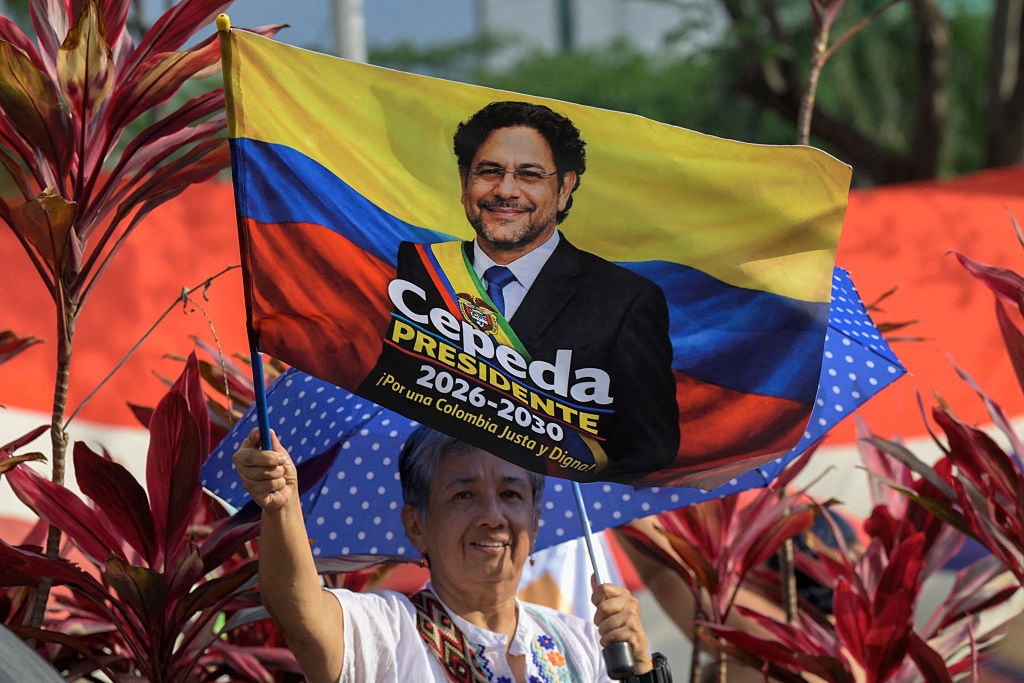
Colombia, under Gustavo Petro's leftward turn, appears the missing piece in an otherwise coherent right-wing configuration in Latin America. (Joaquin Sarmiento / AFP via Getty Images)
In the minds of many outsiders, Colombia remains trapped in a predicament straight from Netflix’s Narcos: suspended between cartels and guerrilla warfare, with the US’s Drug Enforcement Administration (DEA) and CIA operatives hovering as weary custodians of order, saving Colombians from themselves — or so the script goes. This framing reduces political violence to criminal pathology, and imperial intervention to benevolent security management. Like most enduring stereotypes, however, it contains a kernel of truth: Colombia has indeed long been both a theater of internal conflict and a strategic outpost to further Washington’s hemispheric reach.
In recent years, however, Colombia has begun to project a very different presence on the global stage. Consider the scene: a sitting president, Gustavo Petro, standing in front of the United Nations headquarters alongside Roger Waters, calling for disobedience to US military directives; hosting the Progressive International and the Hague Group in Bogotá; severing diplomatic and commercial ties with Israel; and positioning his government among the most outspoken state critics of the genocide against the Palestinian people.
The tension between these two representations, each distilling a distinct meaning from Colombia’s political conflicts and aspirations, has long existed, but rarely so starkly. While the Trump administration recasts its militarized expansion across the Americas as an anti-narcotics crusade, one that has seen missiles indiscriminately lobbed at modest vessels along South America’s coastlines, Petro’s government offers a contrasting narrative. As the Colombian president remarked before the UN in September 2025, “Drug lords live in New York, Paris, Madrid, Dubai. . . . They don’t live in the boats where the missiles fall. . . . They live next to Donald Trump’s house.”
It is along these opposing vectors that Colombia’s present, and indeed its democratic future, begins to unravel. At the very moment the United States sharpens its strategic gaze over Latin America, seeking to reassert hemispheric control under what has been styled the “Donroe Doctrine,” Colombia — long one of Washington’s most dependable allies — finds itself in the midst of a political reconfiguration that aspires to stretch the boundaries of its own sovereignty. Across the region, the prevailing drift moves in the opposite direction. The political mood has hardened decisively to the Right, from Javier Milei’s libertarian authoritarianism in Argentina to the punitive allure of Nayib Bukele in El Salvador and the reactionary resurgence embodied by José Antonio Kast in Chile.
With presidential elections approaching in May 2026, Colombia finds itself at a crossroads. On one side, a resurgent reactionary bloc seeks to re-entrench a security paradigm reminiscent of Plan Colombia (2000–2015), advocating the return of US troops as guarantors of order. On the other, a progressive project, now crystallizing around the candidacy of Iván Cepeda, aims to deepen the national transformation begun under Petro while promoting a multipolar international order and a renewed, assertive project of Latin American integration in an exceptionally hostile regional climate.
Democratic Opening
For much of the twentieth century and well into the twenty-first, Colombian politics was marked by a persistent tension: the apparent continuity of constitutional institutions alongside persistent armed confrontation. Elections were held with regularity, institutional continuity proved remarkably resilient, and the country preserved the outward grammar of representative rule. From afar, this endurance lent Colombia the air of one of Latin America’s longest-standing constitutional democracies.
Yet such stability masked a far more fractured landscape. Public life unfolded beneath the overlapping shadows of deep social inequality, guerrilla insurgency, paramilitary violence, narcotrafficking, and the uneven reach of state authority. Across vast swaths of the country, democracy existed less as a lived experience than as a formal claim, while coercion and violence narrowed the horizons of popular participation and consolidated the enduring dominance of traditional political and economic elites.
Efforts to bring Colombia’s long cycle of violence to a political close surfaced at different moments — from La Uribe in the 1980s to El Caguán at the turn of the millennium. Each briefly raised the possibility of a negotiated settlement. Yet each collapsed, undone by mistrust and the stubborn presence of actors with a vested interest in the war’s continuation.
The failure of Caguán marked a turning point. Spearheaded by Álvaro Uribe, Colombian politics hardened around a law-and-order project that dominated the national stage for almost a decade. A powerful far-right movement coalesced around promises of security, relegating progressive forces to the margins. Under its aegis, the state expanded military and paramilitary control, while social movements found themselves increasingly exposed to surveillance, persecution, and violence. Colombian democracy endured in form, but its political life acquired unmistakably restrictive and punitive undertones.
And yet this model, too, generated its own exhaustion. The cumulative weight of inequality and restricted participation gradually revived the appeal of negotiated peace. The 2016 agreement between the Colombian state and the Revolutionary Armed Forces of Colombia (FARC), however uneven its implementation, helped reconfigure the political field. By partially displacing armed confrontation from national debate, it rendered visible a political plurality that had long remained submerged beneath the imperatives of war.
That reconfiguration found expression in a powerful cycle of social mobilization. The nationwide protests of 2019 and 2021 brought millions into the streets, articulating a broad social discontent with inequality, corruption, and police violence. The effects of this opening became visible in the electoral arena. For decades, Colombian politics had been dominated by a center-right and right-wing constellation whose internal rivalries rarely disturbed the deeper architecture of elite rule.
That equilibrium was broken in 2022. The victory of Petro, at the head of the Pacto Histórico, marked a watershed. For the first time in the country’s modern democratic trajectory, a candidate of the Left reached the presidency through the ballot box. Petro’s victory opened the state to new actors and new demands. It did not, however, dismantle the dense structures of privilege, coercion, and institutional veto through which traditional power continues to operate.
Progressive Reform
If the electoral victory of the Pacto Histórico signaled the opening of a new political moment, the early experience of government quickly revealed the difficulty of the political terrain into which it had stepped. Winning the presidency, it became clear, was far easier than governing.
The progressive coalition secured the executive in 2022 without commanding a stable majority in Congress. With barely a quarter of the Senate and only fragile, shifting alliances, the government’s agenda immediately encountered resistance. Early attempts to stabilize this terrain by allocating key ministries to center-right parties — an effort to secure legislative backing through coalition-building — proved largely ineffective. Rather than consolidating support, the strategy exposed the limits of transactional politics in an increasingly polarized environment, with allies withdrawing or obstructing reforms at decisive moments.
This confrontation unfolded most visibly across the government’s flagship reforms, each tracing, through success, dilution, or collapse, the outer limits of what could be achieved without legislative control. Health care reform, perhaps the most ambitious of the government’s initiatives, was ultimately stalled and shelved. Designed to curb the role of private insurers and strengthen public coordination, it faced sustained opposition from entrenched sectoral interests and a legislature unwilling to concede ground on a system deeply embedded in private capital and political networks.
Pension reform followed a different trajectory. Despite fierce opposition, the government secured congressional approval for a restructuring that expanded coverage and addressed long-standing inequalities. Yet even this landmark reform did not escape institutional friction. Legal challenges from the Constitutional Court underscored the conditional implementation of legislative successes: governmental victories remain subject to ongoing judicial arbitration.
Labor reform revealed the dynamics of compromise under constraint. Initially conceived as a far-reaching effort to expand worker protections and address precarity in the gig economy, the reform was substantially diluted. A more modest version passed in 2025, introducing higher overtime pay and expanded social security contributions for platform workers. Limited though it was, the reform demonstrated that redistributive change remained politically viable.
Fiscal policy proved equally treacherous. In December 2025, Congress rejected the government’s proposed tax reform, intended to raise approximately $4.2 billion to finance the national budget. The bill’s collapse exposed the structural limits of executive ambition without legislative backing. Petro’s subsequent declaration of an economic emergency, intended to bypass Congress, only deepened the institutional confrontation, prompting judicial intervention and suspension pending review.
Taken together, these episodes reveal the tensions of the institutional struggle between traditional liberal-conservative coalitions and an emerging progressive force. Yet the same constraints that curtailed the government’s ambitions also rendered visible the margins within which political contestation could unfold. Even in adverse conditions, partial reforms were secured and new policy directions tested.
Beyond the legislative arena, the government advanced a historically significant land reform agenda. The National Land Agency has acquired over 700,000 hectares for redistribution — twelve times more than the combined acquisitions of the two preceding administrations. Nearly two million hectares have been formalized through titling, and twenty new Zonas de Reserva Campesina have been established. For indigenous and Afro-Colombian communities, the government has constituted 133 new protected areas and titled 105 collective territories. These are not insignificant achievements; they strike at the heart of Colombia’s most entrenched inequalities.
On the economic and social front, the picture is more robust than the legislative record alone might suggest. Following a sharp slowdown after the post-pandemic rebound, growth stabilized and gradually recovered. Employment improved steadily, while poverty fell by 4.8 percentage points in two years, reaching 31.8 percent in 2024 — the lowest level recorded since data first became available. The sustained rise in the minimum wage, the largest in Colombia’s history, including a 23.7 percent increase in 2026, strengthened domestic demand among lower-income sectors, echoing dynamics observed in Mexico.
Politically, the government has navigated these constraints with a degree of resilience that its legislative setbacks might obscure. Approval ratings have remained relatively stable as the administration approaches the end of its mandate, and the progressive camp enters the 2026 electoral cycle with the largest legislative bloc and a leading presidential candidate, suggesting the possibility of continuity. Yet the obstacles to governability have not receded. If anything, they have become more sharply defined.
Electoral Recomposition
Two things became clear after Colombia’s recent parliamentary elections on March 8. First, the presidential race has collapsed into a contest between two opposing ideological blocs, with the center effectively wiped off the map. Second, the newly elected Congress — fragmented, renewed, and populated by a generation of politicians less attuned to legislative compromise — promises to make coalition-building more arduous than ever, regardless of who claims the presidency.
The primaries revealed a political field hardening into poles. On the Left, Cepeda emerged as the progressive camp’s standard-bearer. A veteran human rights defender and the son of a murdered M-19 leader, Cepeda has spent decades investigating paramilitary ties to politicians, particularly centered on the figure of Uribe — work that has earned him both respect and powerful enemies. When conservative factions on the National Electoral Council moved to disqualify him from the primary ballot, the decision was widely read as an attempt to fracture the Left before it could cohere. Instead, it demobilized participation in the left primaries, weakened alternative candidates, and left Cepeda as the undisputed figure of the progressive bloc.
On the Right, Paloma Valencia secured a strong victory in the Gran Consulta primary coalition under the banner of Uribe. Yet her ambition extends well beyond the traditional far-right base. Valencia is actively courting center-right sectors, presenting herself as the unifying candidate capable of absorbing the moderate right before the first round. Her strategy is clear: consolidate the conservative spectrum while neutralizing the alt-right insurgency of Abelardo de la Espriella, a Bukele-type figure who did not appear in the coalition’s primaries.
What was once the center imploded, leaving behind a hollowed-out formation with diminished ideological coherence. The Green Party and its allies, once the self-appointed arbiters of moderation, delivered a weak presidential showing and suffered heavy legislative losses. Figures from across the party’s internal spectrum — whether aligned with the government or closer to the opposition — lost their seats.
If the presidential field has simplified, the legislative one has not. The Pacto Histórico increased its Senate representation from twenty to twenty-five seats, the strongest parliamentary performance ever achieved by the Colombian left. Yet these gains were offset by losses among potential allies, particularly within the Green and Liberal Parties. On the Right, the Centro Democrático expanded its presence, becoming the second-strongest legislative force, largely by absorbing seats from the Conservative Party and Cambio Radical. At the aggregate level, the balance of forces resembles that of 2022. Beneath the surface, however, the composition has shifted in ways that complicate governance even further.
The Pacto Histórico has brought into Congress a cohort of younger figures who have risen to prominence through social networks. On the Right, a similar generational shift is underway, as traditional operators give way to actors more oriented toward ideological confrontation. The result is a Congress less inclined toward compromise and more disposed toward veto.
For Cepeda, this means inheriting the same constraints that hobbled Petro, but with an even weaker group of potential congressional allies. For Valencia — or, should she falter, de la Espriella — it means inheriting a more unified right-wing bloc, yet one consolidated at the expense of the clientelist networks that historically facilitated legislative management.
US Stakes
Colombia’s perpetual conflict furnished the conditions for a sustained military and political presence of the United States. The pivot in this process was Plan Colombia, launched at the turn of the millennium. Under its banner, the United States channeled over $6 billion in military assistance into the country, making Colombia one of the largest recipients of US security aid outside the Middle East.
At its height, US military cooperation extended across a network of Colombian installations to which Washington secured access. Agreements signed in the late 2000s granted US forces operational use of at least seven key military bases, including the air hubs at Palanquero and Apiay. In this way, US agencies became woven into the operational fabric of the Colombian state, shaping both military capacity and national security strategy.
The consequences of this model have been extensively documented. Paramilitary networks expanded, territorial control intensified, and grave human rights violations ensued — of which the recent ruling against Chiquita Brands for funding paramilitaries is but a drop in the ocean. With US backing, Colombian military and paramilitary networks have also been projected outward, entangling the country in mercenary operations worldwide, from the assassination of former Haitian president Jovenel Moïse to the presence of Colombians among the largest contingents of foreign fighters in Ukraine.
This had far-reaching political effects at the national level. It redefined the very terms through which political problems were made intelligible. Inequality, rural dispossession, and political exclusion, which might elsewhere have been treated as questions of social justice, were instead recast under the rubric of security.
The 2016 peace agreement managed, at least in part, to displace this paradigm. By foregrounding territorial development and negotiated settlement, it partially reoriented the state away from a purely military logic. Yet security infrastructures are not easily unwound. In many regions, the withdrawal of guerrilla forces did not produce demilitarization but rather a reconfiguration of armed actors disputing control over newly available territory.
It is in this context that recent geopolitical developments acquire particular significance. Under Trump’s renewed hemispheric strategy, Latin America is once again being cast as the principal theater of armed intervention. The language has shifted from counterinsurgency to anti-cartel warfare, but the underlying impulse is familiar: to secure the hemisphere through intelligence integration, military leverage, and selective alliance-building around extractivist projects spearheaded by US companies.
This renewed interest is hardly incidental. Colombia’s geopolitical position has long made it indispensable: a territorial hinge between Central and South America, with privileged access to both the Pacific and the Caribbean, and a founding pillar of the Pacific Alliance — a bloc through which Washington has historically projected its economic and strategic interests across the region. In a hemisphere where right-leaning governments increasingly fall into line with US priorities, Colombia, under Petro’s leftward turn, appears the missing piece in an otherwise coherent Pacific configuration.
If the Right wins the upcoming presidential election, whether through Valencia or de la Espriella, Colombia will likely witness a revitalization of its military alignment with the United States. A right-leaning executive would reopen the door to US national security agencies to reestablish a more permanent presence on Colombian soil, reversing the partial withdrawal of the Petro years. What would follow is familiar: the expansion of basing rights, the reactivation of joint counternarcotics operations, and the progressive securitization of social conflict.
Democratic space would contract as opposition movements, community leaders, and progressive sectors face renewed surveillance, criminalization, and the repressive apparatus of a state increasingly oriented toward territorial control. Beneath this security architecture, US strategic economic interests would find favorable conditions for expansion, replicating a model already visible in Ecuador, where militarization and corporate consolidation advance in tandem under the guise of security cooperation.
Conversely, should Cepeda secure the presidency, he would inherit a political landscape defined by relentless contestation at both national and regional levels. The experience of the Petro government has already demonstrated the capacity of entrenched elites — deploying congressional obstruction, judicial intervention, and media warfare — to constrain any administration perceived as a threat to established interests. For Cepeda, these dynamics would likely intensify.
Petro is currently entangled in federal investigations in the United States that seek to link his political project to drug-trafficking networks. Given Cepeda’s long-standing involvement in peace negotiations and his engagement with former FARC combatants, similar accusations are likely to surface. Allegations framed under the “narco-terrorism” label could be readily weaponized by sympathetic prosecutorial and judicial actors, following a familiar playbook used against other left-wing leaders. Brazil’s October elections add a further layer of uncertainty: a defeat for Luiz Inácio Lula da Silva would deprive Colombia of a key ally, deepening Cepeda’s isolation and amplifying both domestic and external pressures.
In both scenarios, the most important domain lies beyond the presidential palace. The future of Colombia’s democracy will depend on civil society and popular mobilization. Whether resisting the contraction of democratic space under a right-wing administration or sustaining a progressive government under institutional siege, social movements, organized labor, and grassroots actors — through their capacity to maintain collective action — will ultimately shape the country’s democratic horizon.