A Socialist Is Taking on the Dem Establishment in Syracuse

Maurice Brown

Socialist Maurice Brown has served as a county legislator in the Syracuse area since 2023. Now he is running to replace one of the New York State Assembly’s longest-serving members, who Brown describes as an obstacle to progressive change.
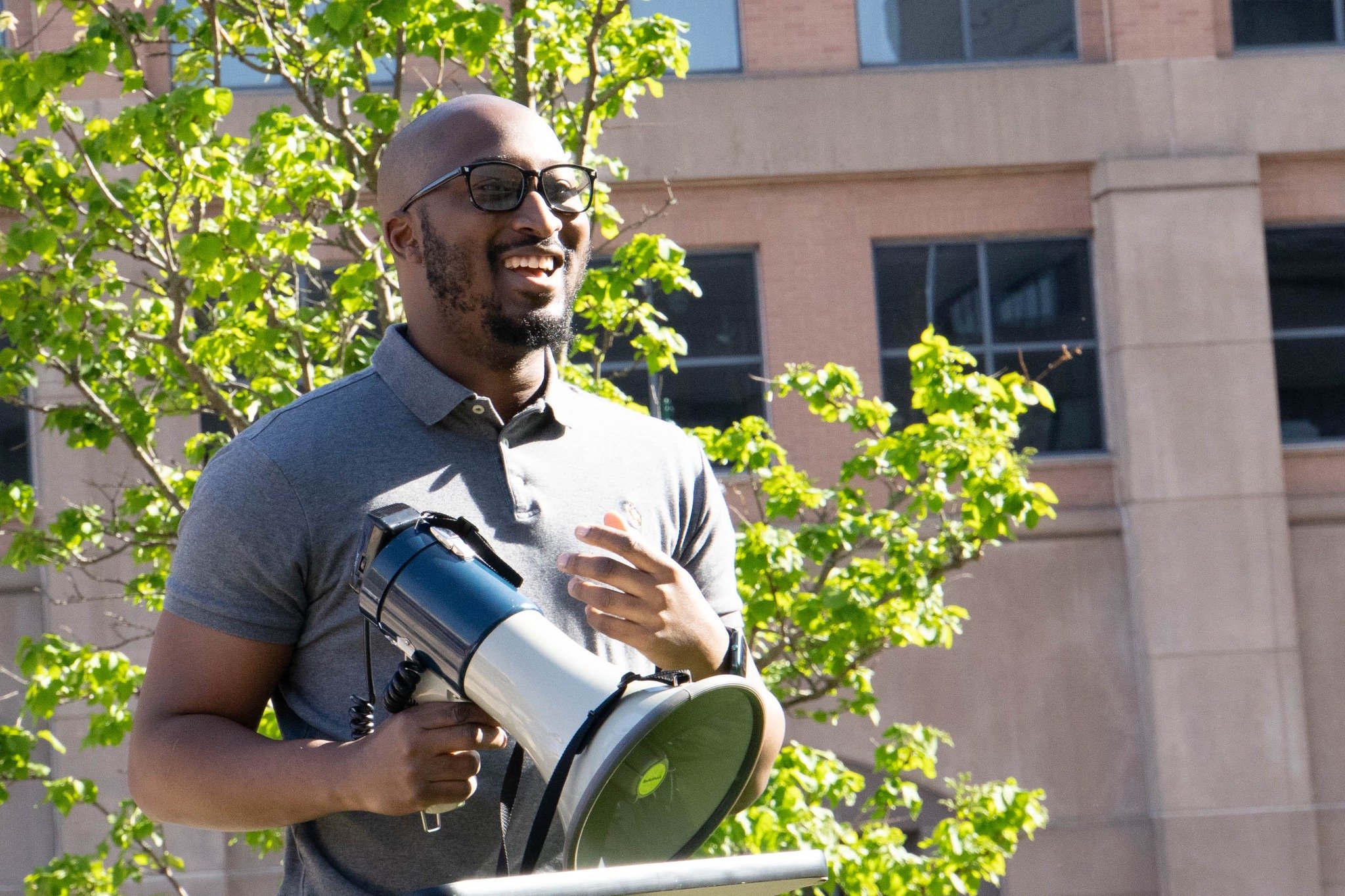
DSA candidate for NY State Assembly district 129, Maurice Brown

In Syracuse, New York, a Bernie Sanders–endorsed socialist, Maurice Brown, is running for state assembly on a platform of taxing the rich to fund childcare and affordable housing for all. (Elect Maurice Brown)


Interview by
Roman Broszkowski

New York City is increasingly known as a stronghold of democratic socialism, thanks in no small part to high-profile elected officials like Mayor Zohran Mamdani and Rep. Alexandria Ocasio-Cortez, as well as a sizable bloc of state legislators. But socialists are making inroads in other parts of the Empire State as well.

Maurice Brown is one of three Democratic Socialists of America–affiliated candidates running for New York State Assembly outside of New York City. Currently a member of the Onondaga County Legislature, Brown — who has also been endorsed by Sen. Bernie Sanders — is running against Democrat Bill Magnarelli, a twenty-seven-year incumbent in Central New York who hasn’t faced a primary challenge in over a decade.

Jacobin recently sat down with Brown to discuss his working-class upbringing, his experience as a county legislator, and why he thinks a democratic socialist can unseat one of the longest-serving members of the New York State Assembly.


Roman Broszkowski

Can you tell us a little bit about your background and the district you’re running in?

Maurice Brown

I live in Syracuse, New York, and I am the county legislator for the Fifteenth District here in Onondaga County. I ran for county legislature in 2023 because I felt that housing, health care, and education are human rights, and I think those rights have been under attack by all levels of government. Before I was in elected office, I worked at Onondaga Community College (OCC) as an adviser; before then I was in the US Army.

I’m running for state assembly in the 129th Assembly District — which is the city of Syracuse, the town of Geddes, and the town of Van Buren — because the gap between what people need and what the government is doing has grown. On the county [level], I saw firsthand projects — like building an aquarium — I saw us prioritize things like that. We’re seeing a lot of the same at the state level. And my state legislator has been absent in the big conversations in the region. We find millions for projects like the aquarium but struggle to invest in housing and in childcare infrastructure.

Roman Broszkowski

What brought you to democratic socialism and the Democratic Socialists of America (DSA)?

Maurice Brown

Bernie Sanders’s 2016 run for president was my introduction to politics overall. Before that, I was a full-time soldier and a stand-up comedian. But Bernie was the first candidate I heard speak directly to what I see as the foundational ill in society, which is the fact that, like, fourteen people have all of the wealth, and it hasn’t trickled down to the rest of us like it was supposed to.

During his campaign, Bernie mentioned he was a democratic socialist. I did research on what that is, and it sounded like me. I think housing, health care, and education are human rights, and the role of government is to protect those rights.

My belief in democratic socialism is that, if you want to sell M&Ms, if you want to sell cars, go crazy! Let profit drive it. But if you want to sell housing, if you want to sell insulin — if you want to sell things that we need to live — I think the government has a right and a duty to step in. I’m running because that duty hasn’t been getting accomplished.

Roman Broszkowski

What has your experience as a socialist in the county legislature been like? 

Maurice Brown

I’m to the left of my entire caucus, both in terms of what I want to get done but also in terms of the tactics I’m willing to employ. Democrats are, for lack of a better term, afraid of our own shadow. We’re always like, “But what will they think if we start helping people?” And I’m of the belief that, if they’re not going to like us because we want to fund the food bank, if we’re going to take political hits for funding the food bank, we need to take those political hits. We have a right to do so. We have a duty to do so.

I’m very disappointed in the Democratic caucus in the legislature. I don’t know if it’s my being a socialist that is the difference between us, and why they don’t feel the same urgency from the community I do, but there’s . . . The Republicans think I’m crazy, but the Democrats think I’m radical or, like, irrational. The things that I’m asking for, they’re like, “This just can’t be done! We can’t put money into a food bank.” But if we need money for the aquarium, it’s a short conversation.

Roman Broszkowski

Not many democratic socialist elected officials in New York are veterans. How has your experience in the military impacted your politics and the way you show up as a candidate?

Maurice Brown

For me, oddly enough, it’s the foundation of it.

I grew up in Brooklyn — ’90s Brooklyn, not this new Brooklyn. I grew up struggling. The military was the first time that my housing, health care, and education were guaranteed. We had school in the military, we had classes, and I was guaranteed to be there. I was going to show up fed; I wasn’t going to be hungry. And if I got sick, I could go to sick hall. Having those foundational rights, having those things ensured, created a much more comfortable living situation for me in the military than I’d ever experienced.

In 2016, while Donald Trump was running for president the first time, I was deployed with a military police unit based out of Wheeling, West Virginia. I deployed with people that didn’t look like me. They were white, they were Hispanic, they were Asian, but they came from poor places. And the things that we coveted, the things that we saw as important, there was perfect overlap. In the military, we were — all of us — in significantly better places than we came from.

I think that everyone should be afforded that luxury. I don’t think you should have to deploy to Cuba in order to have housing, in order to have health care. And we have the ability to provide it for people. We just have chosen not to as a government. That’s a failure of government that I’m hoping to correct.

Roman Broszkowski

What brought you to Syracuse from Brooklyn?

Maurice Brown

Onondaga Community College is known as one of the best community colleges for veterans looking to transition. And I had friends in Syracuse; Syracuse was a safer place, and I wanted something new.

My biggest goal when I got out of the military was to get some kind of degree. There’s a stigma around people who fail out of college and join the military. I wore that pretty heavily, especially within my friend group. But OCC gave me the best opportunity to go from soldier to civilian.

Roman Broszkowski

What more do you think the state should be doing to support community colleges, and what role do you think community colleges can play in the affordability agenda?

Maurice Brown

I think that education is a human right. If anybody wants to go to a state school, especially a community college, we should see it as an investment in that person, and I think you should invest in people any chance you get.

Community colleges should be tuition-free. At OCC, if you’re willing to get into certain career paths that are deemed necessary — for us, it’s specifically based around the Micron semiconductor plant — so if you want to get into engineering, if you want to get into those tech fields in order to have one of those jobs, it’s tuition-free. It’s for transitioning adults, for people that are my age, and that should be the standard. I don’t think we should need a Micron here to do something like that. If somebody wants to transition from construction to nursing, they should be able to do that because we’re investing in that person. The state has the ability to do so, but more than that, we have the duty.

Roman Broszkowski

You speak a lot about housing in your platform. What housing issues does your district face?

Maurice Brown

Fundamentally, Syracuse’s housing problem is a supply-and-demand issue.

We’ve not built enough housing to keep up with the increase in population, but also a lot of the housing that we’ve had, we let it deteriorate. We let it deteriorate to unlivable situations in a lot of cases.

We have to increase supply, but we haven’t. And because the demand is so high, we’re seeing homelessness up, we’re seeing housing insecurity up. One in four of our students is housing insecure. I think I have heard one in eight are effectively homeless: a good portion of them are couch surfing or living with an aunt for this month and then an uncle the next month. As a child, you shouldn’t be subjected to that.

The government has not built enough of any kind of housing. We’ve not built enough low-income; we’ve not built enough affordable housing. But we also haven’t built enough luxury. We haven’t built enough housing for the workforce; we haven’t built enough senior housing. Now we’re all fighting for the same subpar units, and the situation has gotten out of control.

Roman Broszkowski

Why are you running for state assembly now?

Maurice Brown

New York State pays for a lot of the work that I’m doing in the county legislature. The way government works in New York State — as a county official I’m fighting for childcare. I’m fighting for our Department of Health. I’m fighting for the rescue mission to be able to do their job in helping our homeless crisis. Most of these entities and programs get a large portion of their funding from New York State.

The childcare issue was the biggest one that we saw last August. We have the ability as the government to invest in childcare, and we ought to do it because it’s a benefit to our community. I did a lot of advocacy for it, and the state wasn’t moving at the rate we needed to see it. And a good amount of that was due to my assembly member.

I think we need a state legislature that understands the roles that counties play in upstate cities. Counties house our departments of health. Counties house our Department of Social Services offices. These are operated by Onondaga County, not necessarily the City of Syracuse. I don’t think I have a state legislator that understands it. My state legislator has taken his eye off the prize over these last six years, and he’s sat out of really important conversations.

The biggest one is the community grid [a plan to remove a highway in downtown Syracuse and reconnect various neighborhoods]. In 2009, the Federal Highway Administration told us that the highway running through our city, I-81, was going to be out of compliance in the next ten years. So we were tasked as a community with what to do about that highway being out of compliance.

We couldn’t just widen it, because the highway goes right next to a hospital and housing. We would have had to raise it and expand it or get rid of it, which is what we ultimately did. And there were some people, like my opponent, who were proposing that we build a tunnel underneath the city to keep the highway. I disagreed with him. In 2019, I actually considered running for this same office because of those disagreements.

The tunnel option would have just created many more problems. When the advocates of the community grid like myself won the debate, Bill Magnarelli, my assemblymember, just took his ball and went home. He said, “They’re not going with my idea. I’m not going to get in the way of the community grid, but I’m not going to be a leader on this either.”

By taking his eyes off the prize as the chair of the State Transportation Committee, a lot of the confusion we’re seeing around the community is because of that issue. One of our biggest senior facilities, Brighton Towers — public transportation can’t make the left turn into the facility. So now that bus ride is twenty minutes longer, because it has to go past the facility and then all the way around and come back because it can only make a right.

Those are the kind of things that you overlook when you don’t care what happens. And I think if we had an assembly member who was focused, who wanted to make sure the community grid had greenways and walkways . . . if you had somebody who was pushing for those things and not someone who was just hands-off, I think we’d be in a better situation. But we don’t have that right now.

I think Magnarelli views himself as a gatekeeper: someone who assesses what’s going on and says yes or no. I view myself as someone who’s much more in the fray. I want to be in the weeds; I want to know the details. I want to know where the traffic circle is going to be. I want to know how close that traffic circle is going to be to the nearest hospital and whether that will affect an ambulance’s ability to get through.

I do think you need to allow experts to be experts. But I’m an elected official. I represent the people of the 129th District, and hopefully I can make sure their voices are heard in those conversations. Their voice often doesn’t get heard until the very end. And then you have to undo the wrong that was done by people who aren’t living in this situation.

Roman Broszkowski

Why do you think that your opponent hasn’t faced a primary in so long?

Maurice Brown

The Democratic establishment in Syracuse is woefully inadequate. The Onondaga County Democratic Committee is inept. They consistently lose to opposition challengers in a way you don’t see in Buffalo, you don’t see in Rochester, you don’t see in Albany.

A lot of it can be traced back to 2017, where we had an upstart progressive candidate, Andy Maxwell for mayor, who a lot of people wanted to support, and they didn’t get the [Democratic Party ballot] designation. And when Maxwell didn’t get the designation, they dropped out of the race, and a lot of their supporters went to work in DC or Albany. So there was a real talent vacuum. A lot of the people who might’ve eventually challenged my opponent in 2018 and 2020 — they left.

I do think Magnarelli was a good legislator up until 2018. Once the state senate flipped and we got rid of the Independent Democratic Caucus, I think it changed the dynamics in Albany in a way that didn’t fit him. He’s even on record as saying that he supported the New York Health Act. He supported New York for All [a comprehensive immigrant rights bill that would stop state and local law enforcement from being used to enforce federal immigration law, as well as limit areas immigration enforcement agencies can operate without a judicial warrant]; he supported all those things up until 2018. Then, once it was clear that the state senate would also be passing those things, he was like, “Whoa, let’s pump the brakes on these.” That’s when it became clear to me that he wasn’t the person for this moment.