Spider-Noir Is Just Another Night in Noirtown
Nicolas Cage’s black-and-white Spider-Man spin-off, Spider-Noir, recycles all of the tropes of the classic 1940s film genre. But all the femme fatales and wise-cracking detectives can’t keep Spider-Noir from feeling like a lifeless museum piece.
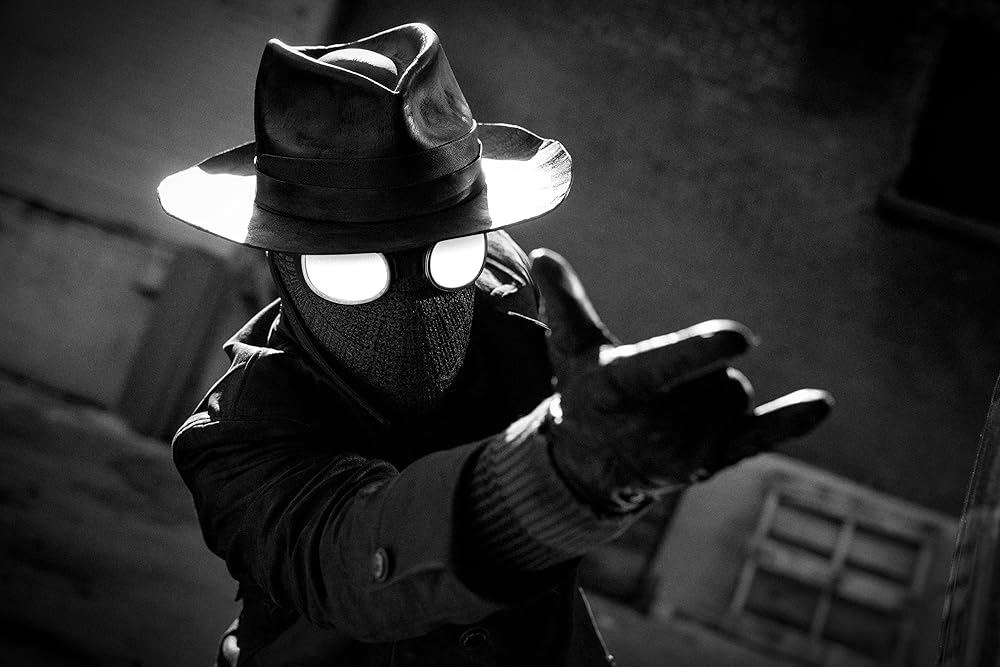
Nicolas Cage stars as Ben Reilly, aka The Spider, in the 2026 television series Spider-Noir. (Sony Pictures Television)
I wish that Spider-Noir was better. Nobody could be more invested in film noir than I am, so I always see the latest effort to revive or rework the genre with naive hopes, thinking maybe, just maybe they’ll pull it off this time. They almost never do.
One of the worst ways to do neo-noir is to stick slavishly close to the most clichéd ways the genre worked in its classic era of the 1940s and ’50s. That inevitably means a cynical gumshoe detective modeled on Humphrey Bogart in The Maltese Falcon (1941) or The Big Sleep (1945) trying to solve an impossibly twisty case in a cityscape of mean streets where he meets colorful urban characters and violent dangers around every corner. It also means there will be a sultry femme fatale at the center who’ll probably sing a mesmerizing siren song in a nightclub. She will erotically fascinate the detective, and most likely at some point hire him — and, at another point, betray him.
He’ll likely provide some voice-over narration, at least early on, in a sardonic, slangy way. He’ll also probably have a friendly female assistant, a loyal Girl Friday who runs his shabby, spartan office, an office that’s his only home and shows he may be down and out, but he’s fundamentally honest, not on the take in this corrupt world. He’s got a loose alliance with some local savant who also knows his way around the city, an unusually decent cop, say, or a fellow detective, or some other wised-up crony.

The visual style of the piece will be crucial to the representation of the oppressive urban world of noir — no doubt black-and-white cinematography with dramatically low-key lighting that emphasizes threatening shadows and shafts of harshly revealing light, sometimes in entrapping patterns resembling prison bars or spiderwebs. (And if that kind of stark, black-and-white cinematography is just too much for some of you, Prime Video allows the audience to opt for the colorized — and extremely ugly — version of Spider-Noir.)
But recreating all those old-time effects is the most numbing, derivative approach to the genre, yet that’s exactly the path taken in Spider-Noir. The main creative figure involved in developing the TV series is Oren Uziel, adapting the work of David Hine and Fabrice Sapolsky, who did the original comic book series as part of the Marvel Noir universe. They added superhero characteristics to the noir antihero and to some of the other colorful characters. But otherwise, it’s just another night in Noirtown. Same old, same old. The whole thing has a lifeless, airless, hermetically sealed quality, like a stiff museum diorama or a mint-condition vintage toy still in its original packaging.
Nicolas Cage brings his vast arsenal of bizarre, actor-y techniques to enliven the lead character of Ben Reilly, hangdog but wisecracking detective of 1930s New York City. His tragic past involving the flashback death of his fiancée has made him cast off his superhero persona known as “The Spider,” though the city is sinking under the brutal rule of crime boss Finn Byrne aka Silvermane, played with welcome Irish brio by always-great Brendan Gleeson. Reilly becomes erotically fixated on Cat Hardy (Li Jun Li), a mysterious singer working at one of Silvermane’s nightclubs. She’s also Silvermane’s mistress.
Ben Reilly’s Girl Friday is Janet Ruiz (Karen Rodriguez). He’s got a loose alliance with struggling reporter Robbie Robertson (Lamorne Morris). Spider-Noir begins in the first episode with Reilly’s sardonic, slangy, rather long-winded voice-over narration.
There’s a somewhat compelling backstory trickling out slowly through the series that involves how The Spider and a few other characters including Flint Marko, aka Sandman (Jack Huston) and “Lonnie” Lincoln, aka Tombstone (Abraham Popoola) got metahuman superpowers during their time as prisoners of war in World War I. They were imprisoned in a concentration camp and experimented on by German scientists. All suffer from destructive side effects, including Ben Reilly’s disorienting, hallucinatory interludes when he clutches the back of his neck and is pulled into blurry images of the past. It’s an inventive update on the kind of psychological disturbances afflicting many antiheroes of classic noir.
Another not-bad angle is the classic noir split personality that takes the form of Ben Reilly’s alter ego, The Spider. It’s inevitable that his Spider persona will be resurrected — in cool form, with big bug eyes that glow white under a fedora — but until that happens late in episode two of this eight-episode series, we’re mostly gumshoeing around the city with Ben Reilly, not knowing what the hell he’s after as he navigates the urban maze.
Which was all incredibly cool when Dashiell Hammett and Raymond Chandler were writing those sharp, lurid, memorable tales of The City almost a hundred years ago. But let’s face it — we’ve squeezed almost all the juice out of them. It takes a lot to resurrect their material successfully, usually involving some inspired new way of reviving certain elements of film noir in wildly inventive new contexts. The Coen brothers used to specialize in exactly that with skewed neo-noir-adjacent visions like Blood Simple, Miller’s Crossing, Fargo, The Man Who Wasn’t There, and The Big Lebowski.

Instead, Spider-Noir relies so heavily on pastiche that there are entire stretches that only exist seemingly in order to lampoon scenes from old movies. For example, Ben Reilly gets access to an apartment by pretending to be a plumber, doing a comic turn involving a goofy hat, round glasses, a high-pitched voice, and a verbal tic that ends sentences with “Hmmmm?” This is a clear homage to Humphrey Bogart’s prissy rare book–buyer impersonation in The Big Sleep, which was funny because Bogart had perfected a star persona defined by its hard-bitten machismo — no one expected him to slip so easily into this effete, snooty bit of role-play. Then of course, decades later, Harrison Ford did his own spin on this bit in the 1982 neo-noir classic Blade Runner, pretending to be a geek in order to get information out of a stripper. The problem is that Cage plays weirdo characters constantly, so the impact is nullified.
In fact, Cage is another problem with this series, constantly drawing attention as the viewer tries to decide if he’s an asset or a detriment to it. He seems wrong for his role throughout, while at the same time, with his notoriously oddball star wattage, at least he’s better than some boring, conventionally handsome TV actor. But at age sixty-two, Cage is certainly too old for the part, a generation older than his love interest played by forty-two-year-old Li Jun Li, and he’s far too elderly to be convincing in the fight scenes. CGI to make him look younger can only do so much.
But on the other hand, without Cage, the series wouldn’t even have the curiosity factor and frisson of star power that’s presumably drawing viewers in. It turns out Spider-Noir is a something of a hit, with glowing reviews from critics who seem unable to resist the most rock-bottom-basic film noir gloss. Unfortunately, it also means we’re likely to get even more Marvel spin-offs, haunting us all until the collapse of civilization itself.
It just might turn out that “superhero but done as film noir” is the least bad idea left.