Elon Musk Represents the Right’s New Reactionary Modernism

Elon Musk is an heir to the reactionary modernists of a century ago, a man whose utopian speculations about the power of technology go hand in hand with apocalyptic doomsaying about the woke mind virus and the “great replacement.”
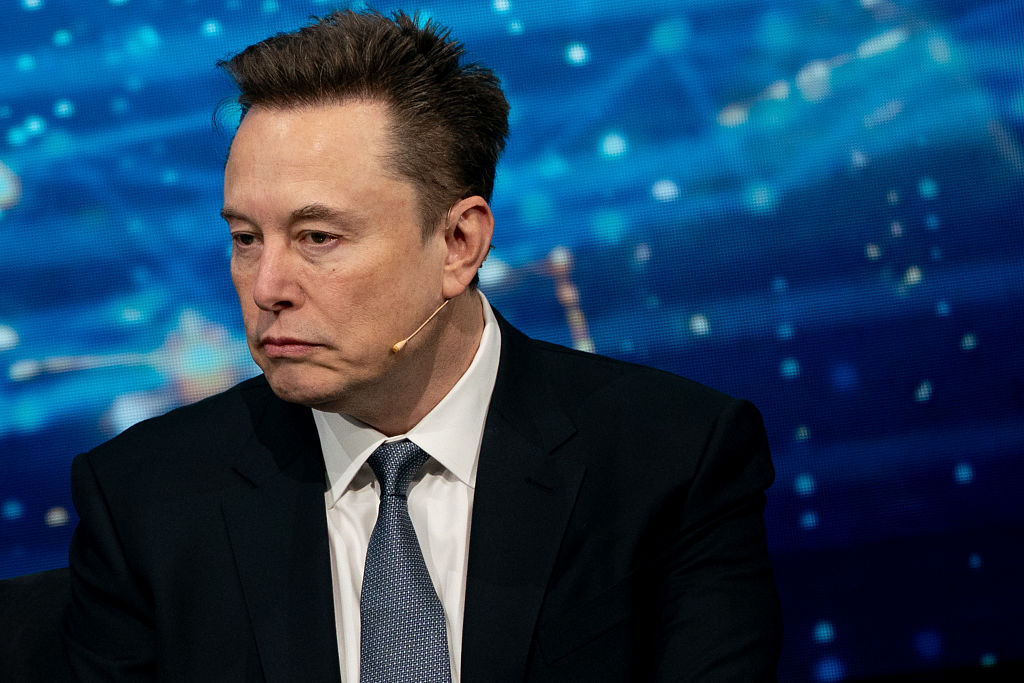
Elon Musk represents the Right’s embrace of a new vision of the future in which technology and progress exist to maintain gender and racial hierarchies. A new book offers a sweeping indictment of this worldview. (Stefani Reynolds/Bloomberg via Getty Images

Elon Musk is many things: entrepreneur, far-right troll, cautionary tale about the negative effects of completely lacking a good sense of humor. This mercurial figure is the main subject of Muskism: A Guide for the Perplexed by Quinn Slobodian and Ben Tarnoff. Both come well equipped for a deep dive into the life and thought of the tech entrepreneur. Slobodian is a professor of international history at Boston University and the author of a number of well-received books on the intellectual origins of neoliberal capitalism. Tarnoff has written extensively on the politics of the tech sector and the personalities who make up Silicon Valley.

That experience is clearly on display in their new book, which is confident and brisk without ever feeling hurried. Part critical biography, part political-economic analysis of the neoliberal era, it’s a well-written, sharp book that unpacks its “protagonist’s” chilling vision of the world in formidable detail.

But for all its strengths, Muskism’s account of the rise and influence of its protagonist is one squarely focused on ideology, obscuring the broader political and economic forces working behind the scenes. This makes the book enlightening but ultimately limited in its approach to understanding the pathologies of the present. It would benefit from situating Musk in the broader nest of institutions and practices that have allowed him to flourish and discussing his relationship to the broader right. Given all that, I found Muskism more suggestive than revelatory and was left feeling the definitive left-wing critique has yet to be written.

Mecha Hitler and Cyborg Conservatism

Musk as a figure lends himself to the kind of analysis favored by Slobodian and Tarnoff, which occupies a liminal space between biography and polemic. He has a pathological need for attention and endless capacity for self-dramatization. These traits were apparently present from the very start of his career. Describing the billionaire’s rise during the dot-com bubble of the 1990s, Slobodian and Tarnoff argue that what “set Musk apart wasn’t engineering skill or business acumen, but his unshakable belief in the future — and his talent for making others believe in it too.” Musk is, at his core, a “fabulist”: someone who “mixes fantasy and realism” to tell stories about the “extraordinary transformations” his companies and their technology will bring about, making sure to leave out the support from private investors and governments that makes this success possible.

Slobodian and Tarnoff observe that Musk’s communication style has always been “proleptic” and promissory. His utopian speculations and belief in the power of technological miracles is the necessary complement to his dark and apocalyptic doomsaying about the woke mind virus, white replacement, creeping socialism, and whatever else the mogul finds himself tweeting about at five in the morning. These dark fantasies are, according to Slobodian and Tarnoff, the obstacle to realizing a “technological sublime that’s only ever another decade away.” This gives Musk an almost religious sense of self-importance. The facade he has created for himself is, however, thin and riven with insecurities, so much so that he has even felt compelled to lie about how good he is at video games.

Slobodian and Tarnoff infer, correctly I think, that this fabulism is integral to Musk’s right-wing politics. There are some interesting comparisons to be made here with his on-again-off-again pal Donald Trump. Trump himself started out with relatively ambiguous but by no means conventionally conservative politics. In an unusually self-conscious passage in The Art of the Deal, the future president described how he played to people’s fantasies through “truthful hyperbole.” He recognized that, while ordinary people might not think “big” themselves, they admire those who “believe that something is the biggest and the greatest and the most spectacular.” For both Musk and Trump, the fabulist can become a great man by playing on the fantasies of the otherwise docile masses — a worldview that explains both men’s fondness for hierarchy and self-elevation. It’s Thomas Carlyle’s great man theory of history for the neoliberal era.

Similarly, Musk might have begun his career catering to upper-middle-class Californian liberals’ desire to save the world by buying $100,000 cars, but this had less to do with a deep love of humanity than a need to have humanity love him. Slobodian and Tarnoff explain Musk’s descent into the conspiratorial right along several lines. Some of the “material reasons are easy to surmise,” they write:

Like other billionaires who projected a liberalish public image, especially those from Silicon Valley, Musk felt alienated by the growing influence of the American left. He despised President Biden’s proposal for a wealth tax on the super-rich, as well as the administration’s support for unions and the regulatory and anti-trust push of FTC Chair Lina Khan.

But the deeper reasons for Musk’s attraction to the Right lay in the realm of ideology rather than political economy. Musk routinely invokes right-wing influencer Gad Saad’s notion of “suicidal empathy” to describe fellow feeling for the weak and suffering as a bug holding back Western civilization. This bug directs excess attention toward the needs and empowerment of the lower orders, which in turn undermines the ability of figures like Musk to build the future in their own image. Muskism has, Slobodian and Tarnoff write, “always been committed to a vigorous defense of hierarchy. Some humans are born to rule; others to be ruled.”

Perhaps unsurprisingly, this ideology has led its exponents to embrace a profound anti-humanism. Humanity “should merge with the machine — so long as it [remains] segmented by gender, race, and class. Call it cyborg conservatism.” For instance, Musk is fine with people microchipping themselves to “Neuralink” with his computers, because he profits from that and gains a measure of control over their lives. But trans people who attempt to change their gender challenge the CEO’s love of a supposedly natural gender hierarchy that must remain essentially unchanged.

Slobodian and Tarnoff’s analysis of Musk’s worldview is fascinating and informative, but the book is a lost opportunity to say something more historically resonant about how the tech mogul’s outlook connects to that of the broader right.

Citizen Musk

Slobodian and Tarnoff’s book is laser-focused on its titular subject. Muskism is very much about Musk’s worldview, right down to the book’s chilling coda in which the authors describe the potential dystopian futures that the tech billionaire would like to impose on us. This is all well and good, but the focus on a singular figure has the effect at points of obscuring as much as it reveals. What social structures enabled Musk and his peers to acquire so much power, such that their messianic techno-reactionary futurism is a real threat rather than just fodder for b-rate science fiction? How and where does Musk fit into the broader history of the political right?

Strangely, despite Slobodian having written extensively about the history of neoliberal thinkers, there is little effort to connect Musk as an individual to that tradition, let alone describe how neoliberal policies and practices helped facilitate his rise. Early in the book, they mention how Musk profited from the George W. Bush administration’s efforts to privatize government functions, right down to the military, in the name of creating a leaner, meaner integration of state and capital. This would help explain why Joe Biden’s milquetoast efforts to rein in the power of the oligarchs came up short. Adopting a more structural, longue durée perspective would also spur a less personalized set of intuitions about how to respond to Muskism and other vulgarities produced by the late stages of neoliberal capitalism.

Slobodian and Tarnoff are very convincing when showing that Musk’s legacy will by and large be a tragic one. But preventing Musk, and the mini-Musks waiting in the wings, from being able to cause damage in the future will require more than just taking stock of and challenging his ideology. We need to diagnose the material forces that enabled these kinds of concentrations of class power. How did people so deeply unethical, so opposed to basic human ideas that they view empathy as a social evil and introspection as a waste of time, come to wield power and influence over American society?

An alternative avenue of investigation would have been to connect Musk and Muskism to the broader history of the global political right. I already mentioned neoliberalism, but the fascist tradition of “reactionary modernism” was also very much on my mind reading the book. As theorized in Jeffrey Herf’s classic book of the same title, reactionary modernism refers to how fascist thinkers and artists dropped the technophobia that had long pervaded the Right and came to fetishize the power of technology.

Figures like Ernst Jünger and Oswald Spengler felt that Germany’s failure to win World War I owed much to its inability to outproduce the Allies. The solution was that a great racial volk could be resurrected and empowered by new, destructive technologies that ought to be embraced by reactionary nationalists wary of science’s association with the egalitarian Enlightenment. For these far-right thinkers, technologies like V-2 rockets and modern aircraft were weapons for great men and warriors to storm the heavens themselves and could be a tool to reinforce social hierarchies by helping Germany to enslave vast swathes of racial inferiors in its new quest for empire.

The contemporary tech-bro right is obviously very different from its interwar counterpart. Musk et al. are much more individualistic, motivated by financial gain, obsessed with video game culture, and very much a product of the twenty-first-century media ecosystem. Yet many of their anxieties — around white decline and the elevation of alleged racial inferiors, potentially militant working-class demands for democracy, cultural decadence and the spread of progressive libertinism — echo those of the reactionary modernists of the last century. And there is much to be said about how both fascist reactionary modernism and modern tech-bro philosophy see in technology a means to conserve social hierarchies and even establish new ones, rather than a means to empower ordinary people and smash elitism. It’s easier for them to imagine us living as cyborgs on Mars than an end to capitalism.

Muskism makes for bracing reading, and its brevity and subject matter ought to earn it a wide audience. This would be a good thing since, as Slobodian and Tarnoff show, his philosophy and its impact are corrosive. But in the end, Musk is just one person. Overemphasizing his importance risks making him a world-historic villain — the dark mirror of his self-appointed role as a world-historic savior. The problem isn’t Musk or Muskism but a world in which the Left is required to take both seriously. Our goal shouldn’t just be to get rid of Musk the symptom but also the social order that germinated him.