The Scam Artistry of the Right’s Dirty Rotten Scoundrels

The Right’s con men promise liberation for those who feel themselves superior but are held back by the leveling institutions of mass mediocrity. Their rhetoric intoxicatingly combines feelings of superiority with a sense of dispossessed victimization.
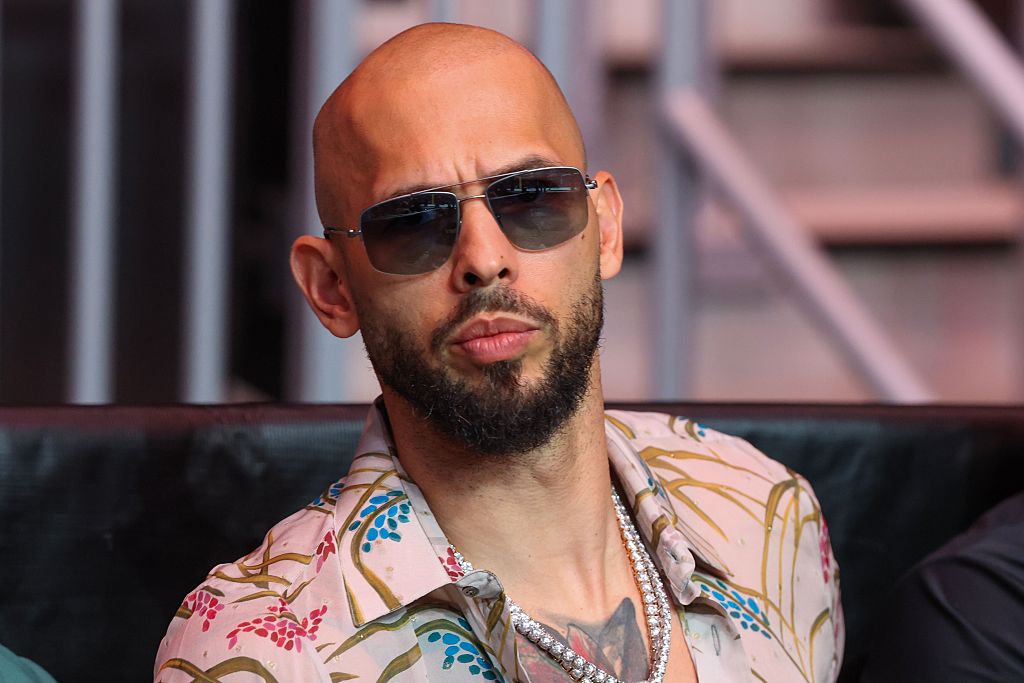
Andrew Tate attends UFC 327 at Kaseya Center on April 11, 2026, in Miami, Florida.

Right-wing confidence men want to sell us on a dark vision of the human estate in which Übermenschen are not held back by mewling masses of Untermenschen. Capitalism’s vast inequalities and recurring crises create fertile ground for these scam artists. (Tasos Katopodis / Getty Images)


Con men are irritating for a lot of reasons. One of the biggest is how little respect they have for their marks. The very human response to most confidence pitches is some version of, “You must think I’m pretty stupid, don’t you?” And when it comes to conservative grifters, the answer has historically been “yes.”

Even great conservative philosophers like the late Roger Scruton called for a society composed largely of “unthinking” people. There is a strain in right-wing thinking that happily conceives of regular people as dumb sheeple in need of a firm hand. If left-wing critical theory tends to valorize “subcultural” defiance of social norms, the Right has traditionally prized “great men” and the case for hierarchy. Donald Trump put it well in The Art of the Deal when he defended using “truthful hyperbole” because ordinary people don’t “think big” themselves but will be inspired and impressed by someone who presents himself as the biggest, smartest, and strongest. Trump’s ascent has brought many of these latent tendencies on the Right to the fore, helping fuel the spread of the right-wing griftosphere.

Landon Frim and Harrion Fluss’s vivid new bookConfidence Men: Peterson, Musk, Tate and the Duping of the American Mind is a laser-focused look at three of the most prominent right-wing influencers pitching today’s all-steak-and-four-daily-cigars reactionary vogue. Jordan Peterson, Elon Musk, and Andrew Tate are very different types on the surface. Peterson is a former academic who regularly cites the Bible and warns about spreading postmodern neo-Marxism. Musk is the world’s richest man, dedicating his considerable resources to convincing the world he is a comic book character — Tony Stark made flesh. Tate is a former kickboxer who proudly never reads books and so predictably thinks facts and data are for “bitches” and “gays.” But Frim and Fluss argue all three are products of a decaying capitalist order. So long as “capitalism remains and keeps generating vast inequalities and crises, these scam artists will keep being generated — in ever changing and diverse forms.”

An Unholy Trinity

Frim and Fluss’s book is divided into three big parts, each interrogating a member of the titular trinity of grifters. Given their very different tones and projects, Peterson, Musk, and Tate are all interrogated in distinct ways.

The section on Peterson is undoubtedly the most “scholarly” in tone. The authors range through much of his published work, lectures, and interviews to unpack the intellectual origins of his worldview. Contrary to Peterson’s self-presentation as a moderate classical liberal spurred to action by toxic woke Marxism, Frim and Fluss point to the reactionary core of his thinking. They insist Peterson’s image as a “classical liberal and political moderate is a lie. His thinking is not derived from Enlightenment rationalism at all. . . . Instead of Enlightenment philosophers like René Descartes or John Locke, [Peterson] takes inspiration from an entirely different lineup of figures, especially existentialists, romantics and far-Right ideologies.” Peterson’s core influences include tsarist nationalists like Fyodor Dostoevsky, aristocratic radicals à la Friedrich Nietzsche, and the Nazi philosopher Martin Heidegger. Far from signing on to the Enlightenment project of liberty, equality, and solidarity for all grounded in reason, these thinkers adopted a dark view of human vulgarity and endorsed hierarchy, authority, and mythology as counterforces.

In Peterson’s hands, this has been modernized into a distinctly anti-realist creed that explicitly holds that “beliefs make the world, in a more than metaphysical sense.” This makes it more than a little funny that Peterson expresses such paranoia toward postmodern subjectivism, since Frim and Fluss note there are more than a few respects in which he is a distinctly right-wing postmodernist.

According to Peterson, truth is not really about logical coherence or the correspondence of thought and language to the external world. Instead, it’s a leap of epistemic faith that allows one to make sense of the primordial chaos the world always risks slipping back into. What differentiates his right-wing postmodernism from the left-wing versions of Michel Foucault or Jacques Derrida (themselves deeply influenced by Peterson touchstones like Nietzsche and Heidegger) is that the “postmodern left wants to begin with a sheer multiplicity of stories and conclude from these a politics of solidarity.”

Interestingly, Frim and Fluss note that in many ways the “postmodern right” is “far more consistent” in recognizing where an anti-reason politics goes. When we lack a shared world that everyone can know and reason about together, what we’re left with is an epistemology that sees the world as clay to be molded. This naturally lends itself to an elitist sensibility, where people further up the social hierarchy feel entitled to impose their vision upon the rest of us.

Of Megalomania and Hypercompetitiveness 

The chapters on Musk take a very different line. Musk is a capitalist, not an academic turned Daily Wire talking head. Instead of an intellectual critique, Frim and Fluss write what amounts to an exposé of Musk’s grandstanding and pretentious rhetoric. In a particularly scathing chapter, they systematically rebut a sycophantic 2015 CNBC article titled “Elon Musk Inventions: Top 10 Developments Positively Impacting Society.” Frim and Fluss point out that many of the “inventions” Musk is credited with were in fact created by others in the companies he bought (Tesla cars), were simply businesses rather than inventions (Zip2), were outright failures (hyperloop), never existed (electric jets), or amounted to marginal improvements on products and services that already existed (location-specific searches).

Frim and Fluss observe that Musk, far from being a Leonardo da Vinci–like creative genius, is fundamentally a smart businessman whose main product over decades has been himself. Echoing the claims of Ben Tarnoff and Quinn Slobodian in Muskism, they paint Musk as a fabulist whose main talent is “captivating public imagination and pitching to investors.”

This isn’t all that surprising. Diving into Musk’s biography and stated philosophy, Frim and Fluss suggest he is prone to flights of megalomania and hypercompetitiveness. Musk’s ongoing characterization of others as “NPCs” (non-player characters) highlights how he views himself as “Player One” in a worldwide game. As his frenemy Sam Altman put it, “Elon desperately wants to save the world. But only if he can be the one to save it.”

Frim and Fluss stress how Musk’s grandiose self-conception mirror’s Peterson’s hierarchical vision of the world, where visionary entrepreneurs aren’t just out for money (though, boy, are they ever). Instead, they are the creative protagonists of the world spirit, and any restrictions on their actions — be it from government regulations or pesky workers wanting to unionize — hold back the “progress” of their sublime projects.

The reality is far more prosaic. It’s telling that we often say a billionaire created one thousand jobs for workers, and not that those one thousand workers made that man a billionaire. Musk’s narcissistic worldview simply blocks out any awareness of the countless others who got him where he is, and to whom he seems incapable of feeling any deep loyalty or concern.

The Confederacy’s Dunce 

That brings us nicely to the final figure in our trinity: Andrew Tate. Frim and Fluss acknowledge that Tate is undoubtedly the most extreme personality of the three. Perennially hounded by accusations of sex crimes and trafficking, Tate nevertheless has millions of followers and was a pioneering figure in the Right’s manosphere.

He presents himself as nothing less than a “superhero of masculinity,” here to slay woke dragons and put “uppity bitches” back in their place. A self-described misogynist, Tate insists that women don’t have “any ideas” of their own and are fit only to be submissive wives and mothers. He is also unapologetically racist and antisemitic, palling around with white supremacists like Nick Fuentes and conspiratorially musing that the “people who wrote the official story [of World War II] have used it to subvert the consciousness of western populations into mass genetic suicide.”

What connects Tate to people like Peterson and Musk is more than their tenuous grasp on the distinction between superhero comics and reality. It’s his radicalization of the postmodern idea that reality is a plastic medium that great men can rework to their pleasing. Tate proudly admits to “ignoring all data” and mocks a hypothetical critic who approaches him saying, “Actually, we’ve got the data to prove . . . ” “To prove what, you little bitch? What are you going to prove to me?” “I can prove that the ice caps are melting.” “But there’s ice in my water right now.”

This hypersolipsistic epistemology aligns with Tate’s butch worldview. Frim and Fluss point out that Tate even acknowledges the capitalist system is rapacious and unfair, presenting himself as “Morpheus” helping followers see through the “Matrix.” But this is an inaccurate comparison. Morpheus in The Matrix was a revolutionary who wanted to liberate humankind from the machine’s grip. Tate, by contrast, thinks the goal of seeing through the Matrix is fighting your way to the top so you can then be the guy in charge. In the world according to Tate, if the game is rigged, you don’t change the game — you get to the point where you’re the one who wins every time. You become the bro who says, “Heads I win, tails you lose,” forever.

I Am My Own

Ayn Rand once said, “I will not die; it’s the world that will end.” This is more than a little odd coming from a woman who confidently called her philosophy “objectivism” and thought that if you accepted that A=A, eventually you’d eventually conclude that the Jeff Bezos and Elon Musks of the world are the only ones doing much of value. But reading Confidence Men, one comes away convinced that Musk and Tate would be happy to sign off on Rand’s dictum. As far as they’re concerned, this is their world, and we just happen to live in it — and not work for them yet.

A key question that Confidence Men tries to answer is why so many people look up to these grifters when it clearly isn’t in their interest. Quoting Spinoza, Frim and Fluss wonder why ordinary people “fight for their servitude as if for salvation.” A weakness in their otherwise excellent book is that Frim and Fluss don’t have a comprehensive answer to what the appeal is. One suspects this is largely down to their simply not finding anything appealing in what Peterson, Musk, and Tate are offering. But the successes of the titular con men belie that sort of dismissal. Until the Left better understands the affective appeal of right-wing ideas, we will be less equipped than we ought to be to confront them.

The reality is that the Left proposes to create a world where everyone is treated more or less equally and has a decent shot at being happy and fulfilled. For most of us on the Left, this vision is inherently appealing and moral. We struggle to understand why the Right’s pitch that some types are better than others resonates with ordinary people.

But it isn’t that hard to understand. For many, being told you are a dispossessed superior or a temporarily soyed alpha will always have more attraction than being told you’re the equal of someone who looks down on you. Contemporary right-wing rhetoric intoxicatingly combines feelings of superiority with a sense of dispossessed victimization. It tells its constituencies that, were it not for wokescolds, liberal nerds, and egalitarian socialists, they would enjoy the “pathos of distance” that comes from occupying their natural place in the sun and looking down on others.

There is an inherently paradoxical quality to this pitch that maps many of the contradictions in right-wing ideology. If it was true that Peterson, Musk, and Tate are so perennially victimized and silenced by the woke mob, the state, the Matrix and so on, how did they become some of the loudest people in the world? If we truly lived in a world where hard work and will alone were proof of excellence deserving reward, why the fixation on immutable characteristics people have no control over — race, gender, natural talents? The thing is, these seeming tensions are generative and add to the appeal of right-wing ideology precisely because they don’t fully make sense. They offer their constituents the chance to both feel like persecuted victims and masters-in-waiting — to individually applaud themselves for being self-made visionaries and collectively part of a genetic or civilizational elite.

But Frim and Fluss are surely right to call this a con. It is “pure nonsense” to insist that, but for the oligarchs like Musk and Trump or misogynists like Tate, everything would fall apart, so we should therefore be grateful for what little they deign to give us. As the authors put it, “human beings are entirely capable of comprehending the human good” and creating a world everyone can enjoy. That is the world promised by democratic socialism, and unlike the con pitched by the Right, it’s the real deal.