Muskism Is the Specter Stalking Our Present
Elon Musk sells us sovereignty through technology in an age of crisis. Muskism resembles past futurisms, but with an important difference: this time, the question of who owns the machines is paramount.
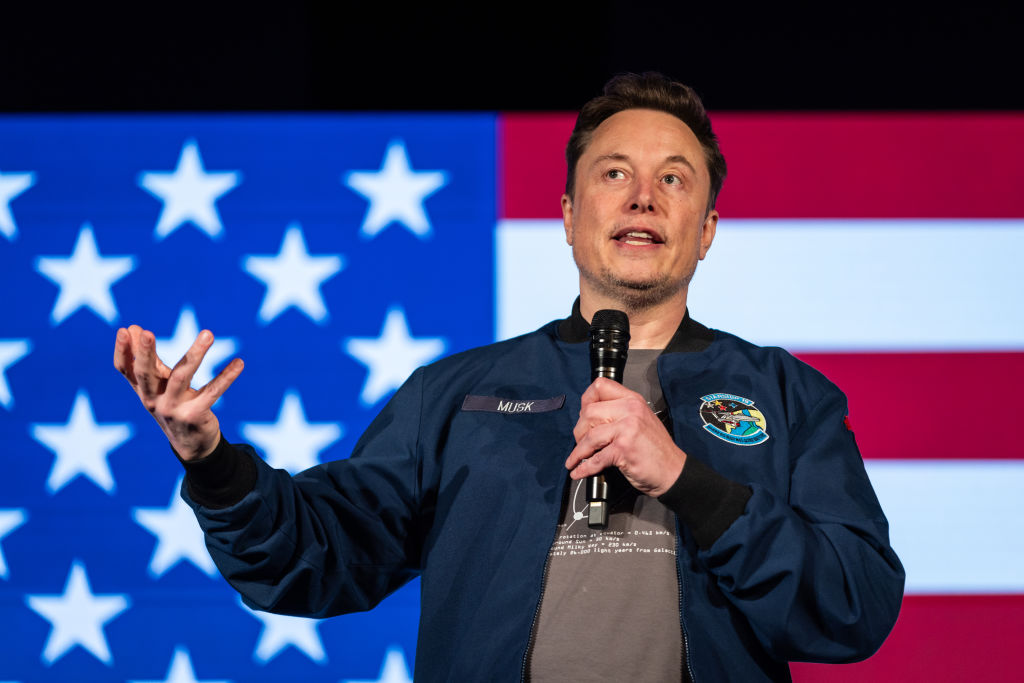
Elon Musk fits the mold of a traditional industrialist. (Samuel Corum / Getty Images)
In probably the most famous futurist artwork, Unique Forms of Continuity in Space (1913), Umberto Boccioni depicted an erect man thrusting forward with velocity, abstracted into intersecting bronze planes and fluid surfaces, as if shaped by momentum. He has no arms and his head is a helmet; man and machine are merged.
The idealizer of futurism, Tommaso Marinetti, talked of “preparing the creation of the mechanical man with replaceable parts.” In Gino Severini’s 1915 painting, Armored Train in Action, five faceless, crouching soldiers are fragmented into composite elements of a train-mounted gun, their individual identities disappearing into the speed and rhythm of mechanized war.
For all that futurism was an audacious, thrilling embrace of the possibilities thrown up by breakneck technical progress — an attempt to reconnect human experience with new social forces. The death drive was always present: the subsumption of the human by the machine and of thought by the oblivion of speed.
Marinetti’s glorification of war — “the world’s only hygiene” — was the clearest expression of antihuman tendencies that would be made grotesquely manifest as Europe became a charnel house. A long liberal period, characterized by war practiced in faraway places “over there” was interrupted by growing tensions between major powers, exploding into a world war.
As geopolitical conflict increases today, there are some — see historians such as Christopher Clark or Richard J. Evans — who see our time as analogous to the end of the Belle Époque. The unipolar liberal order gives way to a multipolar one of waning empire and rising rival powers, as distant imperial adventures once again redound to ground war in Europe.

Over in the New World, Henry Ford installed the first moving assembly line on the eve of war. Shortly after, the eight-hour, $5 workday was introduced, ostensibly allowing workers to afford the products they built. This was the nucleus of a set of social relationships that would be called Fordism — simultaneously a labor process, an accumulation regime, a mode of regulation, and a mode of socialization. The historian Quinn Slobodian and tech writer Ben Tarnoff argue their a new book, Muskism: A Guide for the Perplexed, that Elon Musk emblematizes broader social changes, warranting an “-ism” on par with Fordism. In both the early-twentieth and twenty-first centuries, then, new economic models took shape amid rapid technological and social change — and auguries of war.
Musk emerges as the figure who bestrides our time. His would be a modernizing project whose promise is sovereignty through technology: individuals and states alike can fortify their self-reliance in an unstable world by plugging into his infrastructures. Unlike fellow oligarch-intellectuals like Peter Thiel, however, Musk fits the mold of a traditional industrialist. And it is this, what Musk does and the environment in which he operates, rather than what he says or believes, that most interests Slobodian and Tarnoff. The question is not so much “Who is Musk?” but “What is Musk a symptom of?”
The Industrialist
In the first half of the book, the authors trace Musk’s life, beginning with his early years in South Africa, in which we find a young Musk obsessed with The Hitchhikers’ Guide to the Galaxy, Star Trek, and mecha — human-piloted biomorphic machines. Subsequent chapters trace his career from Internet 1.0 start-ups in Silicon Valley to SpaceX and Starlink and on to Tesla.
In a key chapter, “Sovereignty as a Service,” we learn of Musk’s industrial innovations. Under Fordism, the factory was the nucleus of a type of social order centered on the unity of mass production and mass consumption: higher wages for industrial workers set off a positive feedback loop and served to legitimize a system of exploitation. Musk innovates in a different way — less concerned with managing mass society, more with being the essential infrastructure that both the state and cyborg citizens plug into.
SpaceX is an astounding entrepreneurial achievement: by 2025, it accounted for 95 percent of all orbital launches in the United States and more than 50 percent globally. It manages to mass-produce space rockets cheaply. Musk has fused the big, vertically integrated corporation of the mid-century with the nimble, organizational methods of the neoliberal age by introducing fast, iterative, Agile-inspired development techniques into aerospace — traditionally a slow-moving industry — and combining them with the “lean production” pioneered by Toyota and adopted by management suites globally.
While the latter production system drove outsourcing and offshoring in the neoliberal age, Musk has swum against the tide and brought it all in-house. Musk’s companies therefore find themselves well suited to the age of global supply-chain disruptions. Musk was reshoring before it was cool. One can see an analogy in the way the French state kept up its nuclear plants and state-owned railways, even when this was unfashionable, leaving it much better off than Germany or Britain by the 2020s. Muskism thus points to post-neoliberalism, perhaps to a type of state capitalism.
What made SpaceX possible was the privatization of space and the military. Musk isn’t simply a passive beneficiary of this process but has actively shaped the public-private partnership to his advantage by successfully lobbying to break open the tendering process. By entering into partnership with the state, the company becomes state-like: Musk does “not eliminate the government but vassalizes it such that it can only exercise its authority by purchasing services from a monopoly provider.”
Muskism, therefore, is not libertarian, it “is not about replacing countries with companies — it is about fusing the two.” It is for this reason, too, that any bursting tech bubble may not splatter so badly on Musk: he deals mainly in physical infrastructure and survives on government contracts.
“State Symbiosis”
This, which the authors call “state symbiosis,” is carried over into Tesla, which, as with all Musk ventures, has a strong dependence on the state. Musk benefited from the clean-energy boom driven by state support for renewables and was then able to outlive the collapse of the latter once the shale revolution came online. And he did this through clever factory design: the secret is not what you make but how you make it — and where. “Musk responded to the new reality of interstate competition by making everyone a customer,” and so built a gigafactory in Nevada (a “right-to-work” state) as well as in Shanghai, China, and Brandenburg, Germany. Musk is an ironic avatar of deglobalization.
Tesla also exemplifies two other pillars of Muskism: “financial fabulism” and “fortress futurism” — in the authors’ nifty alliterative concepts. By the former they mean the telling of extraordinary tales to drum up investment or to boost one’s stock price. Indeed, “what set Musk apart wasn’t engineering skill or business acumen, but his unshakeable belief in that future [of imagined profits] and his talent for making others believe in it too.”

The latter concerns “a belief technology can strengthen self-reliance in a hostile world,” visible in the Tesla Powerwall, a home battery that can keep the lights on when public infrastructure fails. The apex is the Cybertruck — a high-tech means of hunkering down. Here the authors discern the influence of Musk’s early years in South Africa: a futuristic fortress state of nuclear weapons, autarky, and isolation, of racial hierarchy and domination.
These twin themes describe a central tension in Muskism: between the hard stuff: energy, infrastructure, space, war, and that of the immaterial: finance, storytelling, AI, and social media. It is often hard to disentangle, especially in our times, in which, for example, as the Financial Times puts it, “The price of gold has entered the realm where storytelling drives its price.” Or where SpaceX’s IPO is “truly out of this world.” The merger of Musk-controlled xAI with SpaceX would have generated a valuation “more than seven times higher than the approximately $200bn level recorded in October 2024,” which would qualify as “an astonishing re-rating in any market.”
What here is really real? And is Musk an avatar of a new factory system or of financialized flights of fancy?
Weightlessness
In the second part of the book, “Cyborg,” Slobodian and Tarnoff reckon with matters of posting, trolling, meme stocks, and Musk’s obsession with the “woke mind virus.” Chapters deal with the attention economy, brain-machine interfaces, the acquisition of Twitter, and Musk’s stint at the Department of Government Efficiency (DOGE) — in sum, Musk’s turn to ideology: a concern with what people think and what people think of him. This marks a partial departure from the authors’ initial method, which, as they explained to me in a recent podcast interview, sought to avoid the temptation of the psychological and instead learn from Musk’s production methods.
Musk haters will find the Musk they know here: the grifter and the far-right troll. In the contemporary economy of unproduction, “people are doing nothing but making money off doing nothing” as the inventor of Dogecoin, Jackson Palmer, puts it. Musk “was and always will be a grifter but the world loves grifters.” In this weightless economy, Musk turns his attention to the “woke mind virus,” held to be “penetrating the firewalls of some of the world’s smartest meat computers at a prodigious rate,” as he wonkishly replied to Richard Dawkins.
What accounts for this turn? Slobodian and Tarnoff argue that “for someone so deeply involved in the heavy materialities of Tesla and SpaceX . . . Twitter held the allure of immediacy.” Here was not just a direct connection to political discourse but to what is in people’s minds.
This is the less convincing half of the book, its arguments resting on more ethereal foundations. Indeed, it is tempting to minimize this section as an account of the megalomaniacal delusions of one of the world’s richest men, hardly comparable to a new system of production or a new social order. But perhaps the wobbliness is deliberate, a necessary product of Muskism’s very essence. Or, as the authors have it, it’s the “inverted pyramid of Muskism: a narrow material base opening up into a vast virtual domain.”
Cyborg is a term that Musk uses all the time, evoked in discussions of human augmentation through implants, of cybernetics. As Tarnoff put it to me, Musk’s dream is to have Neuralink — which creates implantable brain-computer interfaces — connect individuals’ brains directly to X and to Grok, linking them via Musk’s Starlink internet satellites anywhere in the world: hardware and software combined.
But what if these connected cyborgs become infected by bad ideas? The breakdown of the integral, bounded human individual opens up the possibility of erasing all other distinctions and hierarchies. Musk wants to usher in the transhuman but hold the transgender at bay. It thus becomes critical that Musk himself controls the interfaces to make sure the right kind of cyborg is created. The $44 billion acquisition of X is not quixotic and uneconomical, then, but a step in controlling a network that will permeate the boundaries between human and machine.
This fusion of the material and immaterial is fitting, in the authors’ view, because “the machinery of mind control is what the US is in the business of creating,” as the internet has swallowed everything.
Hyperpolitics
It follows that political concerns would become central to business in this context, with the internet being the site par excellence of rhetorically inflated claims and counterclaims that bear little relation to actual human organizations. But why should Musk’s companies engage in such overt hyperpolitics when it clearly risks alienating half their consumers? Is this clever business strategy or a drugged-up CEO’s whims left unchecked? Put a different way: How necessary are right-wing politics to Muskism?

One way to answer this is to ask whether we might have Muskism without Musk, just as Fordism extended well beyond Ford, encompassing a whole range of companies, trade unions, and other institutions. We might imagine Fordism without Ford’s antisemitism, but perhaps not without racialization, which was central to the structuring of labor, to segregate workplaces and maintain wage hierarchies.
By analogy then, Muskism would be a terrain of struggle in which we could just as easily have woke Muskism as we could have reactionary Muskism. The Musk of the 2000s, darling of liberals who would save the planet with electric cars, is not beyond memory. Or we might see woke AI versus MAGA-aligned AI — just so long as a state–industry nexus with emphasis on digital deliverables underpins it all.
The “operating system of the twenty-first century” need not conform to the particular ideological leanings of post-2020 Musk, which was the moment he made his turn to the Right in response to the shutdown of his factory during the COVID pandemic. Instead, what persists across these fluctuations is a conception of society — of human beings — as essentially manipulable, subordinate to the greater intelligence of machines. If this “engineering mindset” is the core of Muskism, we can imagine it operating within different political coordinates, from technocratic liberalism to MAGA to more reactionary formations.
Musk, influenced by the philosopher Nick Bostrom, flirts with a conception of life as a video game or simulation. We cannot be sure that others are humans; they may be “shadow people,” imitation-humans that lack real interiority (an irony given fellow tech mogul Marc Andreessen’s recent denunciations of introspection). If you’re unsure your peers are real, why should you care about them?
Empathy, then, is not a moral imperative but a manipulative code to weaken you, the player. As Musk has posted, “Most humans have very limited firewalls so are easily programmed.” This speaks to our moment in which obnoxious virtue signaling (performatively caring about distant others) is being replaced by noxious vice signaling (performatively dismissing others’ suffering).
Legitimacy
If Muskism is to govern social relations in our age, then is it able to sell itself to masses of people? In the early to mid-twentieth century, Fordism was a capitalist-class answer to the legitimacy question. In the face of a rising labor movement and revolution in Russia, Fordism had a clear “sell” to workers, especially white workers: you’ll have decent wages and working days of tolerable length, you’ll be able to afford consumer goods on the market; in return, you submit to the discipline of the assembly line. So, what is Muskism selling?
The notion of “sovereignty through technology” is suspect as a pitch to consumers or workers. If sovereignty is collective control over social life, Musk’s home batteries or satellite internet look more like survival mechanisms for individuals and families — sauve qui peut. When applied to states, sovereignty is provided through the purchase of products and services from the only company providing them — Musk’s! In either case, this looks less like sovereignty than its privatized proxy.
Here is where the comparison with Fordism comes undone. A hegemonic social order rests on the consent of the ruled. But why care about consent if the ruled are all NPCs (non-player characters)? Indeed, studies pointing to the emergence of a post-legitimate society have emphasized how platform firms are relying primarily on new forms of direct technological control as well as coercive, indirect market compulsion to coordinate activity.
Beyond the workplace, this speaks to an order in which the pretense of consent, of normative justification, or of belief in ruling ideologies is understood to be outmoded. Muskism, then, is the nexus of tech, finance, and the state in a fragmenting world, promising little more than a garrison to protect a select few from the rest of humanity.

Muskism is both less and more than Fordism. Less because the organization of production doesn’t fan out to encompass a whole social order; more because it makes astounding claims about the nature of human being — of human living-together. If Fordism was a way of managing mass society, then post-Fordism — roughly overlapping with neoliberalism — was about managing and motivating atomized individuals in a post-mass society. Muskism would go a step further: not post-mass, but post-human.
A Futurism Too Far
For the futurists a hundred-odd years ago, the crowd was an object of fascination. Boccioni’s Riot in the Gallery (1910) depicts a messy crowd scene in a Milanese gallery; Carlo Carrà’s The Funeral of the Anarchist Galli (1911), a riot of clashing lines, conveys the energy of a confrontational crowd. It is chaotic, violent, and romantic; it is also vitally human.
While Italian futurism fed into fascism, the course of futurism’s relatives is instructive. In Russia, futurism wedded to Bolshevism. The emerging constructivism saw itself as a tool for building a socialist society. In Britain, vorticism was less concerned with the crowd but its regret over industrialized war was made expressly manifest in its works.
In 1913, Jacob Epstein created The Rock Drill: a hybrid, robotic, almost insect-like human figure mounted on an actual industrial rock drill. After the war, Epstein took apart the original sculpture, removing the rock drill and the figure’s limbs, leaving a truncated damaged body — Torso in Metal from Rock Drill — a mutilated survivor. The machine had belatedly come to be understood as destroyer of the body, of the human.
Muskism is ultimately a futurism before it is anything else. But it takes futurism’s antihuman tendencies far beyond the dreams of Marinetti and his fellow champions of mechanized dynamism. Muskism’s fantasy is a fantasy of the factory. Unlike in Fordism, the factory is not a means of production but of the world itself: “A chain of life and labor internalized into a single system: the sovereign factory-state.”
These questions impose themselves: What do we want machines for? Who owns them? How do we make them work for us? Muskism foregrounds them, and they are set to become the key lines of political division in our time.