Elon Musk Is Defending His Walled Garden From the Rest of Us
Tech oligarchs like Elon Musk envision a future in which a chosen elite enjoys sovereignty, as a service, through the technologies they provide. Those left outside their Edenic fortress are merely a threat.
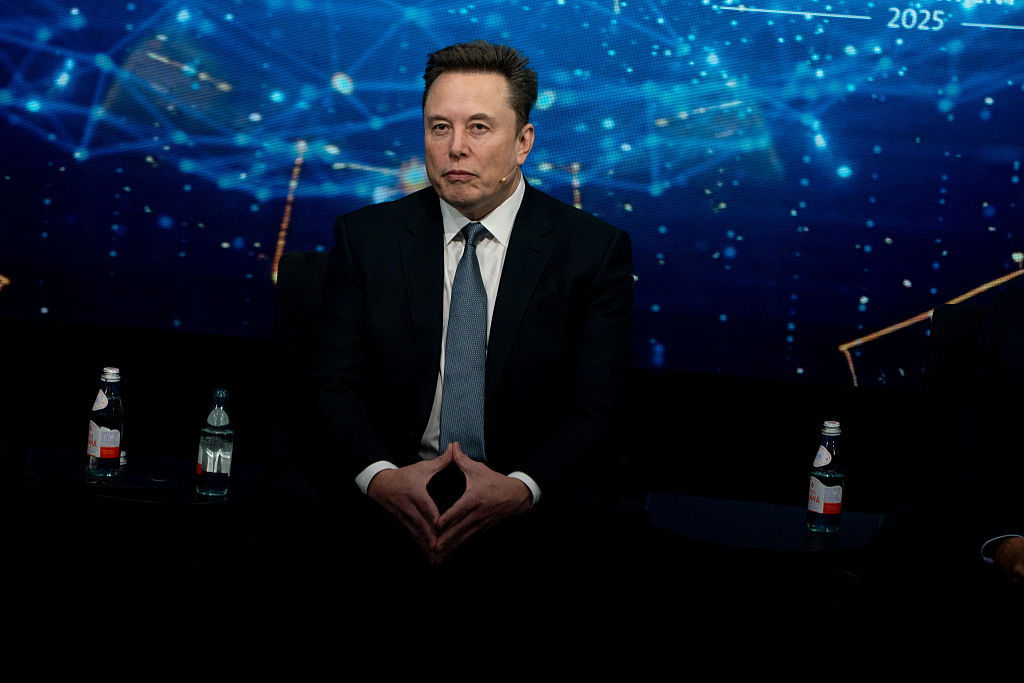
If Fordism was the logic of the twentieth century, Muskism, a new book argues, is the dark and twisted operating system of the twenty-first. (Stefani Reynolds / Bloomberg via Getty Images)
This June, SpaceX is set to debut its initial public offering (IPO), which, at $1.4 trillion, will be the biggest in history. Elon Musk has been vocal in the past about his disdain for publicly traded companies, and even his most devoted fans are puzzled. But going public is a fundraising operation; the world’s richest man needs money.
Last month, SpaceX acquired his money-losing company xAI, the proprietor of Grok, the chatbot best known for espousing white-supremacist conspiracy theories and producing child pornography. While fusing AI capabilities with rocketry will help him deliver on his promise to go to Mars, he still needs the capital to actually get there.
What Musk wants is to turn SpaceX into a meme stock, artificially inflated by his cult of personality and financial sorcery. “I am become meme,” he famously tweeted. This was a statement of purpose. Musk’s memeification is a philosophy: the online is real, and the distortion of reality endemic to the algorithm is reality.
Defining Muskism
The man, the myth, the meme: Elon Musk has worked his way into every layer of American society. His career, spanning multiple tech boom and bust cycles, has reshaped the world in ways that have yet to be fully realized. It is our new fledgling reality, decades in the making, that Quinn Slobodian and Ben Tarnoff try to understand in Muskism: A Guide for the Perplexed. Muskism proposes that Musk’s worldview and legacy represent a paradigm shift that goes beyond the individual man. If Fordism was the logic of the twentieth century, the authors argue, Muskism is the operating system of the twenty-first.
Muskism is not a biography, although Musk’s life story informs the thesis. It is an explanation of the future we are entering. Musk’s career trajectory was an early signal of the kind of tech conglomerate that dominates today, defined by the whims of a few megacorporations that own everything we use and span the areas of software and hardware, consumer and business-to-business (B2B) products, and public and private sector contracts. Musk’s career was a harbinger of this, as he pivoted to hardware while the rest of Silicon Valley was building platforms, foreseeing the defense tech rush of the 2020s almost two decades early.
What the authors propose is that his business ventures, ranging from rockets and satellites to social media and e-commerce, can be explained by more than a rational pivot to whatever makes money in Silicon Valley’s fickle investment landscape. Even as the world perceives Musk to be increasingly unstable, his varied business ventures reflect a coherent worldview, a unique synthesis of right-wing politics, cyborg visions, and statecraft.
Muskism can be defined as an orientation promising “sovereignty through technology” in an unstable world. The authors synthesize three currents of thinking that inform his worldview: fortress futurism, cybernetic collectives, and state symbiosis. Fortress futurism is the deployment of technology through entrenchment of societal hierarchy; state symbiosis is the fusion of Musk’s holdings with the state; and cybernetics is the fusion of the human with the digital.
Muskism is not an optimistic ideology, its fruits bestowed exclusively on a chosen few. Musk is aware that his right-wing, white-nationalist politics bring forth only chaos and immiseration for vast swaths of the public. His answer to this is to close ranks. To those he sees as worthy of life, he offers what the authors call “sovereignty as a service”: providing self-sovereignty on the individual level with electric vehicles built to insulate the consumer from geopolitical oil shocks, and on the national level with Starlink’s satellites and SpaceX’s rockets. At his core, Musk is a survivalist. The hierarchies on which our world is built are fixed, and the externalities of such a system are inevitable. The only thing left to do is to protect yourself by entering his walled garden, a paradise insulated from the racialized masses, which, according to Musk’s far-right radicalization, are an existential threat to the West.
Inside this fortress, there is a dialectic at play. Musk’s factories and companies are vertically integrated to create a seemingly flat structure, but the lack of hierarchy on the factory floor is used to entrench power structures outside of it. The authors recount an anecdote from 2022, shortly after Musk bought Twitter, now known as X: after discovering, in a closet, Jack Dorsey’s old shirts from the 2014 Black Lives Matter era that said “#StayWoke,” Musk “posted a picture of ‘new Twitter merch.’ It showed a shirt that read ‘#Stay@Work.’” The cybernetic system that Musk would like to replace our reality with is a closed loop, highly optimized, operating at maximum capacity and free from corrupting influences. Anything that threatens its balance must be destroyed.
So when Musk refers to left and progressive politics as the “woke mind virus,” he is speaking literally. Notions of democracy and workers’ rights are threats to the harmony of his balanced system, imperfections to be rooted out. They spread mimetically, on the internet, in much the same way as the ideas that led to the development of Musk’s own right-wing orientation. And the only thing left to do with a computer virus is to delete it. This is easy when you own the platform where the discourse takes place. Musk likely understands his transformation of Twitter as part “reprogramming the Matrix,” a concept he lifts straight from the movie franchise.
The Future Is a Walled Garden
Muskism is divided into two parts. The first spans previous eras of Musk’s life and career, beginning with his childhood in South Africa and continuing to his time in the PayPal mafia and later SpaceX, Starlink, and Tesla. The second half brings us into Musk’s life as we know it today, detailing his turn toward the far right, his heading of the Department of Government Efficiency (DOGE), and his hostile takeover of Twitter. In the first half, Tarnoff and Slobodian define Muskism as an ideology and trace its currents to various eras of Musk’s life and career. In the second half, they apply the lens of Muskism to analyze Musk’s recent turn to the far right.
The future of Muskism is far from set in stone. Our present is a world in flux, and it is difficult to predict our technological future just a few years into the supposed AI revolution. Tarnoff and Slobodian paint a picture of a man whose orientation toward our new world is still developing, even as his politics are probably already settled. We can only speculate as to what the future of Muskism will look like.
The authors attempt to do so in the conclusion. Tarnoff and Slobodian outline possible destinations for Muskism and Musk’s career, detailing competing speculative visions. A first possibility, Carbon Musk, posits that he may choose to return to his green technology roots and turn his attention to the climate crisis. This is the most unlikely scenario and thus receives the least attention. What the authors want us to focus on are the other three potential paths: Contractor Musk, a future in which he continues to pursue state symbiosis and takes over the federal government through contract monopolies; Compound Musk, a future in which he deepens his commitment to his far-right, white-supremacist politics and builds for the explicit purpose of fortifying the white race in an increasingly unstable world; and Cyborg Musk, a future in which he doubles down on human-digital synergy and builds an army of humanoid robots for commercial and military use.
Yet Contractor Musk, Compound Musk, and Cyborg Musk should not be framed as competing visions but rather different lenses with which to view the same political project. Muskism’s future will likely be a synthesis of these three currents. This is articulated in the hypothetical future Slobodian and Tarnoff illustrate at the end of their book, a future with remarkably few human interactions: all decisions are mediated by Musk’s various technological offerings, and his suite of products make up the physical infrastructure of the state. This is a future in which AI and robotic advancements are explicitly designed to further white supremacy and turn the page on the “woke mind virus.”
“The great error of history in the dark years of the early twenty-first century,” Tarnoff and Slobodian imagine this dark future, “was that ‘weak makes right.’” This was part of what Musk described as the “vampire cult” of education, now mercifully superseded.
Muskism, of course, is bigger than Elon Musk. Its survivalist ethos is endemic to Silicon Valley and constitutes the guiding philosophy of the Trump administration, the new wave of Silicon Valley defense tech companies like Palantir and Anduril, and right-wing billionaires like Peter Thiel, who has warned of a future in which a “one-world” state without borders aligns with what he sees as the “Antichrist.” The crisis of democracy and its commitment to pluralism (what Musk calls “suicidal empathy”) could spell, according to the tech oligarchs, the end of modernity and Western civilization.
The source of this crisis, Silicon Valley billionaires claim, is the people. AI could never organize a union or join a protest against an unjust war. In a remarkably Christian bent, they believe that when the machine God arrives, the chosen few will ascend into a technological heaven of their own creation. Tech oligarchs like Musk are happy to consign the rest of the masses to hell. The walled garden of Eden, whether in Silicon Valley or on Mars, is the culmination of their life’s work.