The Iraq War Was Not About Oil
As Donald Trump launches a dangerous war on Iran, understanding what really drives US imperial aggression is more urgent than ever. The 2003 invasion of Iraq, which many critics wrongly claim was about oil, offers an illuminating case study.
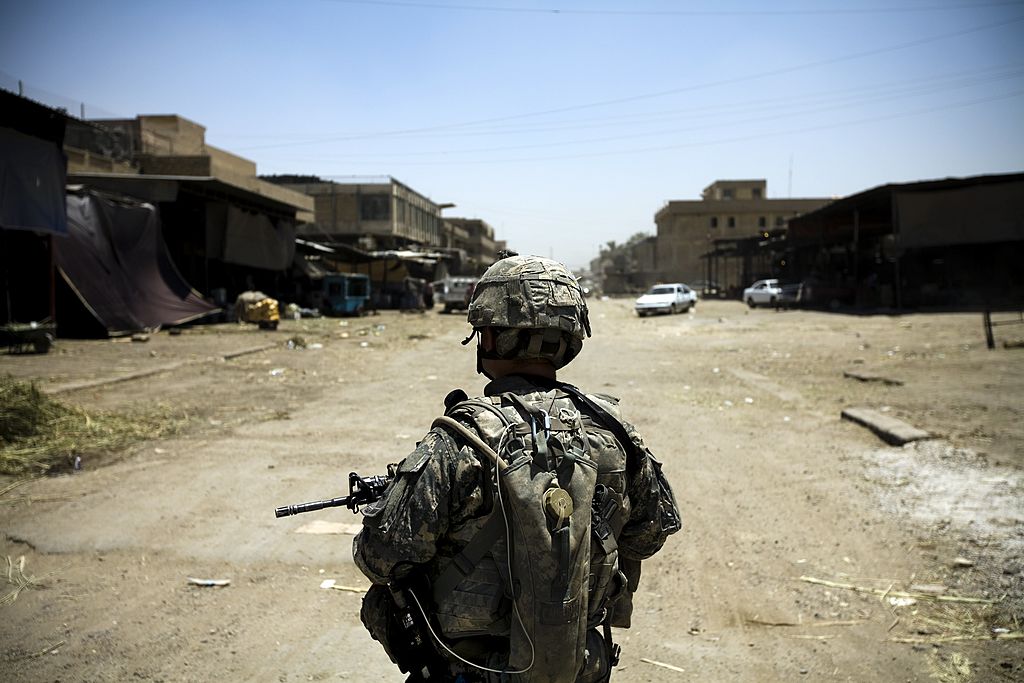
Over two decades later, it’s clear the US war on Iraq was motivated less by a need for oil and more by US policymakers’ desire to project geopolitical power in the Middle East and around the world. (Benjamin Lowy / Getty Images)
In the wake of a full-scale assault on Iran by the United States and Israel, and the kidnapping of Venezuelan president Nicolás Maduro, oil-based theories of imperialism are understandably getting attention. As we approach the twenty-three-year anniversary of the US invasion of Iraq, this perilous moment gives us an opportunity to revisit arguments that the Iraq War was, in the words of David Harvey in The New Imperialism — a tract written in reaction to Iraq itself — “All About Oil.”
On the surface, the case that the 2003 Iraq invasion was motivated by oil seems indisputable. First, after the chaos of civil strife generated by the war, the invasion ultimately led to a surge in Iraq’s oil production. Iraq is now, in fact, the sixth-largest producer of oil in the world.
Second, it was obvious to everyone at the time that President George W. Bush and Vice President Dick Cheney had very close connections to the oil industry. Indeed, Cheney, a former CEO of Halliburton, said in 1999 that Middle Eastern oil is “where the prize ultimately lies.” And when deputy secretary of defense and arch-neoconservative Paul Wolfowitz was asked point-blank why the Bush administration chose to invade Iraq over say North Korea, he responded candidly, “The most important difference between North Korea . . . is [that Iraq] . . . swims on a sea of oil.” The Federal Reserve chairman at the time, Alan Greenspan, also later admitted, “I am saddened that it is politically inconvenient to acknowledge what everyone knows: the Iraq war is largely about oil.”
Case closed, then? Not so fast.
Problem #1: The Malthusian Premise
Many theories claiming Iraq was an invasion for oil were based on the peak oil theory that was prominent at the time but is now completely discredited. More specifically, the theory was that the United States itself was running out of domestic oil sources and thus growing perilously reliant on “foreign oil.”
Michael Klare was the most prominent advocate of a “resource scarcity” theory of conflict that led to a slew of books — each with increasingly Malthusian titles like Rising Powers, Shrinking Planet, and The Race for What’s Left. All were based on the same premise: resource scarcity was driving geopolitical conflict in general and US imperialism in particular. Klare became the go-to oil analyst on the Left in the 2000s, informing Harvey’s theories about Iraq (ironic, since Harvey himself authored one of the most devastating critiques of Malthusianism at the height of its influence in 1974), and Monthly Review even published an article titled “Peak Oil and Energy Imperialism,” drawing from Klare and other peak oil–alarmist geologists.
The problem with these theories is they often emerge in periods of high oil prices — but those very prices tend to incentivize capital to find more oil. And find oil it did: the shale boom in the United States not only restructured the entire global oil market, but it also allowed the United States to surpass its previous “peak” of production in 1970 — the peak that M. King Hubbert had predicted — and become by far the largest oil producer in the world. With a glut likely sooner or later, the problem for oil producers is not oil scarcity but oil abundance and prices crashing (as they did around 2014–16 and again in 2020). Today it’s generally understood that the oil market is still relatively oversupplied (although Donald Trump’s invasion of Iran has meant a spike in prices).
Yet even though peak oil theory turned out to be wrong, we might think, it seemed plausible in 2003 and could have still motivated the Bush administration’s invasion. Perhaps, but I’m skeptical. Cheney and Bush’s close ties to the oil industry mean they would likely also be skeptical of such Malthusian scarcity-mongering. The industry has had rounds of false prophets of resource depletion in the 1920s, 1950s, and 1970s. Why would this time be any different?
Moreover, Cheney in particular was likely aware of the innovations afoot in hydraulic fracturing and horizontal drilling (in fact, the 2005 Energy Policy Act — legislation Cheney no doubt influenced — contained the “Halliburton Loophole” that exempted fracking from the Safe Water Drinking Act ).
When people say the Iraq War was “for oil,” the obvious question is: Oil for whom? There are three basic theories.
First, as Jacob Mundy explains, citing US foreign policy critic Andrew Bacevich, a war for oil such as in Iraq ultimately aims “to preserve the American way of life, rooted in a specific understanding of freedom and requiring an abundance of cheap energy.” In other words, by unlocking Iraq’s oil, the United States ensured cheaper oil prices on global markets to the benefit of US consumers and “the American way of life.”
Yet any analyst of the global oil market would understand that if you want cheap oil, the last thing you should do is ignite massive geopolitical conflict in the Middle East (just look at the oil price surge in the wake of the bombardment of Iran). The invasion of Iraq was followed by one of the largest booms in oil prices in the history of the industry (not only because of the war, it must be said, but mostly because of surging demand from China). Cheap oil did return, but not really because of Iraq. It was more because of the surge in US domestic production.
Second, there is a more direct theory that the United States not only wanted cheap oil or lower oil prices in general, but that it specifically wanted to commandeer Iraq’s oil solely for its own domestic consumption. It wanted to, as Trump claimed it should in 2011, “take the oil” for US consumers specifically. The evidence for this claim is even less convincing. According to the Energy Information Administration (EIA), in 2024, only 6 percent of Iraq’s crude oil exports went to the United States. This is not an outlier — it was only 4 percent in 2021 and only a bit higher at 14 percent in 2014. As with most Middle Eastern oil these days, most of Iraq’s oil is bound eastward — 72 percent of its exports go to Asia.
Third, perhaps the most alluring theory given the Bush administration’s oil ties, is that the invasion was not on behalf of the American consumer at all but on behalf of American oil capital. Many expected the invasion to lead to a full-on neoliberal privatization of Iraq’s nationalized oil sector and a veritable bonanza for US firms.
But this did not happen either. In fact, the regime installed by the United States went out of its way to privatize just about everything except oil. As a helpful explainer from 2016 puts it:
There was no appetite among Iraqi politicians or people for privatisation. The occupation was also in no position to push through any reform that could unite nearly all the country’s political forces in opposition. In the end, the US-led administration announced in September 2003 that foreign investment was acceptable for the rest of the economy but not for the oil sector.
Nevertheless, even if the oil sector was not privatized, perhaps the US oil firms still invested and benefited from Iraq’s notoriously rich oil reserves. Also no. According to the EIA’s latest report, all Iraq’s oil production projects are managed by firms like Italy’s Eni, France’s TotalEnergies, Russia’s Lukoil, PetroChina, and one by BP. There is a recent report that Iraq is trying to offer more favorable terms to US oil investors to curry favor with Donald Trump, but it beggars belief to claim this was the final chess move in a twenty-three-year process to invade Iraq on behalf of US oil capital.
If Not Oil, Then What?
On balance, it seems clear that the invasion of Iraq really was not “all about oil” — or if it was, then the US war was staggeringly ill-conceived and ill-executed. There is basically no link you can make between Iraq’s vast oil reserves and direct benefits for the US state, consumers, or large oil companies.
So, if not oil, what was the reason? I am no expert on the Middle East, nor the American neoconservative movement circa 2003, but my conjecture is that it was part of the larger neocon campaign to project US global power throughout the Middle East and around the world. The 1979 Iranian Revolution, and Saddam Hussein’s audacious invasion of Kuwait in 1991, were evidence of a region out of the United States’ tight control. By taking out Saddam’s regime, the United States could implant another ally alongside Saudi Arabia and Israel (among others) to protect US interests in the region.
Of course, this theory has its own problems, given that the invasion has resulted in basically nonstop chaos and instability since. This chaos continues today as the United States tries to foster regime change in Iran (unlikely to happen simply with bombs from above).
But there is evidence that the neocons and the “Project for a New American Century” were thinking of the Iraq War this way. In their infamous 1997 statement, they argued that the United States needed to more aggressively assert its power on a global scale and resist “isolationist impulses.” Among other things, they argued the United States must “increase defense spending significantly if we are to carry out our global responsibilities today and modernize our armed forces for the future” and “promote the cause of political and economic freedom abroad.”
As in Venezuela and Iran today, and in Iraq, it seems to me the motivation for US aggression is less about the need for oil or other resources and is more rooted in the nature of American imperial power itself. The goal, same as it ever was, is to project US geopolitical power as a nonnegotiable and incontestable force on the global scale. Any oil obtained along the way is merely a bonus.