Politics Is Everywhere, So Why Do People Feel So Powerless?

The defining feature of the last decade was that everything, from food to music, was politicized. All the while, our capacity to act collectively only grew weaker. Anton Jäger’s Hyperpolitics sets out to explain why.
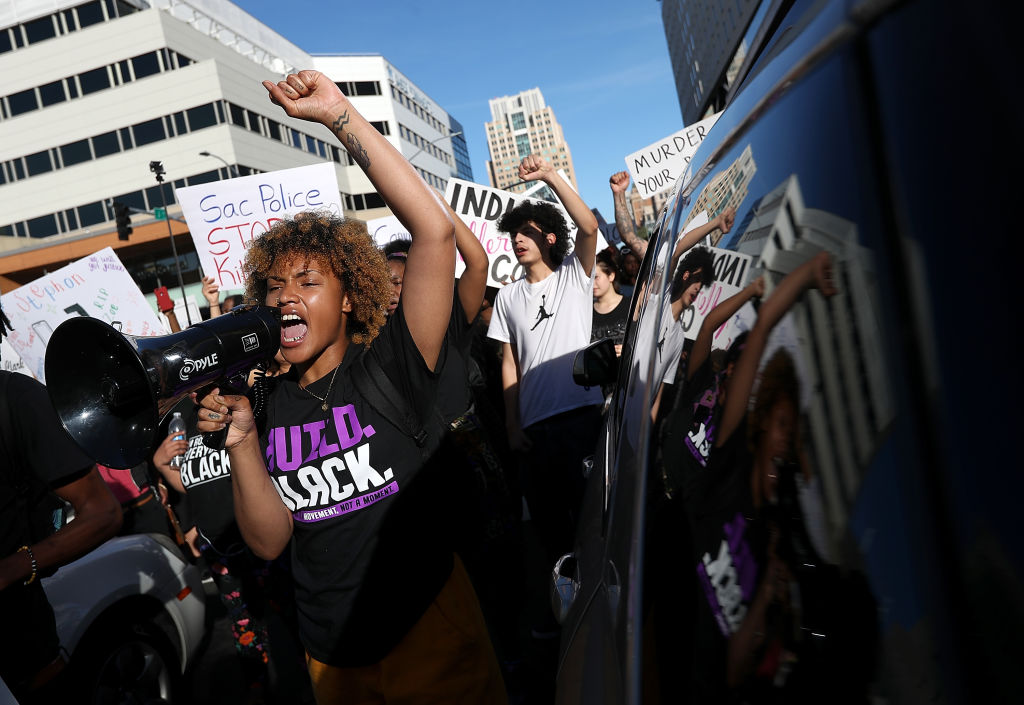
Black Lives Matter protesters march through the streets during a demonstration in Sacramento, California. (Justin Sullivan / Getty Images)

Halfway through his acclaimed novel Perfection, Vincenzo Latronico inserts a particularly revealing episode. It is 2015 and Anna and Tom are both graphic designers, working in one of Berlin’s trendiest neighborhoods. Their comfortable life is suddenly interrupted, however, when a picture surfaces on social media and soon goes viral. It is an image of Alan Kurdi, a young Syrian boy whose body was found washed up off the coast of Turkey and photographed by local rescue workers lying face down in the sand. Jolted out of their state of apathy, Anna and Tom decide to start volunteering at a local refugee center.

Initially, the couple like their work. As Latronico describes, they enjoy feeling part of something bigger than themselves and feel as if they are engaged in a “rendezvous with history.” Gradually though, the novelty starts to wear off. Anna and Tom grow bored with the tasks they’ve been assigned, and when cell phones are banned on-site, they react with outrage. How else will their followers know what they’ve been up to? With surprising ease, the couple soon forget about the body of Alan Kurdi and withdraw to the safety of their regular lives. From the comfort of their apartment in Berlin, they wait patiently for a new atrocity to interrupt their doomscrolling and pierce the carapace of their political ennui.

Perfection is part of a wave of novels satirizing millennial life, and it is clear that Latronico intends Anna and Tom’s narrative to make liberal readers squirm. However, the lessons to be drawn from this episode are relevant to parties far beyond the liberal cosmopolitan readership Perfection attracted. Across the West, political discourse is increasingly shaped by the boom-and-bust cycle of viral outrage. Singular events become political flash points, triggering bursts of energy that rarely translate into longer term engagement, burning bright at first then disappearing just as fast. The result, as Perfection ingeniously demonstrates, is a world in which politics is everywhere and yet nothing seems to change.

Politics Without the Masses

It is this same inchoate landscape that the intellectual historian Anton Jäger attempts to navigate in Hyperpolitics, published for the first time in English courtesy of Verso Books. Charting over forty years of political history, this brief but compelling volume covers uneven terrain: the ideological struggles of the last century on one end and the petty Twitter wars that shape our own on the other. In the process, Jäger shows that our increasingly saturated discourse prevents radical alternatives from taking shape, leaving us trapped in a hyperpolitical limbo: an eternal present characterized by “extreme politicization without political consequences.”

In order to make this argument, Jäger offers his own genealogy of the present, starting with the “mass politics” that defined much of the twentieth century. By mass politics he means politics articulated through “total institutions” such as unions, guilds, or political parties who were able to mobilize easily identifiable social bases to pursue a clear ideological program.

By the 1970s, however, this form of politics was already in recession. Fearful of an inflationary spiral caused in part by worker unrest, governments across the West turned to various policy instruments to reign in labor and strangle the remaining avenues for collective action, effectively shielding the market from mass democracy. In the wake of this restructuring, the only form of bargaining power that remained was the ballot box. But even voting began to feel like cashing a check: a solitary activity, in pursuit of individualistic aims, unfettered by social ties or collective obligations.

Those hoping for an ideological fightback were quickly disappointed. The years 1989 to 1991 saw the destruction of Soviet bloc Communism and a new discourse of liberal triumphalism became commonplace. In Britain, Margaret Thatcher declared that “free enterprise had overwhelmed socialism”; Mikhail Gorbachev appeared in an ad for Russia’s first Pizza Hut; and in Berlin, young people from both sides of the Iron Curtain met in former government warehouses to take drugs and listen to techno.

For Jäger, these ravers — captured in the Wolfgang Tillmans photograph that adorns Hyperpolitics — embodied the carefree attitude that would come to define the next twenty years of political history. They were living through what Francis Fukuyama had described as the “end of history” — and it felt surprisingly good. Why be part of the masses when you could just be yourself? The struggle was over and it was time to get high.

It was not until 2008 that this high first began to wear off. After Lehman Brothers folded, Western leaders laid out a raft of policies to reassure the markets. These included numerous governments bailouts and a set of drastic austerity measures. The backlash was widespread. In Lower Manhattan, the Occupy Wall Street encampment took over Zuccotti Park. Meanwhile in Europe, the success of left-wing parties like Syriza, Podemos, and Jeremy Corbyn’s Labour Party gestured toward a new horizon of radical economic justice. For a moment, it seemed as if the world were witnessing an era of democratic re-enchantment. However, establishment figures soon closed ranks around the insurgent left that failed to shepherd an already-fragile alliance of support to electoral victory.

Within this vacuum, Jäger argues, the anarchic forces of hyperpolitics finally took hold. Having eliminated all of the key opponents to the liberal center, Western democracy began to experience successive convulsions of populist outrage. Denied any institutional framework, however, these waves of political energy began to make themself known in other ways. On social media, niche cultural issues became the subject of heated debate, before suddenly burning out in a matter of days, sometimes hours. Public protests also became more common, although they often lacked anything resembling a policy program. From Extinction Rebellion to anti-vaxxers to the Yellow Vests movement, opposition was ubiquitous but lacked direction. Instead it relied on disaggregated groups of individuals united only by single-issue demands.

Perhaps the clearest example of such disorganized dissent, Jäger claims, was the wave of Black Lives Matter demonstrations that took place in 2020. Following the murder of George Floyd, twenty-six million Americans took to the streets to protest the toll of police brutality and mass incarceration. At the time, this represented 10 percent of the country’s adult population.

However, as Jäger points out, this astonishing level of engagement proved fleeting and yielded few lasting political gains. By 2026, every single one of the state police departments that saw their budgets cut has now seen this funding returned, and in many cases increased. Notably few protesters have materialized to contest these developments, signaling the ease with which even the most vociferous activists have dropped their calls for change. Jäger is disparaging in his assessment of this movement’s precarious social base and compares it unfavorably to the 1963 March on Washington, where many of those present could be seen wearing union pins and city badges, expressions of long-standing solidarity.

In light of these obvious failures, why has hyperpolitics proved such an attractive and durable mode of political engagement? For Jäger, the first answer is deinstitutionalization. As he emphasizes throughout the book, while “popular involvement has experienced a relative resurgence over the last decade . . . institutionalized involvement is at an all-time low.” In Germany, for example, membership of the largest trade federation has more than halved since its founding 1991.

Meanwhile, the US unionization rate reached a historic low of 9 percent last year. The “controlled demolition of the public sphere” that began in the 1970s continues apace and has led to the slow death of civic life. The growing divergence between political interest and political institutionalization has proved particularly devastating, creating an increasingly balkanized landscape, dominated by lone actors pursing aims that are both individualistic and short-termist.

To make matters worse, new virtual worlds have opened up to welcome those who have found themselves politically homeless. During the early days of the Arab Spring, many identified the essential role social media had played in organizing protests, dubbing them “the Twitter uprisings.” Today these affirmations of the internet’s democratic promise seem difficult to fathom.

While there can be no doubt that online activism has lowered the costs of entry, Jäger observes that it has also “pulverized the terrain of radical politics . . . spawning a chaos of vaguely mandated online actors.” Through our cell phones, we are now beholden to increasingly diffuse and extreme forms of content that remain unchecked and unregulated. This freely accessible horror show threatens to undo what little remains of the social fabric: isolating each of us in our own algorithmic pigeon hole and preventing anyone from imagining a horizon beyond the next viral trend.

If anything, one of the flaws of Jäger’s argument is his failure to emphasize the ways in which the virtual free-for-all of Internet 2.0 has reprogrammed our collective subconscious. While he acknowledges that our volatile moment reflects the “crisis of attention characteristic of the age of the smartphone,” he does not dedicate much time to the specific behavioral patterns that define this “age.”

In 2026, social media is now largely run by a number of opaque recommendation algorithms. Each of these algorithms feeds off billions of data points about user behavior, producing carefully curated content feeds that pander to our existing political and aesthetic biases. The result, it seems, is that the mechanics of our subconscious fears and desires have become an extension of the media ecology. And through our various likes, swipes shares, and follows, we have become un-consenting participants in the production line of online content that is both increasingly extreme and increasingly polarizing.

It is clear that this new digital landscape has rendered the possibility of mass politics largely untenable. Of course, there are some exceptions. One thinks of Andrew Tate and his army of overawed alpha males. Or J. K. Rowling, who has become a figurehead of the anti-trans lobby. However, their success has remained contingent on the support of diffuse online mobs, composed of individual actors, animated by personal outrage rather than political feeling. This is not mass politics but a kind of permanent culture war, motored by the careful channeling of rage.

Indeed, this model of rage-bait politics also helps to explain why the Right has proved so successful over the last ten years. It is not, as Jäger suggests, simply that “the ruling class enjoys a structural advantage,” but that the substance of our politics has shifted. In place of redistributive struggles shaped through collective action, moral issues that require elites to apportion blame and responsibility have taken center stage. In the economic domain, poverty increasingly came to be viewed by the Right from the neoliberal era onward as a result of the irresponsible actions of the poor. But the Left also adopted its own moralizing frames, swapping a language of structural exploitation for one concerned with victimhood based on identity.

Ending the End of History?

In The End of History and the Last Man, Fukuyama claims that the new age of neoliberal consensus he predicted would be “a very sad time,” void of the “daring, courage, imagination, and idealism” that ideological struggle inspires. In the place of these romantic ideals, he believed the new millennium promised only “centuries of boredom,” a restless utopia dissatisfied with its own perfection.

However, this prediction could not have proved further from the truth. Thirty years later, we are living in an era of unprecedented noise and excitement: constantly distracted by viral moments that jostle for our already thinly drawn attention. Within this febrile atmosphere, even the act of critique is hampered. Political theorists have found themselves unable to maintain a coherent context in which to develop their own ideas, as the landscape around them continues to fluctuate and all that is solid melts into air.

In spite of these challenges, Hyperpolitics represents Jäger’s effort to ground our ungrounded moment in a clear genealogy. In this regard, he is successful. And while the outlook is bleak, there are reasons for hope that Jäger could not have predicted when submitting his final copyedits. In October 2024, a young member of the New York State Assembly announced his candidacy for the New York mayoralty. On November 4, 2025, just over a year later, Zohran Mamdani was sworn in at the site of a disused Subway station. In the months since, this unlikely political hero has begun implementing many of his most ambitious policies, which include creating a task force to crack down on corrupt landlords, initiating a roll out of free universal childcare for two- to three-years-olds, and opening new bus routes that will be free at the point of use for all service users.

The key to Mamdani’s success, as many critics have noted, has been to create a broad base of support: advertising policies that appeal to the specific demands of different communities who have been hit the hardest by a spiraling cost-of-living crisis: from the highly educated precariat in Bushwick to working-class parents struggling to feed their children to halal van drivers forced to pay extortionate licensing fees around the city. In Hyperpolitics, Jäger writes that the only way the Left might build a sustainable movement today is to “translate the politics of local resistance into a unified vehicle — or ‘total’ institution — capable of linking together its disparate spheres of struggle”: remixing the strategies of mass politics for a world that appears both volatile and divided.

Mamdani has attempted to do just that. The only question that remains is whether this success can be sustained, and if so, whether it can inspire a broader national movement. Much like Anna and Tom, the couple at the heart of Latronico’s Perfection, we are in desperate need of a “rendezvous with history.” The difficulty, to paraphrase Karl Marx, is that we have to make it while a tradition of dead-end politics hangs over us.