American Socialists Aren’t Tired of Winning
More than 100 democratic socialist elected officials, staffers, and organizers from across the US met in New Orleans for the third How We Win conference last weekend. The gathering demonstrated American socialists’ growing influence and confidence.
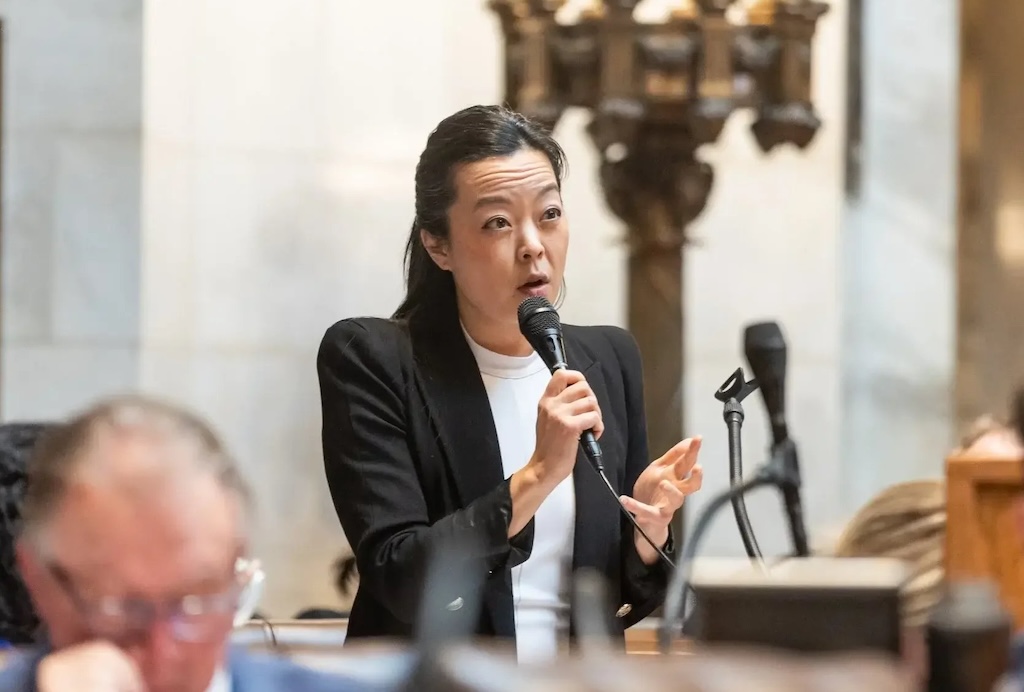
Even most socialists likely have no idea of the breadth and depth of power the movement has won across the US, or the policies those gains have already produced. Both were on full display at this year’s How We Win conference. (Francesca Hong for Governor)
Zohran Mamdani’s mayoral win in New York forced many political observers to think, for the first time, of Democratic Socialists of America (DSA) as a serious and potentially formidable force in American political life.
For the more than one hundred DSA members who assembled in New Orleans for the third How We Win conference last weekend, that fact has long been clear. First organized in 2023 by the DSA Fund, the event has become a key annual gathering of socialist elected officials, legislative staffers, and organizers that showcases the breadth and depth of DSA’s growing political heft.
“To me, it’s a given at this point that the power of this movement can’t be underestimated,” says Willie Burnley Jr, the two-term Somerville city councilor coming off an unsuccessful mayoral run in the Massachusetts city. “It’s being seen locally, statewide, and across the country.”
It’s also being seen well beyond the coasts that commentators have often claimed socialists’ appeal is limited to. Among those milling about the Hilton Riverside Hotel’s St Charles ballroom last weekend were elected officials from the Mountain states, the Midwest, New England, the Pacific Northwest — even, most notably, the South, not exactly a region traditionally friendly to socialists.
Texas alone fielded three DSA elected officials, all from their respective city councils: Mike Siegel from Austin, elected in 2024; Sylvia Campos from Corpus Christi, reelected last year; and newly elected Ric Galvan from San Antonio, who did not personally attend but whose office was represented by his chief of staff.
Georgia’s second-ever socialist official, Kelsea Bond, weighed in on a debate about how socialists in power should approach the issue of law enforcement, while the only two socialist elected officials in all of North Carolina offered insights into working within what the conference’s programming termed “hostile” states — where the GOP dominates electorally and preemptive state laws make socialist goals like taxing the rich or rent stabilization impossible in the near term.
“The obstacles feel absurd and demoralizing. It made me feel better to know that’s happening everywhere,” says Danny Nowell, who this past November won a second term to the town council of Carrboro, North Carolina.
“The first round of comments was kind of like having a support group,” says Siegel. “We moved on in the course of the conversation to learning valuable lessons. One idea I heard was making utilities more affordable through public power campaigns and rate reduction strategies.”
Several newly elected officials from Kentucky attended, including J. P. Lyninger, who, after years of unsuccessful efforts by local socialists, became Louisville’s first socialist city councilor last year. A prime speaking slot was reserved for Gabriela Biro, a local New Orleans DSA member who last year won election to the Orleans Parish School Board. There she has been fighting for the city’s only public school, whose opening last year ended the board’s ambition to be a wholly charter-run district.
“I tried to run with a Dolly Parton ethos,” she says, though she also got inspiration from an unlikely source: Moms for Liberty. Biro says she adopted the right-wing group’s playbook, but for the opposite ideological ends, reaching out directly to parents and asking them if they wanted change — and due to widespread unhappiness with the charter system, they did.
Growing Socialist Influence
In no small number of cases, socialists have not just won seats but ascended to prominent positions. In Toledo, Ohio, a blue city in Trump country, Nick Komives is the longest-serving member of its city council, giving him an elder statesman status that affords him greater influence. “My team is now integrated into the local Democratic Party functions,” he says.
In St Louis, Megan Green has served as president of the city’s aldermanic board since 2022, where she refers legislation to the powerful aldermanic committees that she also appoints. Rachel Miller has, as president of the Providence, Rhode Island city council, likewise set the agenda for that body since 2023, helped along by the kicking in of term limits that opened the door to the youngest, most diverse slate in the city’s history.
“There has been a long-standing conservative tendency, just because people hold onto their seats for a long time,” she says. “The council has been a little behind, politically and in terms of racial demographics, the rest of the city for a long time.”
Providence isn’t the only place where socialist officials have seen the political landscape change in the two years since the first How We Win conference. Nashville’s new mayor is more friendly to the kind of housing policy its only socialist city council member, second-term incumbent Sean Parker, wants to see enacted. He credits the shift to a bruising fight over a publicly subsidized boondoggle of a new stadium he helped lead, which he says also drew more people into municipal politics.
Meanwhile, Wisconsin has seen the first socialist elected to the Milwaukee Common Council since 1948, vowing he was “bringing back sewer socialism” to the city, while the socialist caucus in its state assembly — the first in ninety-two years when it was formed two years ago — doubled in size to four, thanks in part to last year’s addition of state Rep. Francesca Hong, first elected in 2020, who socialist Rep. Ryan Clancy says had been a “de facto” member of the caucus from its founding. Hong has now entered the race for Democratic nominee for governor and currently leads the crowded field, thanks to the wide open lane left by Governor Tony Evers’s retirement.
“I like to call Zohran the Fran Hong of New York,” jokes Clancy.
With more than 1,300 volunteers and a surge of small-donor support, Hong hopes to replicate Mamdani’s people-powered success at the state level, complete with a promise of universal childcare and a vision for expanding the electorate.
“Working-class people are getting screwed. They’re stressed and demanding a change in leadership,” says Hong, who besides being a single mother is herself a renter and works a waged job as a bartender. “These are the same things that people, whether urban, rural, or suburban, are going through.”
Not surprisingly, the conference’s attendees reported the aftershocks of Mamdani’s political earthquake were being felt around the country — even in some surprising places.
“I haven’t seen a New York mayor’s race penetrate Nashville like this,” says Parker. During the recent government shutdown, he and his council colleagues took up the call for fast, free buses as a temporary relief measure. “That was the Mamdani effect, I think,” he says.
“It inspired a lot of conversations among my team and my progressive peers on the city council about how to formulate a similar affordability agenda,” says Siegel, even as he cautions that anti-tax state constitutional amendments mean it would not be funded in Austin by a Mamdani-like tax on the rich.
Socialist Policy Wins
Arguably the most dramatic political shift has happened in Portland, Oregon, where after years of organizing, DSA members now hold a third of the city council seats — a first for any comparably sized city.
One key was the small-donor matching funds program passed in 2016 and modeled on the same public finance system Mamdani rode to victory in New York. Another was the city’s adoption, approved overwhelmingly by voters in 2022, of a ranked-choice, multimember-district electoral system of the kind used in Ireland, which in the Oregon city means three councilmembers representing each of four citywide districts — effectively meaning that candidates can win office by winning a large minority of any district’s voters, whether progressive or conservative.
“We looked at the Irish system, looked at Sinn Féin and others whom DSA has relationships with, and saw that in this system knocking on a lot of doors wins elections,” says Benjamin Gilbert, cochair of Portland DSA’s Socialists in Office committee.
These electoral wins became policy wins. Portland’s new socialist-driven council has passed a ban on algorithmic price-fixing, reallocated $2 million from the city police budget to parks, and is now working to enact a Renters’ Bill of Rights, backed by five of the twelve-member council and modeled on a measure passed by voters in nearby Tacoma, Washington, two years ago. Among its provisions is capping fees, mandating six months’ notice for rent hikes, and requiring landlords to pay for moving costs when they raise rent more than 5 percent.
In Nashville, Parker points to a referendum backed by voters for a half-cent raise in the sales tax to fund public transit, and a zoning reform package he’s spearheading that will open the door to more housing density in the city. Providence, which at one point held the dubious honor of the country’s fastest-rising rent, has under Miller’s leadership seen its city council limit a tactic used by private equity firms to bulk-buy property, ban algorithmic price-fixing like Portland did, and overhaul its zoning regulations to incentivize more housing density and affordability.
The measures show the potentially productive overlap between the Left and the much-maligned “Abundance” movement — as well as its limits.
“‘The Left-lib alliance,’ we half-jokingly call it in Nashville,” says Parker. “More ‘Abundance-coded’ people have worked with us on issues like upzoning and surveillance.”
“There’s an Abundance group in Providence, and it supports the increased density that makes it possible to build more housing,” says Miller. “But as soon as we start talking about regulation of price, maintaining affordability, or anything that’s not ‘We can build our way out of the housing crisis,’ that’s when I get a lot of fear and angst.”
Those are the kinds of measures that Soli Alpert has been able to fight for as chair of the nine-member Berkeley Rent Stabilization Board, which he was first elected to in 2018 while still a student. But Alpert’s goal is not just to fight for tenants’ rights and housing affordability — including by also banning landlords’ use of price-fixing algorithms — but to regrow the Bay Area’s once-powerful tenant movement.
Alpert points to the successful ballot measure he pushed in 2024 that not only expands renter protections but also protects the right of tenants to organize tenants’ unions, allowing them to seek a rent reduction from the board if a landlord is found to have violated that right. The result has been “a boom in organizing,” he says.
Not all the policy wins have involved housing. In Austin, Siegel spearheaded the city council’s termination of the local police’s automated license plate reader (ALPR) program, a pernicious form of mass surveillance that drew renewed controversy due to Trump’s mass deportation efforts. In Toledo, Komives has led a local effort to convert landfill gas to renewable energy and sell it, to plug the budget hole left by austerity at the federal level.
And not all the political change has been to socialists’ benefit. In Missoula, Montana, the two socialists on the city council have been reduced to one, after Daniel Carlino, who first told me about his struggles to advance socialist policy in the city at 2023’s inaugural How We Win, lost his reelection bid by four points. Kristen Jordan, who did win reelection to remain the sole socialist on the city council, calls it the result of a deliberate campaign of “character assassination” by an implacably hostile local Democratic establishment.
Meanwhile, in Somerville, Massachusetts, long a hotbed for socialist electoral efforts, city councilor Willie Burnley Jr will be leaving the seat he has held for two terms after falling short in the mayor’s race this past November. Despite the loss, he looks back at his tenure with pride, having successfully led efforts to forgive medical debt and strengthen tenants’ rights, and believes his campaign leaves the local chapter in a good position.
“My campaign helped bring people to DSA who otherwise would never have been part of the organization, including folks as young as sixteen,” he says. “We really helped build a structure that none of our Boston DSA campaigns had before, and which will be helpful moving forward.”
Tough Conversations
With dozens of elected officials, their staffers, and local chapter organizers brought together under one roof, the event provided a key opportunity for usually scattered socialists to exchange ideas and strategize.
In a session on protecting immigrant communities, Chicago alderperson Anthony Quezada explained to attendees how he had turned his aldermanic office into an “organizing hub” for resisting Trump’s turbocharged Immigration and Customs Enforcement deployment in the Illinois city this past summer. In another, attendees from half a dozen states gave presentations on respective revenue fights they had waged, detailing the coalitions they had built, the strategies taken, and political headwinds they battled through. One solicited ideas for gathering signatures for a planned tax-the-rich ballot measure in Michigan and urged out-of-state DSA members to come and campaign for it.
The largest discussion group centered on the question of “co-governance”: the structures connecting elected officials to their local DSA chapters, and how to ensure socialists continued to advance the organization’s political priorities once they were in power.
Chapters needed to prepare those entering elected office for the realities of their new status, one attendee said, including the demands of human resources and their new relationship with staffers they may have previously considered friends and comrades. It was not enough for chapters to build candidates, said another; they needed to build a deep bench of staffers too, and make sure that valuable institutional knowledge wasn’t lost through attrition.
In Portland, that co-governance looks like regular meetings and frequent communication between elected officials and the local chapter’s Socialists in Office Committee (SIOC), according to Gilbert, its cochair, who stresses the relatively recently created structure is still a work in progress. SIOC members in turn act as unpaid, registered lobbyists with the city under Oregon’s laws.
“I think more organizations that endorse candidates should be following through with them, not just putting a logo on them,” says Gilbert.
It also looks like using mass action, newsletters, and other tools to publicize legislative fights and victories on the inside, with an aim toward building momentum for socialism on the outside. Gilbert points to the enactment of Portland’s ban on algorithmic price-fixing, which DSA brought members into City Hall to watch, followed by a mass text to the chapter’s membership announcing its passage.
“I read responses to this text that said, ‘I had no idea this passed. This is amazing,’ and they asked how to get involved again,” he says. “If we have a legislative win that we can achieve and we’re not bringing rank-and-file members into our organizations, then we’re leaving power on the table.”
The weekend wasn’t without disagreement too, as the face-to-face gathering offered the chance to hash out matters that have divided the movement. One debate involved the question of how elected socialists should orient themselves toward the establishment politicians they are forced to work alongside.
Those favoring a more antagonistic posture argued that it was a betrayal of the communities they were elected to fight for to lend their support to largely objectionable legislation just for the purpose of horse-trading, and that elected socialists needed to be willing to lose their seats in order to hold the line on certain matters. On the opposing side, attendees argued some flexibility was required in order to work within the system to deliver for constituents, and that socialists needed to prove to their more centrist colleagues that working with them was not a waste of time, as well as give those colleagues the space and opportunity to shift their thinking.
“I don’t think my colleagues would have elected me president if I was taking a wholly confrontational stance,” says Miller, who has parlayed her experience as an organizer into a reputation on the council as a consensus-builder and “the adult in the room.”
“I tend to think we have to do some of this stuff by working with people and bringing them in and bringing them along,” she says.
“We have to position ourselves in ways that we’re not viewed as simply hostile actors trying to take down the system,” says Burnley:
Even if we have transformational politics, they have to be packaged in a way that we can say we’re trying to improve upon all the good things we have here, and that even if you’re not from a working-class background or a socialist, you can see yourself in our shared vision. To do that, we have to be able to maintain relationships with other electeds, who may not share our overall worldview.
Yet those on the more conciliatory side of things also saw value in the arguments of the more confrontational side.
“It hadn’t occurred to me until that conversation with folks more prone to being more antagonistic what an opportunity our hard lines as socialists are,” says Nowell. “If we know where we cannot move from, that gives the establishment an idea of where they can move to come to us: if you can meet this condition of solidarity, then we can trade other horses.”
The two sides seemed to find some broad agreement that the right approach depended on the wider political conditions: whether they were in a blue or red state, part of a legislative majority or minority, or the lone socialist member on their elected body or part of a caucus. For many, the two approaches were not mutually exclusive.
In the Wisconsin Assembly, Hong says, she has built relationships with both centrist Democrats and those who might be progressives but do not consider themselves socialists, because she and the socialist caucus see themselves as organizers first and “organizing relies on building relationships.” But they have also held the line on certain principles and voted no on legislation that violates them, preserving the coalitions they’ve built with progressive organizers on the outside, thereby leading with what she calls moral courage and setting expectations — all while impressing members with their regular meetings to discuss legislation and communications infrastructure. “So I’d argue that we provide the type of leadership and structure that allows us to govern more effectively,” she says.
For Missoula’s Kristen Jordan, movements need all of the above, whether button-pushers or relationship builders. She recalls a friend who views herself as a negotiator telling her she couldn’t do her job without those who push the envelope — a role Jordan is comfortable with on what she complains is a conservative city council that puts accruing political capital among colleagues above principles and the common good. “I’m getting in voters’ ears instead of trying to appeal to the council,” she says.
Over her tenure, Jordan says she received far more pushback from the council’s establishment Democrats — not an uncommon complaint from conference attendees — than its few conservatives, with whom she has built good working relationships. But a funny thing happened after she won a second term with a resounding thirteen-point margin this past November.
“Being reelected has solidified my position,” she says. “People have come to me saying they want to work with me.”
Write Off at Your Own Peril
Socialists’ three days in New Orleans last weekend displayed the increasing maturity and sophistication of an organization and wider political movement that has often been written off over the past decade — written off by both the political establishment and, at times, by its own adherents.
Instead of factionalism, posturing, and interpersonal conflict, 2025’s How We Win showed a serious and united movement laser-focused on winning state and municipal power, using that power to benefit working-class Americans and further build itself, eager to exchange strategies and tactics for doing so, and capable of talking through potentially rancorous disagreements in productive ways. The establishment can continue to write them off — but it may end up doing so all the way to its own defeat.