Why We Need Union Halls in Every Town
Lainey Newman and Theda Skocpol’s Rust Belt Union Blues makes a compelling case that left-wing success in the rust belt depends on reviving the presence and stature of unions — and the sense of social connection they offer — in local communities.
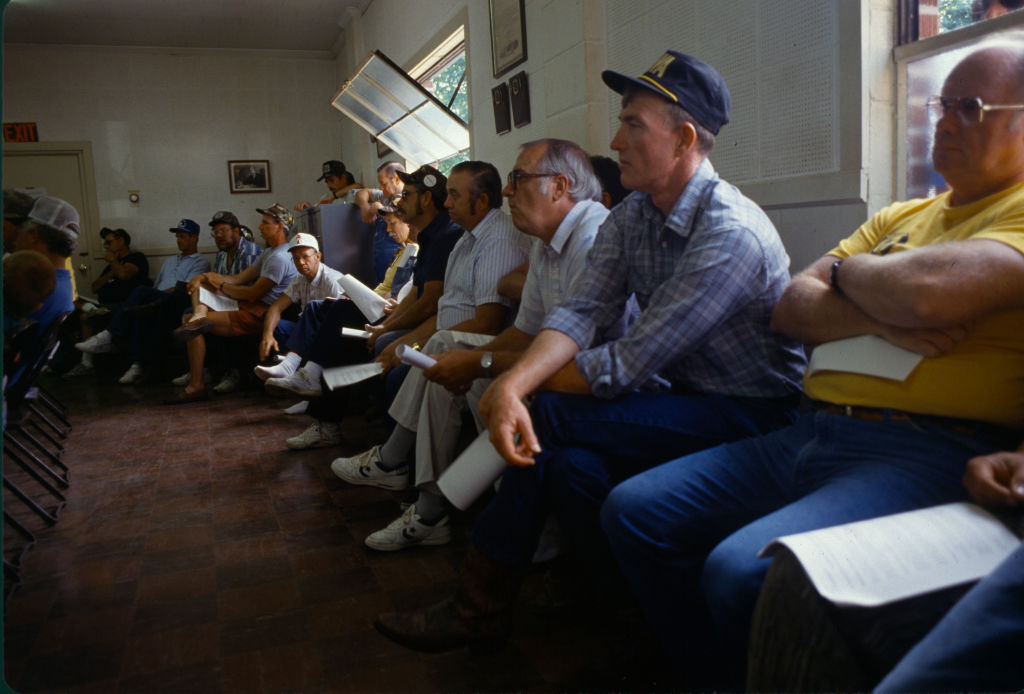
Striking coal miners hold a strike meeting in a United Mine Workers of America union hall in August of 1993 in Boonville, Indiana. (Andrew Lichtenstein / Corbis via Getty Images)
Progressives have rightly sounded the alarm about the dire state of labor in the United States for decades. Today union density in the private sector stands at just 6 percent, down from a high of over 30 percent in the 1960s, and the labor movement exerts less influence in American politics than it has since the 1920s.
The effects of labor’s weakness are easy to predict: mass unionization went hand in hand with decreased income inequality and higher wages for workers and increased job security and working conditions, in addition to decreasing gender and racial economic disparities and encouraging pro-worker legislation like minimum wage standards and paid leave. Not surprisingly, then, American workers do not feel great, and many commentators correctly argue that the only cure is a large-scale revival of the labor movement.
Yet as Lainey Newman and Theda Skocpol argue in their new book Rust Belt Union Blues, even the daunting task of organizing new workers into unions on a mass scale to reverse decades of tragic decline is only half the battle. Unions not only need to add new members to their roles, but they also must be present in communities in a way that they haven’t been for a long time; they have to mean something in the daily experiences of workers and the communities where they live. Without this key second ingredient, workers will not look to unions anywhere beyond the narrow confines of the bargaining table, and unions’ historic role as an effective conveyor belt for connecting working-class communities to progressive politics will never be restored.