The US Propped Up the Shah’s Dictatorship to the Bitter End
The shah of Iran faced a secular opposition that wanted to restore constitutional government. Washington continued to back his dictatorship as it faced mass protests, paving the way for Ruhollah Khomeini to establish a theocratic system after its fall.
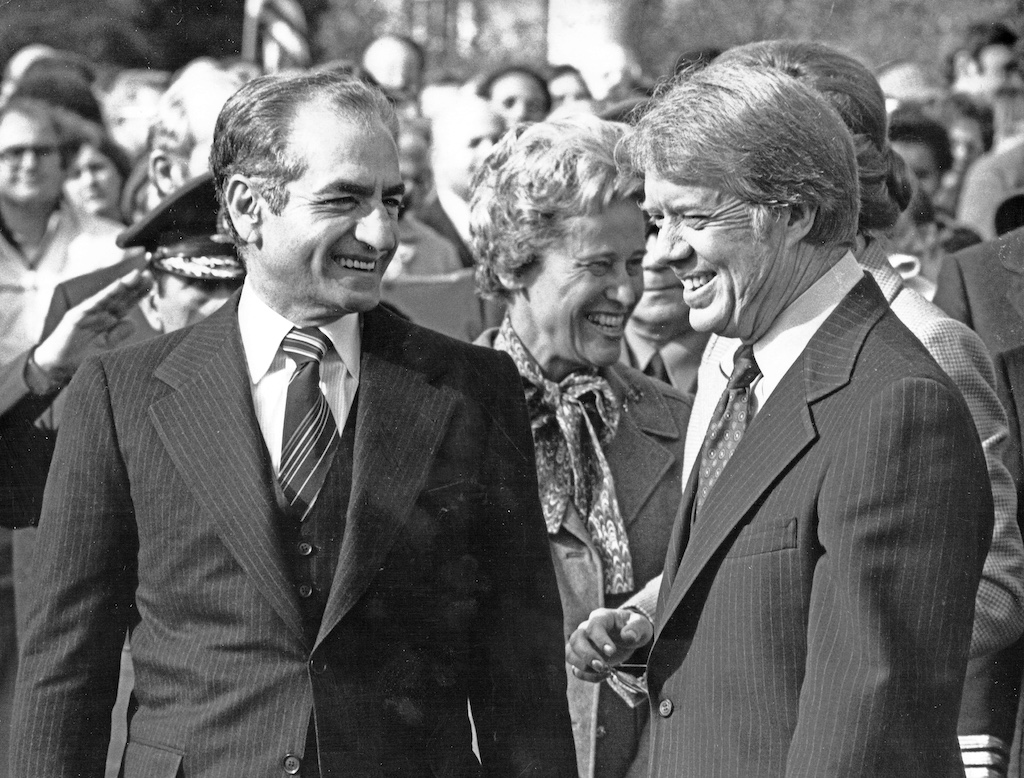
The pivotal years of 1977 and 1978 coincided with the presidency of Jimmy Carter, whom many (including the shah himself) hold responsible for undermining his throne. (Benjamin E. “Gene” Forte / CNP via Getty Images)
Scott Anderson’s new book, King of Kings, takes its title from the English translation of “Shahanshah,” the official Persian-language title of Mohammad Reza Pahlavi, Iran’s last king or shah, who was overthrown during a popular revolution in 1979.
Anderson, a US political journalist who has previously written both novels and nonfiction works, like the best-selling Lawrence in Arabia, approaches this true-life story in the dramatic style of a fictional work.
In line with previous accounts of the Iranian Revolution, it focuses on the ways in which the shah’s delusional despotism, aided and abetted by a succession of US administrations, paved the road for Iran’s revolution.
Before the Fall
King of Kings comes in the wake of several recent books on the history of US-Iran relations, including works by John Ghazvinian, Mahmood Monshipouri, Firoozeh Kashani-Sabet, Matthew K. Shannon, Vali Nasr, and Mohsen Milani, as well as my own forthcoming Axis of Empire: A History of Iran–US Relations. These are scholarly tracts that closely trace Persian- and English-language sources, primarily addressed to readers interested in Middle East history and US foreign affairs.
Aimed at a wider, nonspecialist readership, Anderson’s book is cast in a different register, with a nonacademic style and prose, and his sources are all in English (though some are translations of Persian originals). King of Kings uses scholarly material idiosyncratically to give its narrative hyperbolic thrust and dramatic flair. A few pages into its preface, for example, the book draws an idyllic picture of the shah’s reign to amplify the shock effect of its imminent overthrow:
Over the span of the shah’s rule, per capita income had increased a phenomenal twenty times over, the literacy rate had quintupled, and the average lifespan of an Iranian had more than doubled from twenty-seven to fifty-six. During his reign, half a million Iranians had obtained college degrees abroad, while the network of universities within Iran ranked among the finest in the region. Socially, women enjoyed greater freedoms than almost anywhere in the Islamic world.
Though some of these claims might be partially true, they are all based on contested statistics. Yet Anderson simply asserts them as fact without citing any sources.
King of Kings is primarily a melodramatic story of the shah and his court during the 1970s and secondarily an account of the shah’s relations with the United States, particularly the Carter administration. Anderson’s portrait of the shah as a weak and delusional dictator corresponds to the consensus of scholarly studies, as does his depiction of Washington’s Iran policy as self-serving, shortsighted, and incoherent.
In addition to the shah, the book focuses on Iranian personalities, such as Prime Minister Asadollah Alam, Queen Farah, and Ayatollah Ruhollah Khomeini as well as Jimmy Carter; his national security officer, Gary Sick; the last ambassador to Tehran, William Sullivan; and diplomatic staff members who knew all was not well under the shah.
Foremost among the latter is Michael Metrinko, a former Peace Corps Iran volunteer and political officer at the US consulate in Tabriz and the embassy in Tehran. That was where he was taken hostage in November 1979, going on to spend 444 days in captivity along with fifty-one other Americans.
Metrinko is Anderson’s outstanding source, identified as such in a Politico promotion of King of Kings titled “This Diplomat Saw the Fall of the Shah Coming. Jimmy Carter Ignored Him.” In truth, however, Metrinko was just one of a host of Foreign Service officers, journalists, diplomats, and Iran experts, as well as thousands of Iranians studying in the United States, whose warnings about the likely consequences of American support for the shah’s dictatorship were habitually ignored in Washington.
Willful Blindness
Anderson is correct in insisting that the systematic suppression of information critical of the shah’s regime led to disastrous results for US-Iran relations. Yet rather than stemming from naiveté or distractedness, Washington’s neglect of Iranian realities was the result of a Cold War mindset whereby the US political establishment and media routinely distorted facts to paint a glossy picture of life in Iran under the shah.
Misinforming the American public about Iran became official policy during the Nixon administration, solidified when former CIA chief Richard Helms arrived as ambassador to Tehran in 1973. But the US news media and academic establishment were also responsible for promoting a distorted image of the country. The New York Times, for example, practiced systematic falsification as far back as its record of covering up the CIA’s role in restoring the shah to his throne in 1953.
While receiving generous funding from the Iranian government, leading American universities such as Harvard, MIT, Princeton, Georgetown, UCLA, and Columbia bestowed honorary degrees on the shah, sponsored projects supporting his policies, and published scholarly volumes that were largely oblivious to the dark side of Iranian politics. Meanwhile, exceptional scholars, including James Bill and Thomas Ricks, wrote about repression and dictatorship in Iran and found themselves ignored by the media, academic, and political establishments.
As Anderson explains, by the mid-1970s, in the wake of the Vietnam and Watergate fiascos, the shah’s glorious image in the United States was gradually coming into question. Congress was trying to exert control over foreign policy, pushing back against the Nixon-era “imperial presidency.” The news media, too, began questioning the wisdom of unlimited arms sales to a one-man dictatorship that suppressed all dissent and tortured its opponents.
For nearly two decades, the loudest opposition to American support of the shah was voiced by thousands of young Iranians studying in the United States. Numbering around fifty thousand by the late 1970s, Iranians were the largest group of foreign students in the United States. Many were active in the Confederation of Iranian Students, the world’s most effective left-wing student organization of the 1960s and ’70s. For anyone who paid attention, years of noisy Iranian student protest offered ample evidence of how wrongheaded Washington’s support for the shah had been.
Ironically, Anderson’s preface notes that he personally witnessed one of the most spectacular Iranian student protests that took place during the shah’s visit to the Carter White House on November 15, 1977. Working as an “errand boy” at the Treasury Department in Washington, DC, the eighteen-year-old Anderson watched as about four thousand students broke through the police line to fight pitched battles with a smaller crowd of shah supporters recruited by the Iranian embassy.
Close to a hundred demonstrators and twenty-eight police officers were injured in what the Wall Street Journal called “Washington’s largest and most violent street disturbance since the end of the Vietnam War.” In spite of having enjoyed this front-row view of history, Anderson only has one short paragraph beyond the book’s preface on the impact of Iranian student opposition in altering US perceptions of Iran.
From Truman to Carter
King of Kings starts with a few chapters on historical background featuring individuals, such as Prime Minister and later Court Minister Alam, who had a sobering influence on the shah before his shaky self-confidence turned into megalomania when he took charge of Iran’s booming oil income in the 1970s. However, the early chapters also include uninformed judgements such as Anderson’s confident claim (again without any citations) that oil was not crucial to US interests in Iran during the run-up to the 1953 CIA-orchestrated coup.
This assertion overlooks solid academic studies, such as those by Ervand Abrahamian, which argue that the breakup of Britain’s monopoly over Iranian oil — something that happened right after the coup — was indeed a prime American objective under the Truman administration in the early 1950s. Anderson is aware of Abrahamian’s scholarship, which he cites in the above-mentioned chapter whose sources are otherwise mostly non-scholarly, like A. S. Cooper’s The Fall of Heaven, or partial to the monarchy’s alignment with the United States, such as the work of Abbas Milani and Ray Takeyh.
Anderson devotes the bulk of his book to the second half of the 1970s, when the monarchy’s growing economic and political challenges, as well as confusion in its relations with the United States, quickly escalated into a prerevolutionary crisis by 1977–78. Here, the author aligns with the consensus view of historians that, until the last year of his reign, the opposition to the shah was largely secular and liberal, demanding no more than the restoration of constitutional government. He argues that the shah might have saved his dynasty if he had relinquished dictatorial power and agreed to rule as a constitutional monarch in 1977, an option he accepted only when it was too late by the end of 1978.
The pivotal years of 1977 and 1978 coincided with the presidency of Jimmy Carter, whom many (including the shah himself) hold responsible for undermining his throne. The entire second half of King of Kings is devoted to a scrutiny of US-Iran relations during this period. Anderson uses more reliable primary sources here, such as the testimony and writings of Gary Sick who served on Carter’s National Security Council.
Anderson correctly notes that in spite of his human rights rhetoric, Carter continued the policy of massive arms sales to Iran, without pressing the shah to compromise with his secular liberal opposition. If a grand compromise could have averted a looming revolution, the Carter administration must therefore share responsibility with the shah for not adopting this approach in 1977.
Perhaps the strongest part of King of Kings is its coverage of relations between Washington and the shah in fall 1978, when it suddenly dawned on the former that the latter faced a crisis that he would not be able to survive. By this time, Ambassador Sullivan, with ears on the ground in Tehran, had begun secret liaisons with the camp of Ruhollah Khomeini, the Shia cleric who now clearly occupied a position of leadership in an impending revolution.
Even at this late stage, the Carter White House remained bitterly divided over how to react. A hawkish faction, led by National Security Advisor Zbigniew Brzezinski, insisted that the shah would have to be saved at any cost, up to and including a bloody military coup. The State Department, on the other hand, mostly agreed with Sullivan that the monarchy was finished and the United States would have to establish working relations with Khomeini and his associates.
American Folly
After much vacillation, by early winter 1979, Carter finally gave up on the shah, informing Sullivan that he should tell him to leave Iran. Meanwhile, during late fall and early winter of 1978–79, secret envoys carried messages between Washington and Khomeini, who had moved to France from his exile in Iraq. In an important final message, soon to be made public, the ayatollah promised normal relations with the United States if Carter stopped backing the departed shah’s caretaker government.
Anderson names some of the Khomeini–Carter go-betweens, including Ibrahim Yazdi, the Iranian American aide to Khomeini, and the US scholar and former CIA agent Richard Cottam. He also notes the role of General Robert Huyser, who was dispatched to Tehran by Carter after the shah’s departure to act as the commander in chief of Iran’s armed forces. Huyser’s job was to make sure that the army, which was closely tied to the United States, remained intact no matter who emerged on top of the revolution.
This plan, too, proved to be another American folly as the armed forces, already on the brink of collapse, fell apart in the face of a massive popular uprising in early February 1979. From that point onward, American policy in Iran faced the challenge of salvaging relations with a provisional revolutionary government that had not completely severed ties with the United States.
As Anderson observes, Carter doomed his tense balancing act with postrevolutionary Iran when he allowed the shah to come to the United States. This move triggered a crisis that led to the US embassy staff in Tehran being taken hostage, an event that, in turn, changed the course of the Iranian revolution by putting it on a radical collision course with the United States.
King of Kings thus ends with the familiar narrative arch of the Carter administration’s blundering response to a triumphant Iranian Revolution. What Anderson does not address — and he is not alone in this — is what an alternative, saner response might have been. That would have involved an open admission of past mistakes and the realignment of US policy with the realities of an anti-imperialist popular revolution.
Instead, Carter stayed the course of duplicitous diplomacy, quietly trying to rebuild ties to Iran’s armed forces and engaging the CIA and the US embassy staff in clandestine meetings with members of the provisional government. Washington had learned nothing from its disastrous encounter with Iran, while the hostage crisis would inaugurate another bellicose chapter in US global posturing, with the lessons of Iran, Vietnam, and Nicaragua obliterated in the face of Reaganite America’s right-wing drift.