Iran Is Facing Its Deepest Crisis Since the 1979 Revolution

Discontent over dire economic conditions lay behind the protest wave that rocked Iran earlier this month. A US attack will make things even worse for the Iranian people, whether or not it results in the regime change Donald Trump would like to see.
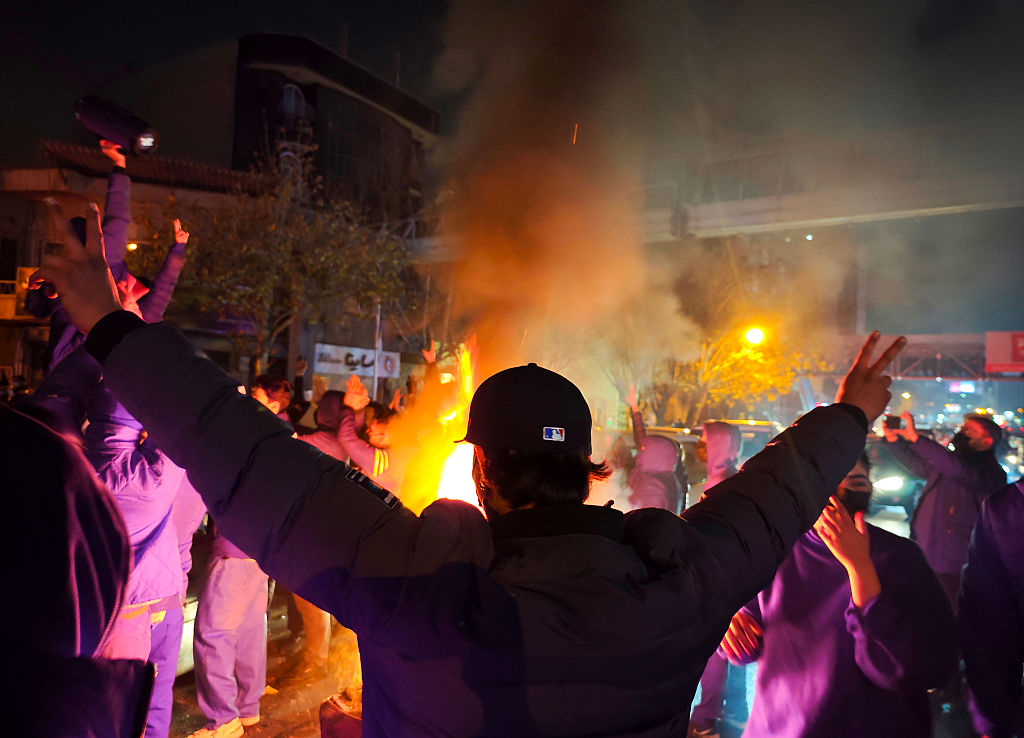
Repression of opposition currents inside Iran that called for the transformation of its system has created a political vacuum. Well-funded monarchist TV channels have been working to fill the space, promoting a whitewashed view of the shah’s old regime. (Anonymous / Getty Images)

Interview by
Daniel Finn

The wave of protests that rocked Iran earlier this month was one of the biggest challenges the Islamic Republic has faced since the revolution of 1979. The state security forces appear to have contained the protests after harsh repression that resulted in thousands of deaths, but the country is still facing a deep economic crisis that underpins popular discontent. Meanwhile, the Trump administration is threatening to launch another attack on Iran, with a major buildup of forces in the region.

We spoke to historian Eskandar Sadeghi-Boroujerdi about the development of the protests, the response of Iran’s rulers, and the possible consequences of US military aggression. Eskandar is an assistant professor of the international relations of the Middle East at the University of St Andrews and the author of Revolution and Its Discontents: Political Thought and Reform in Iran. This is an edited transcript from Jacobin’s Long Reads podcast.


Daniel Finn

Before coming to the protests that began at the end of December, could you give us a quick summary of the main developments between the end of the Twelve-Day War last summer and the beginning of the protests?

Eskandar Sadeghi-Boroujerdi

Last June saw a major set of military attacks, with aerial strikes as well as on-the-ground operations, to take out Iran’s air defense systems and assassinate much of the top brass in the Revolutionary Guards and the Iranian military. Even though the government was quick to replace those individuals in the command structure, there was an issue of penetration of the security apparatus, which was very real and which the Islamic Republic was trying to address.

The other major development that came out of the June war was, of course, the Trump administration breaking the taboo of direct strikes on Iran. This was something that multiple US presidents had toyed with, but [Donald] Trump was the first to undertake a direct military attack on Iranian nuclear facilities. The Islamic Republic was very much trying to regroup during this period. There were indications that it might try to pursue negotiations again, and there were calls for such negotiations, both at a popular level but also within sections of the Iranian elite.

However, three European states — Britain, France, and Germany — moved to invoke the snapback mechanism, which called for the reimposition of Security Council sanctions against Iran. Although those sanctions didn’t quite have the catastrophic impact that many had anticipated, they did accelerate the depreciation of the Iranian currency.

What we’ve seen since last June is an ongoing deterioration with an accumulation of long-standing crises. The immediate trigger for the protests was the 40 percent depreciation of the currency’s value. That is what led to the initial protest in the bazaar in Tehran. The economic situation has been worsening with very little prospect for improvement unless there are significant negotiations with the United States and the alleviation of sanctions, which is a remote possibility.

Daniel Finn

Is it possible to assess how much of Iran’s economic malaise was caused by or related to sanctions and (most recently) direct war damage, and how much of it stemmed from long-term structural problems of the Iranian economic system and the class interests that the system prioritized?

Eskandar Sadeghi-Boroujerdi

We have inflation running at more than 40 percent, or even higher for significant goods like foodstuffs — bread price inflation has been running at well over 100 percent. Obviously, this impacts different sectors of Iranian society in different ways. Poorer Iranians tend to consume more bread, so high inflation is going to have a very significant impact on not just their standard of living, but their very ability to survive. When one listens to the accounts of protesters, it is often couched in terms of survival.

The question of how sanctions and domestic economic corruption and oligarchy interact is a very complex one. You have to look at the specific mechanisms and look at them in quite concrete terms. But there’s no doubt that sanctions have reduced access to foreign currency, which limits the ability to purchase core goods. This has knock-on effects all the way through the Iranian economy as a whole.

In the literature on sanctions, it is very clear that they foster black markets and entrench clientelist networks, making corruption worse. It’s no secret that the Revolutionary Guards and various actors that are close to the state have privileged smuggling networks through which they procure various items that the state and the wider society need. More often than not, they make a killing as a result.

Another aspect of this was the preferential exchange rates in Iran. Well-connected actors in the Iranian economy could get a preferential exchange rate for dollars, which generated a huge amount of rent-seeking and corruption. Those who had this privileged access could sell their dollars to others at a mark-up, or they could procure vital goods at the preferential rate and then sell them at the market rate.

Sanctions and structural weaknesses feed off one another — there’s a symbiotic relationship between them. One exemplary case involved Ayandeh Bank. This bank, which was privately owned, essentially functioned as a Ponzi scheme and had to be bailed out by the government in order to protect depositors.

It has been alleged that the bank’s key role was moving money around for the state and various actors therein — most likely the Revolutionary Guards. Because of sanctions, it’s very difficult to move money, and not surprisingly, they take huge amounts in commission fees for doing it.

There are genuine, profound structural weaknesses within the Iranian economy, but they have been exacerbated and intensified by the sanctions regime. Certain path dependencies have been created that would not have existed otherwise. Corruption can be found in many economies in the Global South, but in the Iranian case, it has brought things to an impasse. That is why we are seeing this deep crisis of governance more broadly.

Even though the government has run up a very significant budget deficit, it is finding it difficult to muster the fiscal resources to address these issues. Before the latest round of protests began, the president, Masoud Pezeshkian, was addressing a large audience and he said to them, “Where do you expect me to get the money from?” He was holding up his hands in resignation.

Daniel Finn

What was the starting point for these protests, both in geographical terms and in terms of the initial grievances and demands? Did those demands evolve as it became a larger movement that spread throughout the country? What was the scale and social composition of the protests, and how did it compare with previous waves?

Eskandar Sadeghi-Boroujerdi

As I mentioned already, the initial trigger was the depreciation of the Iranian currency since the June war. It began among electronics vendors in the Tehran bazaar. These individuals were particularly exposed because they are completely dependent on foreign supply chains in order to procure mobile devices, laptops, and so on.

The fact that the Iranian currency was experiencing a massive downturn made it virtually impossible for them to carry out business. They would buy something one day, then they would sell it at a much higher price the next, but if they wanted to resupply their stocks, the price would be even higher, so they would be making losses overall. This was an unsustainable situation.

From there, we saw the protest spread to the Grand Bazaar, which is the more traditional part of the bazaar and is very significant historically speaking. The elites of the bazaar were traditionally seen as being very close to the elites of the Islamic Republic. There is a long-standing relationship between clerical families and bazaar families (though one has to be careful in saying this — it is a complicated picture).

It was notable that many leading figures within the political elite acknowledged these protests and said they were legitimate. The government met with the bazaari very quickly and tried to address their grievances. This contrasts with how often the Islamic Republic has met more working-class protests with stern repression, throwing their leaders in jail.

However, the protests then moved to the provinces and smaller towns quite rapidly. There was quite significant violence used against protests and some people were killed. There were even reports of an attack on a hospital, which boosted the protests further. The strength and robustness of the security forces varies from region to region: they can be a lot more heavy-handed in the provinces, and there is lots of video evidence to that effect.

The protests then began to diffuse throughout the country. There was a call by Reza Pahlavi, the exiled son of the last shah, urging people to come out on Thursday, January 8. We saw very large protests in Tehran but also in other major cities across the country. The next day, Supreme Leader Ali Khamenei and other security officials, including the head of the Iranian judiciary, threatened that there would be serious repercussions if people came out again. It was a very clear threat.

On state television, you had commentators saying that if you allow your children to come out the following night, don’t expect them to come back. From speaking to people who participated in those demonstrations, the ones on January 8 were very sizable. Some people who were very committed then went out again the next day, and those protests were significant, although they weren’t as big as the ones of the previous day, from what I understand. That is when we saw the state unleashing high levels of violence against the protesters.

Daniel Finn

How much reliable information can we gather about the nature of the clampdown by the state security forces? How many people were killed or injured? How does it compare with the response of the state to previous protest movements?

Eskandar Sadeghi-Boroujerdi

It’s an important question, and we do have to tread carefully. We shouldn’t have any reservations about concluding that the overwhelming majority of violence was committed by the state against protesters. The state is armed to the teeth, and we have historical precedents where mass violence against protesters has been carried out — not on this scale, but there are several clear precedents for it.

However, it’s difficult to be sure exactly how things unfolded on the ground or what the specific sequence of events was — the degree to which there may have been agitators or people who wanted to intensify the protests and push them further and further. I’ve spoken to a number of people who are inside Iran, but they’re all looking at things from their own perspectives and where they happen to be and recounting their own observations.

We do have lots of video evidence of violence against protesters — that’s very clear. There is also video evidence of some protesters having knives, machetes, and sometimes firearms. But the problem is that these videos are often completely decontextualized. We don’t know what the sequence was and how things unfolded.

As I said previously, there was a significant degree of geographical variation, but there’s no doubt that the state used overwhelming violence to nip this in the bud, as they see it. It comes through in the state’s own language — they see this as an extension of the June war that is predominantly foreign-orchestrated by the likes of the Mossad and the CIA.

The figure that the state has now issued is 3,117 deaths. Quite a few of the deaths listed are from members of the security forces: between 200 and 500, from what I’ve heard, which is a very significant figure and shows that these protests did become very violent in some cases. But there’s also a problem with these figures, because we have many cases where it’s clear that the state has forced the families of those who were killed to say that they were members of the Basij paramilitary force in order to get the bodies of their children back.

To some extent, we are groping in the dark, and we don’t even know how many security personnel were killed, how many were loosely affiliated with the Basij, and how many were peaceful protesters. At the moment, human rights organizations are going through a process of trying to verify the figure, which ranges from five thousand to much higher estimates.

Some people have put out figures as high as 60,000, which I think we have to be very careful about. There are lots of partisan elements involved in this and many people who want to trigger a military intervention as well. They want to use the state violence as a pretext to invoke the “Right to Protect” doctrine, and you can see those very high estimates trending on places like X.

To sum up, there’s no doubt that there was massive state violence against protesters, most of whom were overwhelmingly peaceful. There was some violence among protesters, but we don’t know how many security personnel were ultimately killed. There’s a profound and warranted lack of trust in the information provided by the Islamic Republic as well as in the information from propagandists in the West who are trying to trigger some kind of military intervention.

Daniel Finn

As you noted, spokesmen for the regime were very quick to present these protests as having been foreign-orchestrated. Of course, that doesn’t tell us anything in itself, because that’s part of the standard discursive tool kit for any regime that is faced with an upsurge of protest. We could say the same thing about statements by Israeli figures claiming that the Mossad played an outsize role in orchestrating this unrest, because they would have their own reasons for trying to claim credit for things that may have had little or nothing to do with their actions.

Getting away from that information war, is there any accurate picture that we can gather about whether there was some kind of outside intervention to try and guide the protests in a particular direction, or is that notion entirely phantasmagoric?

Eskandar Sadeghi-Boroujerdi

There is no doubt that these protests were organic and that they were triggered by the immiseration of millions of Iranians, which, as we have been discussing, is the product of economic warfare by the United States — Treasury Secretary Scott Bessent has admitted that this was exactly what the strategy of maximum pressure was designed to achieve — in conjunction with oligarchic predation by elements within the Islamic Republic’s ruling elite.

That is obviously what triggered the protests, and it follows the trajectory of similar protests, particularly the ones in 2017–18, which weren’t quite as big or quite as intense, but they were very much linked to the question of growing impoverishment in the periphery and provincial towns and cities. There is clear evidence and historical precedent that we can point to showing that these protests were driven by organic economic and political demands.

The Islamic Republic, as it tends to do, immediately resorted to a “war on terror” style of discourse, branding the protesters as terrorists — the same kind of discourse that was used by the Assad regime in Syria to demonize and delegitimize the protesters in 2011 and justify a merciless crackdown. The Iranian state and its defenders have even gone so far as to compare the protesters to Daesh, although that doesn’t make any sense whatsoever.

But do we have evidence that the Mossad had a direct role? On the one hand, it’s clear from the June war that Israel does have assets in Iran. It was already clear before that from the assassination of Ismail Haniyeh in Tehran. They have assets on the ground as well as access to advanced intelligence and the ability to target state institutions or officials. We know that is true, but nobody knows the full picture, besides the Mossad itself and the CIA.

All we know is that there is some evidence of agitators who were organized and who were trying to push the protesters in a certain direction. But that could be anybody. It could be underground cells who are opposed to the Islamic Republic and want to get rid of it. There are plenty of people who absolutely detest the regime. Anyone who pretends that they know for sure is being dishonest in my opinion, because we don’t have a clear picture.

Again, we shouldn’t lose sight of the fact that these were very significant protests with organic drivers. That’s the key point that we should not forget, while being mindful that of course, the United States and Israel are trying to hijack this wave of protest and most likely are trying to insinuate themselves in certain contexts. But there’s no way that they could generate protests in various remote towns that some Iranians in Tehran have never even heard of. It just doesn’t hold water in my mind.

Daniel Finn

Outside Iran, the monarchist current associated with the latest Pahlavi scion claims to speak on behalf of the Iranian people, as does the MEK, which is quite a strange organization with a checkered past, but one that has been rather successful in developing lobbying contacts in Washington and elsewhere. That influence outside the country doesn’t necessarily translate into any real political weight on the ground in Iran itself. Have the slogans and discourses associated with the latest protests given us a sense of what kind of political currents might be, if not hegemonic, then certainly more influential than others?

Eskandar Sadeghi-Boroujerdi

What is clear is that the protests were overwhelmingly anti-systemic and about repudiating the Islamic Republic in its entirety. Obviously, there were those who were calling for freedom: they were saying death to the dictator, death to the supreme leader — lots of things of that nature.

But another undeniable point — and I think those of us who are on the Left usually struggle with this — is that there were sizable numbers of protesters who chanted pro-Pahlavi slogans. A lot of them were saying, “Long live the king — this is the last battle — Pahlavi will return.” The key thing to understand is that this is symptomatic of decades in which the Islamic Republic has blocked and suppressed various efforts to reform it internally as well as more inside/outside challenges.

Going back to 1997, you had the Khatami administration, which was trying to push through certain structural reforms (limited as they were) — particularly around elections, stripping the Guardian Council of its power to veto candidates that its members didn’t believe were loyal to the system. That effort was defeated in the end. Then you had the Green Movement, which emerged in the context of the contested presidential election of 2009. That was a major movement with huge protests — I saw them with my own eyes.

Those protests had a strong middle-class component and a strong emphasis on nonviolence and civil disobedience. They were looking toward a new constitutional settlement, one in which Iran would be more democratic, there would be greater respect for political pluralism, and civil rights would be guaranteed. Again, that was quite brutally suppressed. Even though the figurehead of that movement, Mir-Hossein Mousavi, was a former prime minister, he has been under house arrest ever since.

The most recent protest movement that had a coherent emancipatory vision was the Woman, Life, Freedom protests of 2022 that erupted after the killing of Jina Mahsa Amini by the morality police. That also had a very broad geographical diffusion, with women at the forefront, rejecting gender discrimination, patriarchy, and the way in which women’s bodies were policed. It had a profoundly anti-systemic thrust to it.

The government was forced to make some concessions. You can see that when you look at videos of Tehran or talk to people who have recently been there. While mandatory veiling still exists in some areas, it is not what it was before. But the repression of these movements has created a political vacuum that has been filled by much more right-wing, reactionary currents and disciples of the Pahlavi family.

What we have is disillusionment, after so much systematic repression and disorganization of coherent alternatives on the ground. The vacuum is being filled to some extent by reactionary, foreign-backed TV stations. One is called Iran International, which is widely believed to have initially been backed by Saudi Arabia and now perhaps by Israel. There is another one called Manoto.

Both channels have systematically presented a whitewashed, revisionist picture of the Pahlavi era as a sort of golden age. Again, it needs to be said that a lot of this is symptomatic of the lack of trust in the Islamic Republic and Iranian state TV. That is why people have turned to these channels as alternatives, and I think they have had a significant role to play in the radicalization of quite a few people. They openly tout the use of violence against the Iranian state.

We do need to understand that while the Islamic Republic is paranoid, it is also very much under siege from all sides. We need to take that seriously and try to understand it as best we can. We shouldn’t under any circumstances think that the monarchists speak for all Iranians — they certainly do not. But we need to understand that this current has become stronger and more prevalent.

Of course, it also enjoys foreign support. Reza Pahlavi has gone to Israel and met with Netanyahu multiple times. There is plenty of evidence that the Pahlavi current is backed by the Israeli information ministry. Israeli publications such as Haaretz have documented this.

It is a complex combination of factors. While we have seen this right-wing shift, we have also seen that this call for a moment of rupture, in which the regime will be overthrown, has not come to pass. A lot of people have criticized Pahlavi for being reckless in specifying, for example, the time at which the protesters should come out — basically telling the security forces in Iran when this would happen — and feeding people the idea that if you come out into the streets, the regime will just melt away and the leadership will flee to Russia.

Daniel Finn

In spite of the fact that the Iranian ruling elite clearly uses the idea of being under siege as an excuse for domestic repression, the fact remains that Iran is very much under siege from powers like the US and Israel, with the threat of a renewed military offensive hanging in the air and being openly discussed by Trump administration officials over the past couple of weeks. Why do you think they pulled back from the idea of direct military action at the high points of the protests, and what do you think the prospects are for another US attack in Iran over the coming weeks and months? If it was to happen, what form would it be likely to assume, and would it be geared toward precipitating regime change (or regime collapse)?

Eskandar Sadeghi-Boroujerdi

It’s very difficult to know. On the one hand, Trump has already broken the taboo when he undertook those attacks against Iranian nuclear sites. The response in MAGA circles and within the Trump administration was to say, “Look, we attacked Iran, and this didn’t lead to the regional conflagration that many had been predicting, so it shows that we can project power in a controlled way without facing repercussions.” The kidnapping of Nicolás Maduro in Venezuela has reinforced the idea that you can undertake spectacular actions with few consequences for the United States and its allies.

At the same time, Trump seems to have invested very deeply in the idea of being unpredictable, and there’s no doubt that has caused a lot of fear among political elites throughout the world. Iran is no exception to that. Its leaders have been struggling to read him. If we cast our mind back to the June war, Iran was in the middle of negotiations at the time. One of the most prominent negotiators was targeted and only narrowly survived.

The Iranian leadership has come out very robustly and said, “We will treat this as an act of war, and we won’t act in a calibrated and restrained way as we have done previously.” The prospect of Trump attacking Iran has worried Turkey and the Gulf states, which are extremely wary about the profound destabilization that an attack on Iran could unleash.

The question is whether Iran can climb the escalation ladder in the aftermath of a US attack, if it does happen, and continue to fire back at various US targets or US allies throughout the region, which could have very serious implications for the global economy. Iran is threatening to do that, but a lot of people have tended to overestimate its capabilities, which are largely for deterrence purposes in relation to external threats. They’re not calibrated to launch full-blown wars.

If you look at Iran’s strategy over the last twenty years, the so-called axis of resistance was developed as a way of pursuing asymmetric conflict in the absence of possessing advanced conventional military means. Since October 7, we have seen the decapitation and weakening of Hezbollah, attacks on the Popular Mobilization Units in Iraq, and of course the complete desolation of Gaza. The axis of resistance and its deterrence capability isn’t what it used to be either.

That is obviously why Israel and the United States were emboldened to go to war last June, and nothing has changed in that regard. It is very difficult to read whether this is simply a bluff from Trump and whether he would be willing to strike a deal with the Iranian government, providing it effectively concedes to his demand of total surrender. I don’t think he’s going to budge there.

The Islamic Republic has been reluctant to plunge into a much bigger conflict precisely because of the internal brittleness and fragility of the regime and the successive waves of protest. At the same time, the Trump administration is pushing for a maximalist, total surrender objective. There is a good chance that they could pursue a decapitation strategy again, especially before the midterms, going after leading figures in the military, the Revolutionary Guards, and perhaps even the supreme leader himself.

One final point to make is that the Iranian system doesn’t fit the model of an Oriental despotism where everything hinges on one individual. Given the precedent of the June war, it is very likely that there are already measures in place to replace anybody who is killed, which then won’t necessarily result in regime collapse. It will mean that the regime is further weakened, but somehow able to carry on. It will not pose a threat to the United States in any meaningful sense at all, but it will be more of a threat to its own population than anything else.

Daniel Finn

There are so many different variables in play at the moment, both inside Iran and on the international stage, that it’s difficult to know what is likely to happen. But could you make any tentative predictions about the most likely pathways from the current moment in Iran?

Eskandar Sadeghi-Boroujerdi

On the one hand, we could see some sort of US decapitation strike and then an authoritarian consolidation by the Revolutionary Guards, further tightening their grip on power and further militarizing society, which would obviously be very detrimental to any prospects of democratic, popular, or working-class movements emerging. The Revolutionary Guards are the most powerful organization in Iranian society — probably the most powerful institution in the history of Iran — and they aren’t going to melt away, although they could transform in certain ways or break apart into different factions.

We’re talking about hundreds of thousands of personnel, very well-armed, with access to domestically produced tech. We also shouldn’t forget that while Russia and China aren’t going to imperil themselves for Iran, they have been offering considerable support to prop it up and giving it access to key surveillance and military technology. I don’t see why that wouldn’t continue to be the case.

Another important question is: Do the United States and Israel share the same set of objectives, and do they desire the same outcomes? While I think they are definitely aligned on trying to destroy the Islamic Republic, the kind of outcomes that they’re looking for could significantly vary. It seems that the Israelis are very committed to promoting Reza Pahlavi and using him as a stalking horse to pursue the objective of breaking Iran apart into different ethnic enclaves so that it can never pose a threat to Israeli dominance in the region. We’re a long way off that scenario, but in the longer term, it is certainly a possibility.

Along with those two scenarios — authoritarian consolidation and militarization on the one hand, state breakdown and Balkanization on the other, which I think is the more remote one — we could also carry on with the status quo for a while longer. Ali Khamenei is eighty-six years old, so he could pass away tomorrow or in a couple of years from now — we don’t know. But we could also envisage a situation where the Islamic Republic becomes even more besieged and even more authoritarian, even if the current configuration manages to limp on for a little while longer.

A lot will depend on what the Trump administration does and how the Iranian state reacts — if, for example, there is an attack on Revolutionary Guards sites and that is treated by Iran’s leaders as an all-out war instead of calibrating their response in the way they have done previously. You could potentially see a situation where the United States is dragged into a bigger and longer  conflict, along with its allies. But there are so many variables in play that anyone who tells you they know how this will play out is trying to sell you snake oil.