The Left Owes a Lot to Jesse Jackson
As a movement builder, spokesperson, and candidate for the presidency, Jesse Jackson’s accomplishments were massive. He was one of the towering figures of American progressive politics in his era — or any era.
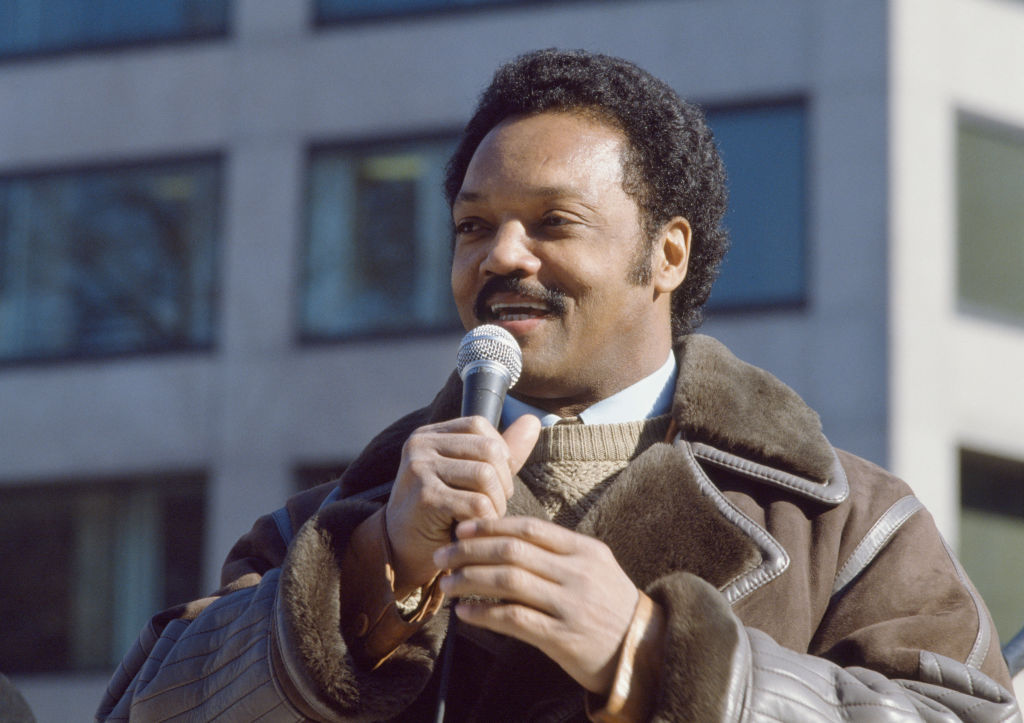
By the time Jesse Jackson ran for president in 1984 and 1988, he had transcended the “civil rights” label to become the most visible progressive leader in the country. (Jean-Louis Atlan / Sygma via Getty Images)
One of the most famous photographs of Martin Luther King Jr shows him standing on the balcony at the Lorraine Motel in Memphis, Tennessee, with three of his top aides — Ralph Abernathy, Hosea Williams, and Jesse Jackson. The next night (April 4, 1968) on that same balcony, King was murdered. Jackson was one of several staffers with King at the hotel that fatal night.
Jackson had been drawn into King’s inner circle at a young age. After King’s death, some activists considered Jackson to be the slain leader’s heir apparent, although others considered Jackson too young, inexperienced, and brash to assume King’s mantle. By the 1970s, however, Jackson had become the nation’s most visible civil rights leader. By the time he ran for president in 1984 and 1988, he had transcended the “civil rights” label to become the most visible progressive leader in the country, with a racially and economically diverse following that he called a “rainbow coalition.”
Twenty years later, in 2008, another photo symbolized the long journey that Jackson, and the nation, had taken. It showed Jackson standing in Chicago’s Grant Park, holding a small American flag, with tears in his eyes, as he listened to Barack Obama speak to a huge crowd on the night he was elected president of the United States. The photo did not require a caption. Jackson had clearly paved the way for Obama’s victory.