Anthropic Is Already Part of the Security Establishment
Four trustees elect most of Anthropic’s board, and one of them runs a leading national security think tank. The establishment didn’t have to buy Anthropic to get a seat at the table.
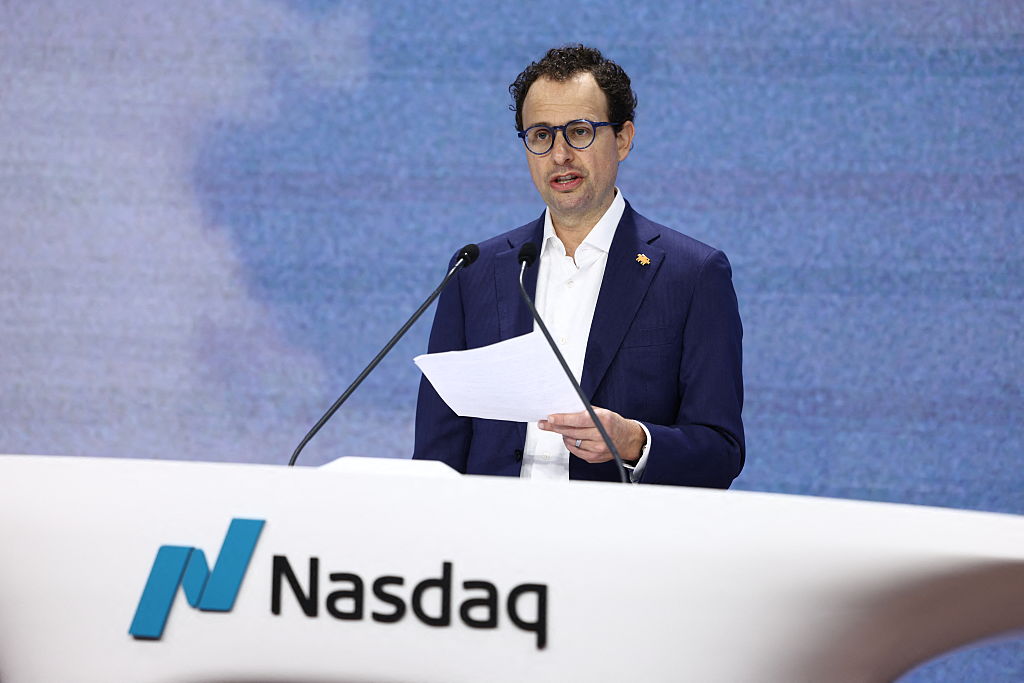
Anthropic says its mission is the long-term benefit of humanity. A closer examination of the composition of the trust that that will select a majority of its board of directors calls that into question. (Charly Triballeau / AFP via Getty Images)
Anthropic, which priced its initial public offering (IPO) last night and began trading on the Nasdaq today, published an S-1, the corporate prospectus for the offering. The document, which extends over five hundred pages, is intended to provide potential investors with an outline of its corporate structure, business model, and financial situation. Much of the document is, accordingly, dedicated to mundane legal minutiae: long lists of hypothetical events that might adversely affect investments, specific provisions for investment to comply with foreign nations’ securities law, etc.
Some points, however, are quite instructive. As the filing explains, large-scale corporate decisions are overseen by a “long-term benefit trust” (LTBT): a five-person body responsible for appointing a majority of Anthropic’s board and entitled to a special class of corporate stock. Unlike most benefit trusts, the LTBT is a “‘purpose trust’ that is managed for the achievement of a purpose rather than for the benefit of a particular set of beneficiaries.”
While the LTBT itself has received mainstream attention, less notice has been given to the identity of the trustees. Of the four currently appointed, one is Ben Bernanke — infamous as the architect of the Obama-era Wall St bailouts. And one is Richard Fontaine, chief executive officer of the Center for a New American Security (CNAS) and North American executive director of the Trilateral Commission. The latter appointment is especially noteworthy, for it speaks to an increasing coalescence of Anthropic, effective altruism, and the US national security establishment.
Company Purpose
The LTBT is something of a novelty in corporate structure. It is a fine-tuning of the usual public benefit corporation (PBC) — a form of corporate governance that allows the company to balance other stated interests against the pecuniary interests of its shareholders. Anthropic’s innovation is to hand over much of the responsibility of enforcing these competing interests to the LTBT, which will eventually appoint a majority of the board of directors. The company is also unusual in the sweeping humanitarian nature of its “company purpose,” against which shareholder returns are to be balanced: “the responsible development and maintenance of advanced AI for the long-term benefit of humanity.”
The LTBT is an important indicator of Anthropic’s ethical self-understanding. According to the S-1, it “is intended to operate as an independent body of Trustees with expertise in AI safety, national security, public policy, and social enterprise.” These experts are selected for their perceived competence in promoting the humanitarian company purpose and “the best interests of those materially affected by our conduct” — a class which, given Anthropic’s stated beliefs about its potential impact, includes all living humans. In addition to vesting them with material power, therefore, Anthropic’s choice of LTBT members says something about what the company understands those humanitarian interests to be.
A Greater Degree of Moderation in Democracy
Both CNAS and the Trilateral Commission enjoy a dark reputation among critics of the US-aligned international security community. The commission is especially notorious, and has long starred as the villain in a number of conspiracy theories of varying levels of plausibility. CNAS, however, may yet be the more influential of the two, and is to all appearances more bound up with the emerging hybrid of corporate AI, effective altruism, and the security establishment.
The Trilateral Commission is a private, international membership organization intended “to discuss and propose solutions to some of the world’s toughest problems.” Members include various senior government officials, business executives, and academics. They are drawn primarily from the commission’s eponymous three regional groups: Europe (mainly Western), East Asia (mainly Japan), and North America (mainly the United States). Their official 2025 leadership list, which names Fontaine as executive director of the North American group, mourns the passing of two founders: David Rockefeller and Dr Henry Kissinger. The commission’s operations are famously clandestine, which together with the elite status of many of its members has contributed to its perennial mystique.
Among leftists, it may be best known for its 1975 report (one of only a handful available to the public), “The Crisis of Democracy” — which was prominently criticized at the time by Noam Chomsky. The report’s section on the United States, authored by conservative intellectual Samuel P. Huntington, ascribes the preceding decade’s social turmoil to an “excess of democracy” — to be counteracted by “a greater degree of moderation in democracy.” Included in this excess were protest movements opposed to the Vietnam War and in support of racial justice. These movements helped dangerously integrate hitherto marginal populations, like black Americans, into the political process. “This marginality on the part of some groups [ . . . has] been one of the factors which has enabled democracy to function effectively.”
Half a century later, a similar attitude toward protest survives in Anthropic’s commercial and political activities. As Daniel Boguslaw details in The American Prospect, the company has been explicit about its plans to deploy AI to surveil, predict, and stifle protest activism. These plans include collaboration with law enforcement, and fit well with historical calls for digital surveillance from AI safety lobbyists at organizations with ties to Anthropic. Fontaine, who has served as the commission’s North American executive director since 2019, was appointed to Anthropic’s LTBT in 2025.
The Revolving Door
CNAS, on the other hand, is a Washington-based national security think tank with extensive ties to both Republican and Democratic White House administrations. Joe Biden and Donald Trump staffers with CNAS ties include senior figures like Avery Alpha, who occupied high-level roles at the Central Intelligence Agency and Department of Homeland Security from 2017 to 2025 before turning to consultancy work. The organization has traditionally pursued a broadly neoconservative line on foreign policy. Fontaine was elevated as president in 2012, only to be promoted again to CEO in 2019 — five months before his Trilateral Commission executive appointment.
CNAS also has an exceptional history of conflicts of interest and likely illicit influence. Several of these came to light in a 2021 bombshell report by the Revolving Door Project, which also helped expose CNAS members’ deep presence in the Biden and Trump administrations. The center has repeatedly championed private sector industries, international organizations, and foreign governments from whom it has received funding — often without explicit acknowledgement in the course of their advocacy.
Fontaine himself has taken direct part in these ethically suspect lobbying campaigns. In 2009, for example, he coauthored a policy paper defending the use of private military contractors in the war on terror — without any explicit acknowledgement of CNAS’s funding from several military contractor firms. He also did not acknowledge the $25,000–$50,000 funding the think tank had received from the North Atlantic Treaty Organization, during an event to promote NATO in 2019 at the Truman Library.
Anthropic is now itself among the beneficiaries of this conflict-ridden advocacy. On November 3, CNAS published a report advocating a suite of policy recommendations to protect against autonomous AI agents. The proposed policies align largely with Anthropic’s own stated regulatory agenda. And, conspicuously, certain of the policies clearly serve Anthropic’s commercial interests — especially against Chinese competitors. These include crackdowns on potential avenues of model distillation by foreign entities as well as diplomacy to erect barriers to powerful open-weights models. Model distillation by Chinese competitors has long been a sore point for Anthropic, and these competitors overwhelmingly favor open-weights licensing. At no point does the report mention Fontaine’s ties to Anthropic.
This hidden connection is just one part of a broader integration of CNAS, Anthropic, and affiliated organizations. CNAS affiliates now include major figures at Anthropic, like the center’s adjunct senior fellow, Michael Sellitto. Sellitto, who served on the National Security Council during the Obama and first Trump administrations and currently serves on the Council for Foreign Relations, is head of Anthropic’s Global Affairs team. The team is associated with Anthropic’s known surveillance activities and advocacy.
Effective Altruists and New Cold Warriors
CNAS has also maintained a partnership with the Center for Security and Emerging Technology (CSET) — an Anthropic-linked AI safety lobbying organization with deep ties in Washington. In 2025, for example, CSET announced its new advisory board, including CNAS member Michael Brown. It has also collaborated on several policy documents and research projects, particularly on combating Chinese AI development.
CSET enjoys extensive connections with Anthropic. These include personal overlaps, like Anthropic adviser and CSET Senior Fellow Ben Buchanan, or Anthropic policy executive and CSET advisory board member Joel Meyer. The two organizations have collaborated on the CHIPS Act and export controls against China, and are generally united under the ideological banner of effective altruism and AI safety.
In addition to personnel, CSET, CNAS, and Anthropic are linked financially through Coefficient Giving, the premier effective altruist donor body. Since its founding in 2019, CSET has received over $100 million from Coefficient Giving (formerly Open Philanthropy), most of it in advance of its collaboration with CNAS. CNAS, too, has received funding directly from Coefficient Giving, albeit in smaller quantities. The bulk of this transfer was conducted in 2022 and 2025, when it received grants of a bit over $5 million and $8 million, respectively, for work in AI governance and security. These larger grants built on a series of smaller ones (from around $24,000 to $260,000) starting in 2017.
Anthropic enjoys deep ideological and personal ties with Coefficient Giving. Both emerged from the effective altruist and AI safety movements, which continue to shape their rhetoric and policy directions. Holden Karnofsky, cofounder of Coefficient Giving’s precursor GiveWell, is married to Anthropic board member Daniela Amodei, herself the sister of Anthropic CEO Dario Amodei. Neil Shah, another LTBT member, served as managing director of Givewell until 2022. And Joe Carlsmith formerly led the AI-focussed “Worldview Investigations” team at Coefficient Giving (then Open Philanthropy). Now, he heads the “character” team at Anthropic, which is devoted to tailoring the values and personality of the company’s “Claude” assistants.
In the coming years and months, we are likely to witness a new influx of Anthropic money into Coefficient Giving and similar funding organizations — and thereby to more distant beneficiaries like CSET and CNAS. Many employees and executives have announced their intention to donate large portions of their wealth to charity, sometimes up to 80 percent. Coefficient Giving, itself a tax-deductible 501(c)3 nonprofit, has been recognized as a “favorite” of Anthropic executives, whose personal net worths extend into the tens of billions. In addition to laundering the donors’ reputations, these wealth transfers thus promise to further entrench the financial and organizational ties between Anthropic on the one hand and the Washington security establishment on the other.
Entanglement
The foregoing connections only scratch the surface of Anthropic’s ever-deepening entanglement with the security state. Beyond Fontaine, for example, the LTBT includes Harvard physicist Christopher Stubbs — who in addition to his academic appointments serves as a member of the independent scientific advisory group JASON. JASON’s work (much of it classified) largely concentrates on defense and nuclear strategy, including “studies under contract to the Department of Defense, the Department of Energy, the National Nuclear Security Administration, the U.S. Intelligence Community, and the FBI.” Most notoriously, it collaborated with military leadership during the Vietnam War, as revealed by Freedom of Information Act disclosures in 2002.
These connections do not merely speak to the increasing influence of the security establishment over Anthropic (and vice versa). They are also a clue as to the meaning of the company’s professed concern for human welfare and survival. Together with statements from company leadership, they paint a picture of long-term human interests deeply inflected by interventionist, antidemocratic, and anti-privacy strains in modern American foreign policy. Those who distrust such strains would do well to regard Anthropic, or any company with similar entanglements, with serious apprehension.