How Big Tech Became Part of the State
Amazon, Meta, and OpenAI wield tremendous influence over our politics, but does this mean we are entering an era of technofeudalism? In a wide-ranging discussion, Evgeny Morozov and Cedric Durand ask how we ought to understand contemporary capitalism.
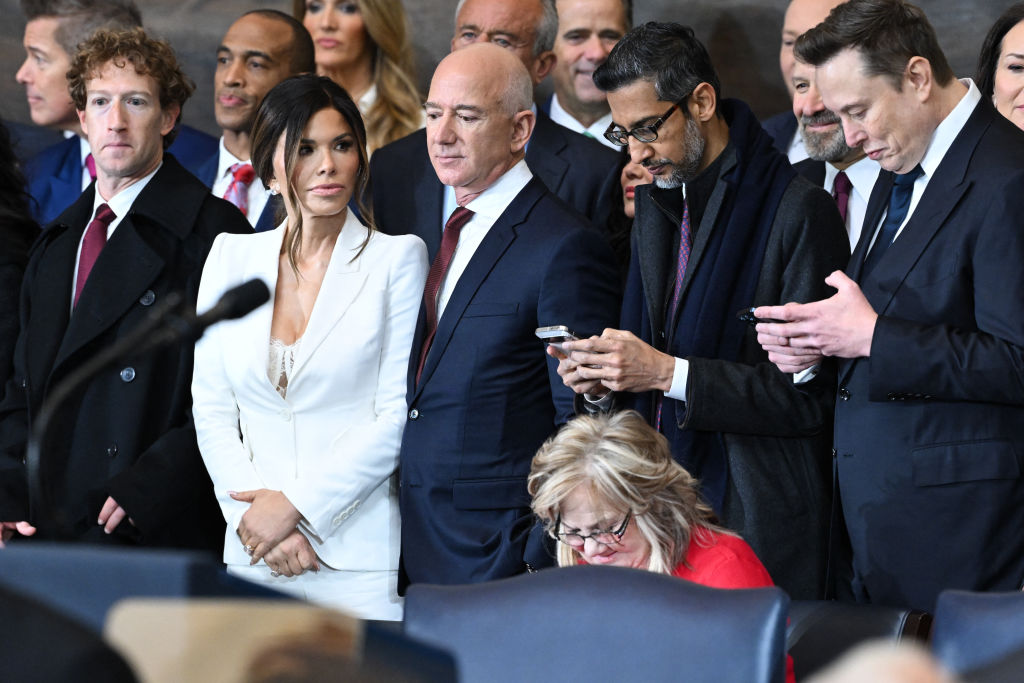
CEO of Meta Mark Zuckerberg, Lauren Sanchez, Amazon founder Jeff Bezos, Google CEO Sundar Pichai, and Tesla CEO Elon Musk attend the inauguration ceremony before Donald Trump is sworn in on January 20, 2025. (Saul Loeb / Pool / AFP via Getty Images)
When Donald Trump was sworn into office in January, he was flanked by Jeff Bezos, Mark Zuckerberg, and a collection of other tech billionaires. For some, this moment symbolized a fusion of economic and political power that bore a closer resemblance to premodern feudalism than capitalism as we know it. Instead of outcompeting rivals, these individuals used their political influence to shape regulations, enabling tech monopolies such as Amazon, Google, and Meta to profit by extracting rents from users. Within this new post-2008 world, profit no longer lay at the center of capitalism. Instead, powerful elites with close ties to the state used their influence to enrich themselves directly through political means.
Others, however, read the moment quite differently. They argued that the tech billionaires had been domesticated by the Republican Party and were lining up behind Trump to pay tribute, not to demand favor. Rather than challenging an overbearing state, Big Tech and the crypto industry served to shore up American power and keep neoliberalism in place. In a wide-ranging discussion, Susan Watkins, the editor of the New Left Review, spoke to Cédric Durand and Evgeny Morozov, two of the foremost thinkers on these issues, about how one ought to understand contemporary capitalism and decide between these two opposed positions.
Cédric Durand was born in France, educated in Grenoble and at the EHESS in Paris, and he completed his PhD on mining in post-Soviet Russia. Durand is best known for his two recent books: Fictitious Capital (2014), examining the dynamics behind the financial crisis, and Technofeudalism (2020), which explores the digital revolution. Evgeny Morozov was born in the Minsk region of the Soviet Union, just a few years before it disintegrated. Educated at the American University in Bulgaria, with a PhD from Harvard, he is the author of The Net Delusion (2011), a prescient demolition of the idea that the digital age would bring democratization.