Google Paid to Fete Key Lawmakers at a Secret Summit
Google recently paid state lawmakers upward of $2,000 as “gifts” to cover their attendance at a secret all-inclusive summit with “educational” sessions discussing artificial intelligence and other issues that many of these officials will soon be voting on.
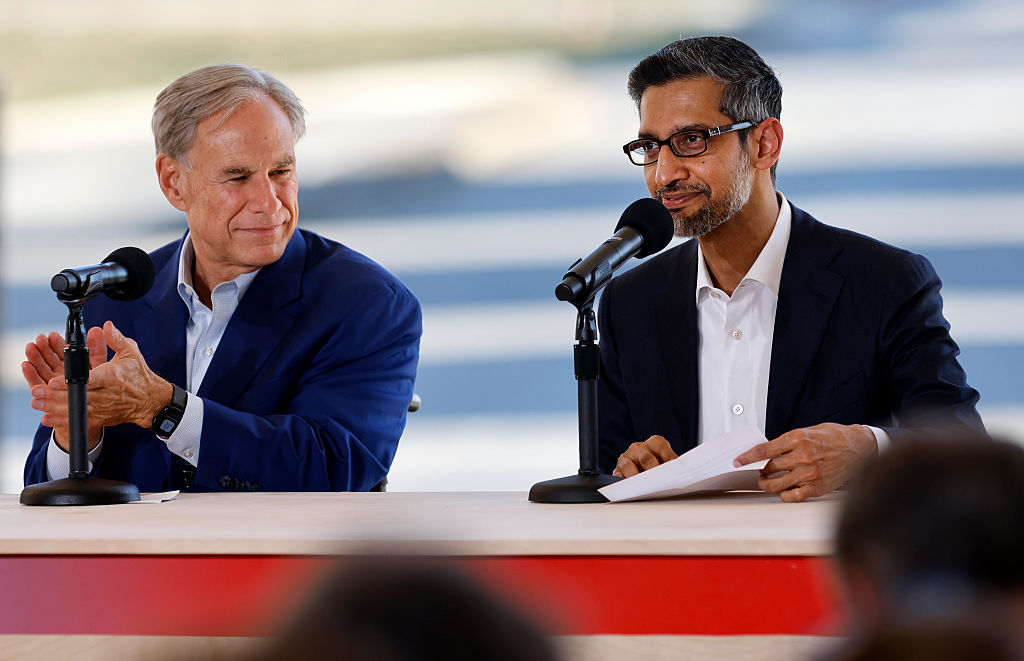
Texas governor Greg Abbott and Alphabet and Google CEO Sundar Pichai arrive to speak at the Google Midlothian Data Center on November 14, 2025 in Midlothian, Texas. Google announced that it plans to invest $40 billion dollars in new Texas data centers through 2027. (Ron Jenkins / Getty Images)
Ahead of states’ 2026 legislative sessions, Google paid state lawmakers upwards of $2,000 as “gifts” to cover their attendance at a secret all-inclusive summit with “educational” sessions extolling the benefits of artificial intelligence among other policy issues. Lawmakers enjoyed hotel rooms costing up to $500 a night, a party at Wrigley Field, and a chance to rub elbows with company executives and lobbyists, according to public records reviewed by the Lever.
Now, dozens of those same state officials will be weighing legislation on matters like artificial intelligence, data center construction, and online privacy that could boost Google’s profits.
The summit, which took place over three days near the end of October, comes at a time when battles over regulating tech platforms and artificial intelligence have largely shifted to statehouses, as action stalls at the federal level. Google, which boasts one of the country’s largest AI businesses, has spearheaded a multimillion-dollar lobbying blitz to kill related state regulations, most recently targeting an AI safety bill that passed earlier this year in California.
Federal anti-corruption laws prohibit outright bribes to politicians in exchange for favors. However, the regulation of gifts to government officials for “educational events” is left up to a patchwork of state laws.
At least twenty state lawmakers from ten states attended the summit, according to state ethics disclosures and public social media posts, though the event’s entire list of attendees is not yet known. The deadlines for filing “honorarium disclosures” to ethics offices detailing such gifts vary by state, if they’re required at all.
The known guest list featured leading lawmakers in state capitals with the power to set the legislative agenda, fast-tracking or stamping out proposed bills.
Those officials include:
-
- Representative Tom Sawyer, Democratic House minority leader in Kansas, where the legislature recently delivered tax breaks for investments in large data centers amid new Google energy projects in the Kansas City region.
- Representative Timothy Lang (R) of New Hampshire, where Google has reportedly inquired about taking advantage of the legislature’s recently passed bill allowing the construction of off-grid power plants that are exempted from state regulation.
- Representative Ryan Bizzarro (D) of Pennsylvania, where Google is planning a massive data center buildout amid growing community backlash to such projects. Bizarro, chair of the Pennsylvania House Democratic Policy Caucus, was one of four Pennsylvania Democratic lawmakers in attendance.
- Senator Sean Bennet (R) of South Carolina, where he’s chairman of the state senate’s ethics committee. Google recently invested $9 billion in a new data center expansion in the state.
Consumer protection bills have been introduced in each of these state legislatures that would impose restrictions on artificial intelligence technology to protect children’s privacy from chatbots and social media algorithms. In states like New Hampshire, there are also industry-supported versions of these bills that would relax regulations on Big Tech.
The Lever asked each lawmaker known to be in attendance about their reasons for participating in the summit given Google’s vested financial interest in a light-touch regulatory framework.
Lang responded by email that “This was a discussion summit, where legislators get to ask questions and followup questions directly to the industry leaders… and [that] makes us better stewards of the public trust.”
When asked about whether the reimbursements he received from Google might undermine public trust from his voters, he emphasized that “we want NH [sic] to be technology business friendly [and] continue to expand and diversify NH economic interests.”
Google does not appear to have directly publicized the summit online, despite promoting similar events.
In its September email invitation to lawmakers, a spokesperson for the Google summit wrote, “Google goes to great lengths to comply with applicable ethics obligations, which address gifts from companies like Google.”
Google did not respond to the Lever’s requests for comment.
The New Playbook for Influence Peddling
Corporate-backed lobbying operations have targeted state-level lawmakers for decades. Most famously, the American Legislative Exchange Council (ALEC), a conservative network backed by the Koch family and powerful industries, has an explicit mission to shape state-level regulations in a more pro-corporate direction. Along with drafting model legislation, the group holds training sessions and annual conferences attended by lawmakers.
Ostensibly, outfits like ALEC are registered as nonprofit policy advocacy groups funded by corporate donors with a particular set of interests.
Google has honed this influence-peddling playbook in Washington, DC. For years, the company has funded a constellation of nonprofits staffed with supposedly neutral experts who advocate for policy positions on technology-related issues beneficial to Google.
One such Google-backed astroturf group, the Chamber of Progress, was founded to keep the Democratic Party aligned with Big Tech.
These nonprofits have been key to the company’s years-long charm offensive in Washington to try to ward off antitrust lawsuits and other regulatory scrutiny.
The Antonin Scalia Law School at George Mason University, a conservative-leaning institution funded in part by Google, holds all-expenses-included training sessions in Hawaii, the Napa Valley, and other luxury resort locations for federal judges to learn about antitrust law. The curriculum at those events propagates a particular pro-industry school of thought in which consumer prices are often presented as the only relevant benchmark, an interpretation favorable to Google’s advertising business model.
Until now, Google had not directly held its own policy summit for state lawmakers, according to tech watchdogs who have tracked the company’s influence-peddling for years.
“Google wines and dines lawmakers for the same reason they are funding Trump’s ballroom: the American people increasingly dislike their products and distrust their leadership, so Google resorts to buying influence,” said Sacha Haworth, Executive Director of the Tech Oversight Project.
The timing of Google’s first state-level policy summit coincides with hundreds of proposed and enacted bills in state legislatures around the country that could alter the regulatory landscape for artificial intelligence. State legislators are also hotly debating online child privacy protections, matters that could impact Google’s search engine algorithm.
Google has supported a “national framework” to nullify state-level regulations of AI technology, mirroring the aims of a federal push to impose a ten-year moratorium on all state laws governing AI. While those congressional efforts have not yet been successful, Trump announced that his administration will set a moratorium on state AI restrictions via executive order, a weaker legal mechanism that is expected to be challenged in the courts.
Inside the Junket: “Value of Data Centers”
A brochure for the “Google State Policy Summit,” reviewed by the Lever, details the full agenda of seminars and events at the three-day summit, many of which were led by Google’s own employees. The panels’ topics — in which the company has a vested financial stake — were framed in terms favorable to Google’s bottom line.
An online privacy panel was titled “How YouTube is Designed with Youth Safety in Mind.” A panel touting the benefits of data centers was titled “Value of Data Centers to States & Communities” and led by Google’s head of Data Center Public Affairs, Amber Tillman. Another one was called “Rate Making 101: Paying Your Fair Share.”
Google has spent tens of billions of dollars in building out datacenters to power its AI technology, including most recently a $40 billion investment in Texas this fall and a $25 billion investment in the Mid-Atlantic regions serviced by grid operator PJM this year.
These facilities’ energy demands are jacking up Americans’ utility rates and using vast quantities of water, making them a hot-button political issue. In its summit agenda, Google framed the topic for lawmakers as a matter of “national security” and “American competitiveness.”
Along with energy, educational sessions about AI technology were a major focus of the summit.
According to the agenda, one keynote panel on “AI: Big Challenges and Big Opportunities” featured Jennifer Granholm, the Biden administration’s Secretary of Energy and former governor of Michigan, in conversation with George P. Bush, son of former Florida governor Jeb Bush and a former Texas lands commissioner, where he oversaw the leasing of state-owned land to outside companies.
As fears mount about AI automating jobs across the country, Google framed the topic in positive terms in its summit agenda: “Workforce Competitiveness: Skilling in the Age of Al,” hosted by Bronagh Friel, head of partnerships at Grow with Google, a program that offers job training to workers and other businesses. The summit also covered other regulatory issues facing Google’s search engine.
A “Technology and American Competitiveness” panel was hosted by Kent Walker, the architect of Google’s defense strategy in a major antitrust lawsuit brought by the Justice Department. A federal judge in that case ruled that Google held an illegal monopoly in the search market in violation of antitrust laws. Last year, Google lost another court case over its monopolization of the advertising technology market.
A related panel was titled “Protecting User Data & Promoting Small Businesses,” led by Google’s global head of advertising privacy, Ari Levenfeld.
“Interactive, Educational Convening”
After concluding the second day of panels at the summit, lawmakers were treated to a “social event at Wrigley field,” the iconic baseball stadium that Google rented out for the evening, even allowing guests to walk onto the field.
One of Google’s external public relations firm, LSG, posted about the event on LinkedIn, noting the shop was “proud to support this event, which brought together state legislative leaders and Google product and policy experts for hands-on demos and deep-dive discussions on AI, energy, privacy, and the future of innovation.”
For accommodations, the summit’s invitation recommended hotels such as The Emily or the Hoxton in Chicago’s upscale West Loop neighborhood, but guests were free to select any hotel of their choosing, for which they would be eligible for a $496-per-night reimbursement from Google.
The full summit agenda was disclosed as part of lawmakers’ filings to multiple state ethics offices. Such “honorarium” disclosures are one of the only requirements for politicians to receive “gifts” in most states.
While bribery is illegal under federal law, the definition of what can be considered bribery has been limited by recent Supreme Court rulings.
“The Supreme Court has made it very difficult to bring bribery charges,” said Craig Holman, a corruption expert for the advocacy group Public Citizen. “It has to be very blatant, very obvious, almost humorous since it has to be in exchange for an official act which is difficult to prove.”
Among other decisions, the court last year legalized “gratuities” to politicians paid after the fact to show appreciation for a politician’s behavior, voting record, or regulatory favors.
“Gifts” to state politicians are another form of permissible payment to lawmakers that is not covered by federal law and instead left up to states to regulate. Holman explained that in the Supreme Court’s interpretation, the line delineating when a gift becomes an illegal bribe is a matter of whether there’s an explicit quid pro quo.
Each state has its own set of rules over what lawmakers can and can’t receive as gifts. Some states cap gift amounts, among other restrictions, but nearly all states make exceptions for costs related to “educational” events.
In Oregon, reimbursements for a trip are permissible as long as it’s related to a “fact-finding mission” deemed in the public interest. Under that stipulation, the state’s ethics office signed off on thousands in reimbursements to two senators, one Democrat and one Republican, who submitted paperwork to attend the Google summit, although their offices did not confirm whether they subsequently attended it.
The brochure for the Google State Policy Summit described the panels as an “interactive, educational convening,” and most lawmakers’ disclosure filings echoed that idea to justify reimbursements.
In a pre-certification application submitted to the Alabama ethics commission before the event, State Senator Steve Livingston, the Republican Senate majority leader in the state, said “this interactive, educational convening is designed to bring together state legislative leaders across the country to share ideas and interface directly with Google product and policy staff.” While the request was approved, Livingston told the Lever over email that he was not able to attend due to a scheduling conflict in his district.
Likewise, Lang, of New Hampshire, wrote in his ethics filing that the summit involved “learning about AI and how state policies might effect this growing industry.” For that, he was reimbursed $1,697.