An AI-Powered Stock Market
The stock market is touching near all-time highs, while Americans’ credit scores are hitting an all-time low. Indicators of a dynamic business environment couldn’t be further from a realistic picture of ordinary citizens’ economic position.
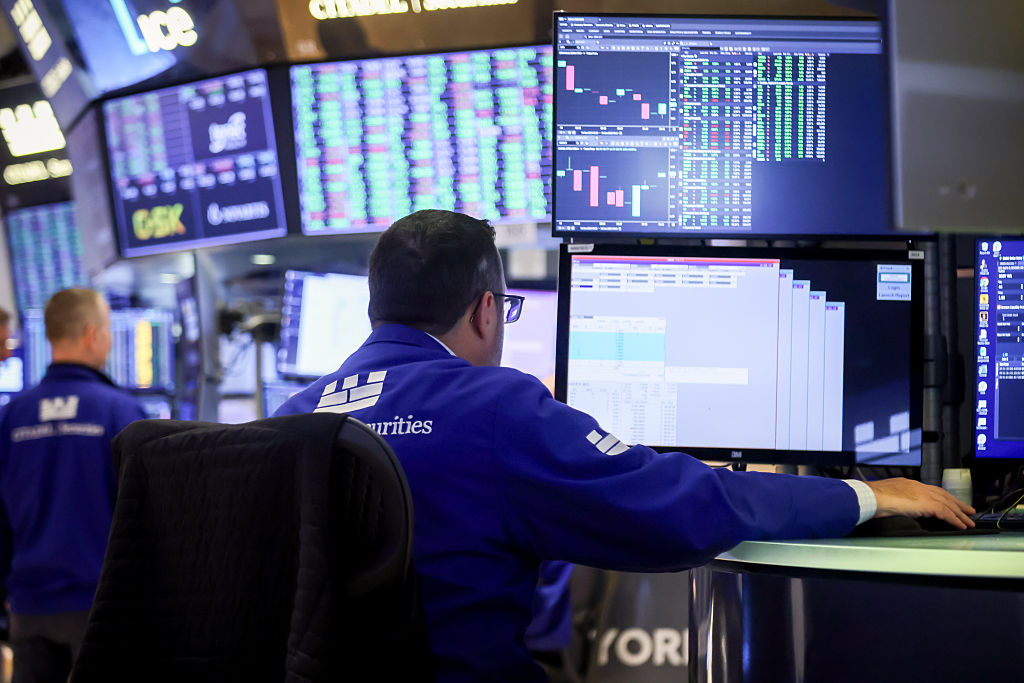
Nvidia is not just the chip supplier of the technology sector but its central bank as well. (Michael Nagle / Bloomberg via Getty Images
The stock market is, plainly, no longer simply a concern of the elite. “We like to joke that the markets are not the economy,” Peter Atwater of Financial Insyghts recently told Bloomberg, “but we’ve reached a point now where the economy is the markets.”
In past articles, I’ve covered the rise and risks of retail investing for everyday Americans. To recap: a majority of Americans now own stocks; young women are the fastest growing demographic of investors; and the onset of “commission free” trading has lured millions of us into high-risk trading in speculative stocks and the derivatives market. All of this has taken place under the guise of words like access, equality, and democratization.
Yet recent weeks has seen a spread of predictions of a bubble — and cracks beginning to show in the consumer economy as well as private credit. Faced with all this, there’s perhaps three compelling narratives that can tell us something about what’s happening on the stock market today.
“A Jobless Boom”?
The first such narrative looks at the late David Graeber’s 2018 book, Bullshit Jobs: A Theory. In it, he argued that capitalism solved a former wave of automation by conjuring up a class of white-collar workers who don’t do anything useful.
The theory caught fire — and workers came forward in droves confessing that they, too, are not exactly sure why they are needed. White-collar professionals were overseeing teams, drafting new PowerPoint decks, and peddling through emails, but few felt like their work was essential to the production process.
Now, we find ourselves in the worst job market since the turn of the century, rivaled only by the immediate crisis of 2009. This October saw the mass firing of middle managers and office workers at a handful of tectonic companies like Amazon, UPS, Target, and General Motors. The stocks of each company jumped upon layoff announcements. It turns out that Wall Street doesn’t believe these corporate workers are adding value to companies, either.
In past economic downturns, the first to be fired weren’t the professional-managerial class of six-figure earners. But as companies hunt revenue amid a consumer recession, cutting payroll can look the same on balance sheets. Call it — as some analysts on Wall Street do — “a jobless boom.” And what will they need the money to be freed up for moving forward? In many cases, the cost of what’s replacing labor: chips.
Devaluation Schedules and Creative Accounting
That takes us to the second story of the market: chips, and specifically, chip devaluation schedules. About $2 trillion of market cap is floating around this unanswered question. Microsoft, Google, Oracle, Amazon, and Meta have all extended their depreciation schedules from three to four years in 2020 to five to six years in 2025. Depreciation schedules are just tax planning documents that allow companies to recoup costs over time.
Yet their supplier, Nvidia, is now running an annual cycle on chip releases. Its CEO, Jensen Huang, wants to innovate at a rate that renders last year’s chips worthless. He recently joked that “you couldn’t give Hoppers away” — referring to a GPU model released in 2022 — once the newer Blackwell model ships in volume. For context, Nvidia claims Blackwell chips provide twenty-five times the performance on a per-dollar basis, against one-quarter of the energy usage to accomplish it.
The gap between the real and reported useful life of these assets is a form of creative accounting by these megacompanies. If you can lengthen the life of chips on paper, you ease the reported costs over a longer horizon, allowing revenues to artificially grow.
Much has been made in recent weeks of the “circular financing” at the heart of the AI boom. It’s a method of business transacting commonly conflated with “round-tripping” and “vendor financing.” There’s a thin line between them — vendor financing being considered legitimate and round-tripping a way to cook the books. Those in the know disagree on Nvidia’s form, but the result is the same: they are financing the costs of their own products to be purchased: everyone involved sees an increase in capital expenditure.
Nvidia, in one of the more discussed transactions, invested $100 billion in OpenAI, and OpenAI, in turn, agreed to give it all back to purchase Nvidia-made chips. This is one circular link in a funding map that looks like a tumbleweed with Nvidia at the core. We can see this as either a feature or a bug of the AI ecosystem.
The Nvidia State?
But Nvidia isn’t, it seems, simply “round-tripping” or “vendor financing.” Writers Matteo Wong and Charlie Warzel at the Atlantic came the closest to describing it with their term: the Nvidia-state. Still, I think they missed the ball. Nvidia is practicing its own economic theory, not simply impacting the American one. In an era of global capital mobility, as many have previously noted, transnational megacorporations take on a governing life of their own.
Nvidia isn’t a state for the reason they write, i.e., that it’s holding the nation’s GDP captive as a “load-bearing piece of the global economy.” Rather, Nvidia is state-like because it’s running a quasi-Keynesian economic experiment at a corporate scale. The company is bigger than the GDP of France or India, so we should treat its operations as commensurate.
Nvidia is stimulating the buying-power of its own consumers by rinsing capital through their balance sheets. One problem with the AI-bubble theory is that this process is going to continue, through better or worse. Nvidia will continue to engage in countercyclical investing to reinvigorate the market, if and when their tentacle companies ever struggle.
The company is not just the chip supplier of the sector but its central bank as well.
All of this matters as the stock market, and the economy writ large, has flatlined except for the “ten titans” of the S&P 500. And companies holding up the market economy like Nvidia can go to the moon without ordinary consumers, so long as they finance their corporate clients.
“Control What You Can Control”
Anyone who claims to understand exactly what is happening in the market, or where we are headed next, is not speaking in good faith. For decades, as the stock market rose, so, too, did job openings, on aggregate. Yet over the past three years, this hasn’t been true: Since 2022, for the first time, the stock market unplugged itself from the job market; the former is up 70 percent, and rising month in and month out, but job openings are down 30 percent.
Whether or not AI is literally taking our jobs on a one-for-one basis might not be the best question. What we can ask is: Has the introduction of AI altered companies’ orientation toward the labor market more generally?
Said another way: AI cannot do most of the white-collar work that these employees once accomplished, essential or otherwise. But companies, like governments of the past, have attached themselves to an idea: “control what you can control.” In a corporate landscape of shifting goalposts, that means cutting labor costs: a renaming of the austerity urge.
The stock market is touching near all-time highs, even after recent draw downs, while Americans’ credit scores are hitting an all-time low.
Where Do We Go From Here?
We are all about to learn something critical from Zohran Mamdani’s election as New York City mayor. David Backer at the Baffler is the only one discussing it at length: the Left needs financial experts, ones that can work with and alongside mass movements. Socialist dreams of funding transit, housing, health care, and the coming wave of unemployment benefits are simply ideas until they meet the market.
What today’s conditions offer is a unique opportunity: merging class interests between blue- and white-collar segments of the economy. AI is knowingly or unknowingly recreating the NAFTA moment but for white-collar work. Jobs aren’t being destroyed by offshoring per se, but present labor power is being transformed into chips: a congealing of past human labor embedded into a machine. Chips, notably, work around the clock, without a union, and represent capital’s final achievement of self-perpetuating production; one disembedded from social relations while still exploiting the inputs of underpaid workers across the Global South.
Mass movements can mobilize budgetary wins, but true redistribution at multiple scales will require shock troops entering into the system, much like Mamdani’s new transition-team cochair Lina Khan, who upended markets with her work at the Federal Trade Commission.
The quicker we can narrativize the current economy in a kind of open-source fashion, with constant updating and revising of what’s going on, the quicker we can strategically resist it. Past crises like COVID-19 should serve as a guide for the coming one: the working classes, the bottom 80 percent of us, may no longer be needed for the consumer economy to grow and the stock market to rise. But we still make up the water that the boat is sailing on.