The Democratic Candidate Closely Tied to Crypto and Big Tech
A crypto super PAC is intervening in a competitive Maryland Democratic primary to back Adrian Boafo, a lobbyist who has been working for cloud-computing tech firm Oracle while simultaneously serving as a state lawmaker.
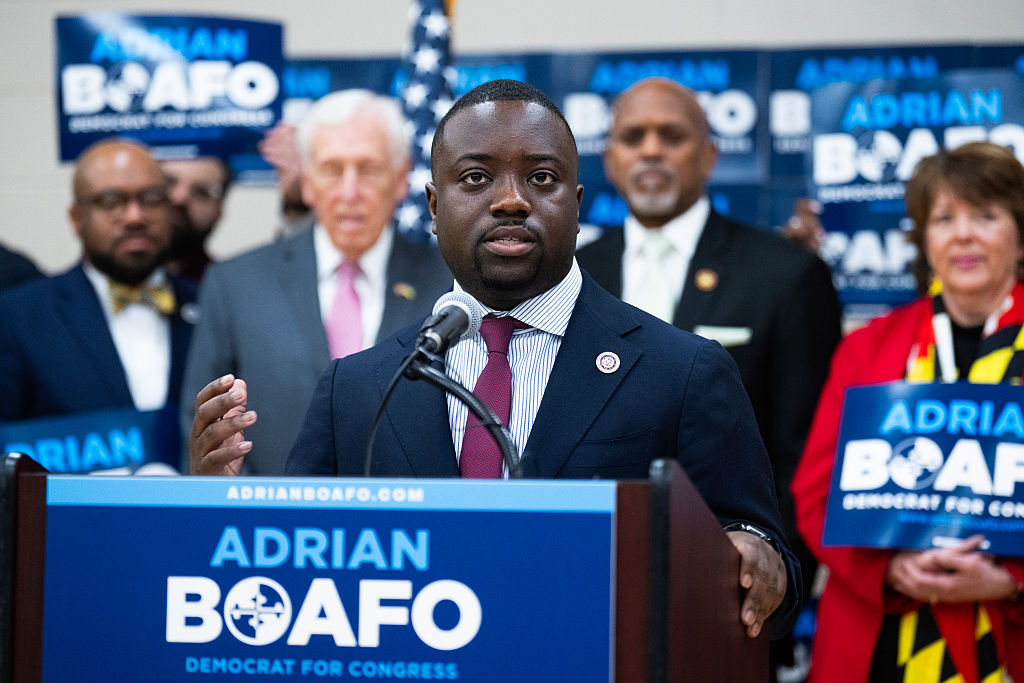
The Democratic establishment and the crypto industry are intervening in a competitive Maryland Democratic primary to back candidate Adrian Boafo. (Tom Williams / CQ Roll Call via Getty Images)
The Democratic establishment and the crypto industry are intervening in a competitive Maryland Democratic primary to back a lobbyist who has been working for the tech giant Oracle while simultaneously serving as a state lawmaker.
According to federal campaign finance records reviewed by the Lever, a deep-pocketed crypto super PAC is now spending $300,000 to support the lobbyist’s candidacy — one of the largest cash infusions the group has made so far this election cycle.
Democrat Adrian Boafo worked as a top lobbyist at Oracle, a cloud-computing tech firm cofounded by billionaire and GOP megadonor Larry Ellison, as recently as the final quarter of 2025. For more than half of the nearly five years he has been at the company, he has held public office in the Maryland House of Delegates. His LinkedIn page still lists Oracle as one of his current employers.
Now, Boafo is vying for the seat of retiring Rep. Steny Hoyer’s (D) in Maryland’s Fifth Congressional District. Although the primary field is crowded, Boafo, who formerly worked as Hoyer’s campaign manager, won Hoyer’s endorsement as his successor, making him a front-runner. Maryland Gov. Wes Moore (D) has also thrown his support behind Boafo.
The significant media buy by the Democratic crypto influence group Protect Progress — $303,641 over the last week — is a sign that the crypto industry, which engaged in massive political spending in the 2024 elections, is trying to tip the scales in favor of its chosen candidates in safely Democratic districts.
Per Federal Election Commission records, the outside spending group spent $60,000 last week on direct mailers for Boafo and an additional $240,000 on advertising.
There are indications that the Democratic establishment is now lining up behind Boafo as well.
While Democratic Minority Leader Hakeem Jeffries pledged that the party would not get directly involved in primaries for safe blue seats, Julie Merz, the executive director of the Democratic Congressional Campaign Committee, the official party committee working to elect House Democrats, contributed $250 to Boafo’s campaign this quarter. (Merz is a former Hoyer staffer.)
Boafo’s campaign did not return a request for comment from the Lever.
“Blockchain Is the Future”
Protect Progress — an affiliate of Fairshake PAC network, which has raised $193 million to spend in the 2026 midterms — describes itself as supporting “Democratic candidates committed to securing the United States as the home to innovators building the next generation of the internet.” Crypto and venture capital firms, including Coinbase and a16z, have contributed tens of millions to the network. In the 2024 elections, Fairshake and its affiliates spent $133 million.
The group’s cash this cycle has already helped tech-friendly Democratic candidates beat out more progressive challengers in their primaries. Protect Progress spent more than $600,000 supporting Democratic House candidate Melissa Bean in Illinois, who ultimately won the March primary over several candidates to her left.
Crypto’s support for Boafo’s candidacy comes after he boosted several of the industry’s legislative priorities as both a lobbyist and a state lawmaker.
Boafo joined Oracle as its director of government affairs in March 2021, according to his LinkedIn profile. In January 2023, he took office in the Maryland General Assembly.
While working as both a lobbyist and serving in the state legislature, Boafo introduced industry-friendly legislation to create a task force to advance Maryland’s blockchain and digital-asset sector — the underlying technologies for cryptocurrency.
“Blockchain is the future,” Boafo wrote in a 2025 LinkedIn post promoting the bill. “Let’s make Maryland the national leader of blockchain technology and crypto.”
The bill was ultimately signed into law.
As an Oracle gun-for-hire, disclosure records show that Boafo lobbied on federal data center efforts in 2025, 2024, and 2023, including a Trump executive order to expedite federal permitting for data center development.
Both artificial intelligence and cryptocurrency technologies rely on data center infrastructure to store and manage the massive repositories of digital information generated by their operations.
“It makes sense that crypto sees in an Oracle alum a kindred spirit,” said Jeff Hauser, the executive director of the Revolving Door Project, an advocacy group that tracks conflicts of interest in Washington. Hauser noted that Oracle was at “the epicenter of companies deemed to have gotten too close to the sun” in the AI bubble.
In an interview with a local radio station, Boafo claimed his main role as a lobbyist for Oracle related to improving tech literacy.
“My core job at Oracle is about education,” Boafo said.
“A Company Tied to ICE Operations”
Lobbying disclosures indicate that Boafo regularly lobbied the Department of Homeland Security on Oracle’s behalf, through at least the end of 2025.
In 2021, while Boafo was working as an Oracle lobbyist, the company fought to secure a contract to provide cloud services to Immigration and Customs Enforcement (ICE), an arm of the Department of Homeland Security. The company at the time argued that ICE had unfairly excluded it from competing for the contract.
The next year, in December 2022, after successfully getting the Department of Homeland Security to alter its contracting requirements to allow Oracle to bid for the contract, Oracle secured a deal with ICE.
Details in Oracle’s lobbying reports are vague, making it difficult to determine exactly what Boafo was lobbying the Department of Homeland Security for and whether it involved the tech giant’s ICE contracts. But during the period when Oracle was focused on competing for the major ICE cloud contract from 2021 to late 2022, he appeared on several lobbying reports that mention the agency.
Oracle has ongoing business with the Department of Homeland Security and its various law enforcement arms, advertising in a 2026 flyer that it provides “AI-driven insights” to the agency in order to “help protect the nation’s borders.”
Boafo’s work with the company — while also campaigning on additional oversight of ICE — has drawn criticism from his opponents.
“How can voters trust Adrian Boafo to stand up to Trump’s ICE policies when he works for a company tied to ICE operations?” challenger and fellow Maryland state lawmaker Rushern Baker wrote on social media this week.
The Boafo campaign did not respond to a request for comment about Oracle’s work with ICE and Boafo’s lobbying before the Department of Homeland Security.
While Maryland state ethics rules do not outright prohibit lawmakers from working as lobbyists, the law requires disclosures of any conflicts of interest. Boafo had several irregularities in his disclosure forms.
Initially, Boafo did not report holding any Oracle stock, according to his 2023 ethics form. But Boafo later amended the disclosure to include that he owned stock in the company, and in 2025, he reported selling $100,000 worth of his equity.
Boafo’s initial 2024 disclosure indicated that Oracle did not hold any existing contracts with the Maryland state government. But then in November 2025, Boafo changed the disclosure to note that the company did business with the state’s port authority and health benefit exchange.
Boafo has claimed he did not work on state matters for Oracle — only federal issues — and that he has kept a firewall between his public and private work.