For Bertolt Brecht, War Isn’t Humanity’s Eternal Fate
With Europe in ruins in 1945, Bertolt Brecht wrote that war “has been discredited for some time to come.” That period seems to be meeting its end, as European states push a new era of rearmament.
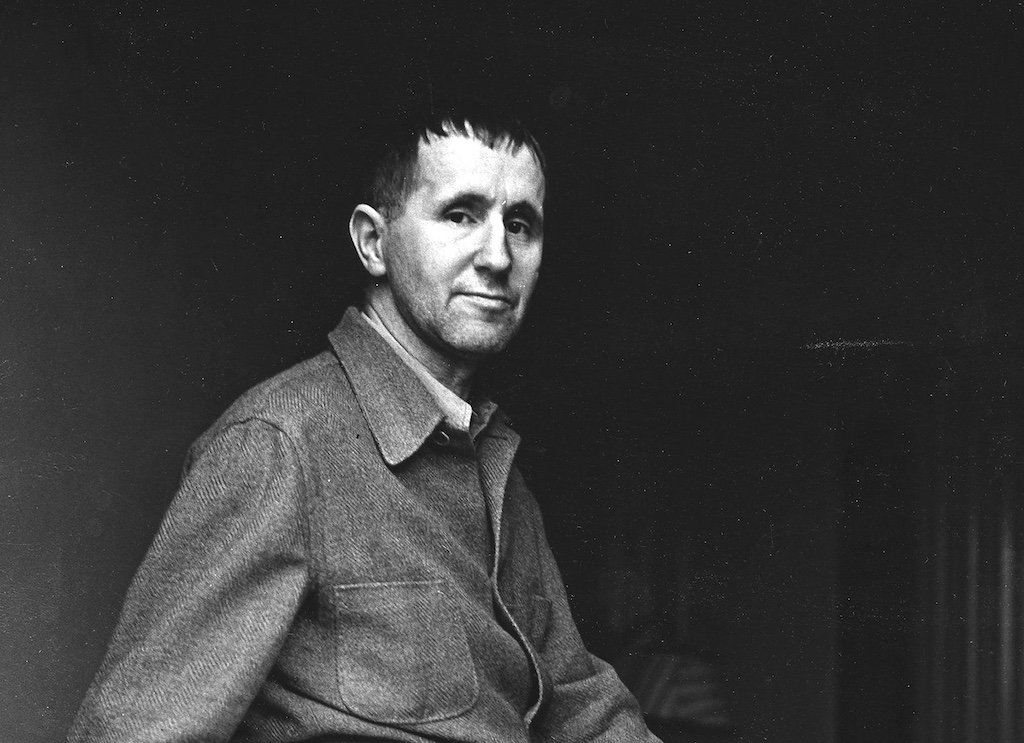
Portrait of German playwright Bertolt Brecht. (Fred Stein Archive / Archive Photos / Getty Images)
The key decision in director Lisaboa Houbrechts’s new production of Bertolt Brecht’s Mother Courage and Her Children, which showed this June in Paris as part of a European tour, was to replace the play’s famed market cart with a massive ball and chain. In Brecht’s masterpiece, the cart is already intended to be an absurd load — and a character in its own right in this cautionary tale about the perils of war.
Having fled his native Germany in 1933 after the Nazis came to power, Brecht wrote the play from exile in 1939 alongside his frequent collaborator Margarete Steffin. He was then at the height of his poetic and political prowess, spinning out works decrying the imminent dangers of fascism and jackboot militarism. Mother Courage wouldn’t see its first production until 1941 in Switzerland. However, by that point, the march toward war had exploded into yet another world-spanning conflict.
It would be an exaggeration to call Brecht a pacifist. His firsthand awareness of the threat of fascism in his own time was far too acute for that. Brecht’s political and historical frescoes like the Life of Galileo or Fear and Misery of the Third Reich are almost documentaries, with a politically committed and staunchly pedagogical undercurrent. But as Brecht also knew, conflicts tend to take on a life of their own, subsuming the motives of belligerents and imposing their own logics until war becomes an end unto itself.